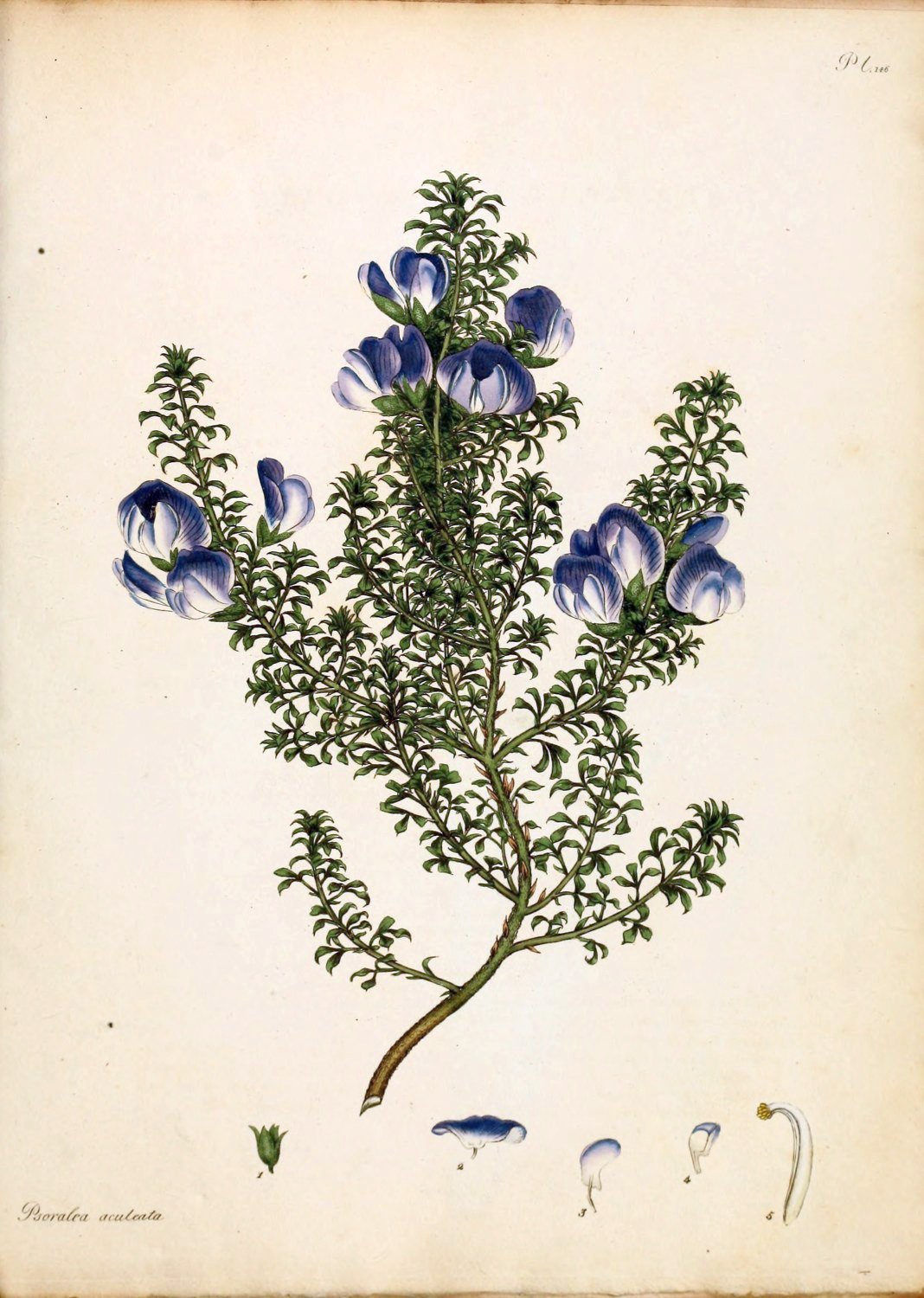
Volume 3 — PLATE CXLVI. PSORALEA ACULEATA. Prickly Psoralea.
Reading edition
CLASS XVII. ORDER IV.
DIADELPHIA DECANDRIA. Chives in two sets. Ten Chives.
GENERIC CHARACTER.
Calyx. Perianthium monophyllum, tuberculis punctatum, quinquesidum; laciniis acutis, æqualibus, persistentibus; infima duplo longiore.
Corolla papilionacea, pentapetala.
Vexillum subrotundum, emarginatum, assurgens.
Alœ lunulatæ, obtusæ, parvæ.
Carina dipetala, lunulata, obtusa.
Stamina. Filamenta diadelpha (simplex setaceum et novem coalita), adscendentia. Antheræ subrotundæ.
Pistillum. Germen lineare. Stylus subulatus, adscendens, longitudine staminum. Stigma obtusum.
Pericarpium. Legumen longitudine calycis, compressum, adscendens, acuminatum.
Semen unicum, reniforme.
Empalement. Cup one leaf, dotted over with small tubercles, and five-cleft; the segments equal and remaining, the lower one twice the length of the others.
Blossom butterfly-shaped, five petalled.
Standard nearly round, notched at the end, turned upwards.
Wings half-moon-shaped, obtuse, small.
Keel two-petalled, half-moon-shaped, obtuse.
Chives. Threads in two sets (a single one like a bristle, and nine united), ascending. Tips nearly round.
Pointal. Seed-bud linear. Shaft awl-shaped, ascending, the length of the chives. Summit blunt.
Seed-vessel. A pod the length of the cup, flattened, ascending, and tapered to the point.
Seed, one, kidney-shaped.
SPECIFIC CHARACTER.
Psoralea foliis ternatis, minimis, confertissimis, recurvatis, in spinulam desinentibus.
Psoralea with three-leafletted leaves, very small, very crowded, bent back, and ending in a small spine.
REFERENCE TO THE PLATE.
1. The Empalement.
2. The Standard of a Blossom.
3. One of the Wings of the same.
4. The two Petals of the Keel.
5. The Chives, a little magnified.
The Prickly Psoralea is not a new plant in our collections; for, it was first introduced by Mr. F. Masson to the Royal Gardens at Kew, as we learn from the Catalogue, in the year 1774. But although so long a sojourner with us, it is not found in many collections, owing to the difficulty in its increase, as it seldom ripens its seeds; and cuttings, the only remaining method, but seldom succeed; although by taking them from a vigorous growing plant and giving them the assistance of the bark-bed of the hothouse, early in March, a few plants have been procured occasionally. Our drawing was made from a most beautiful plant in the Clapham Collection, last year, in the month of August.