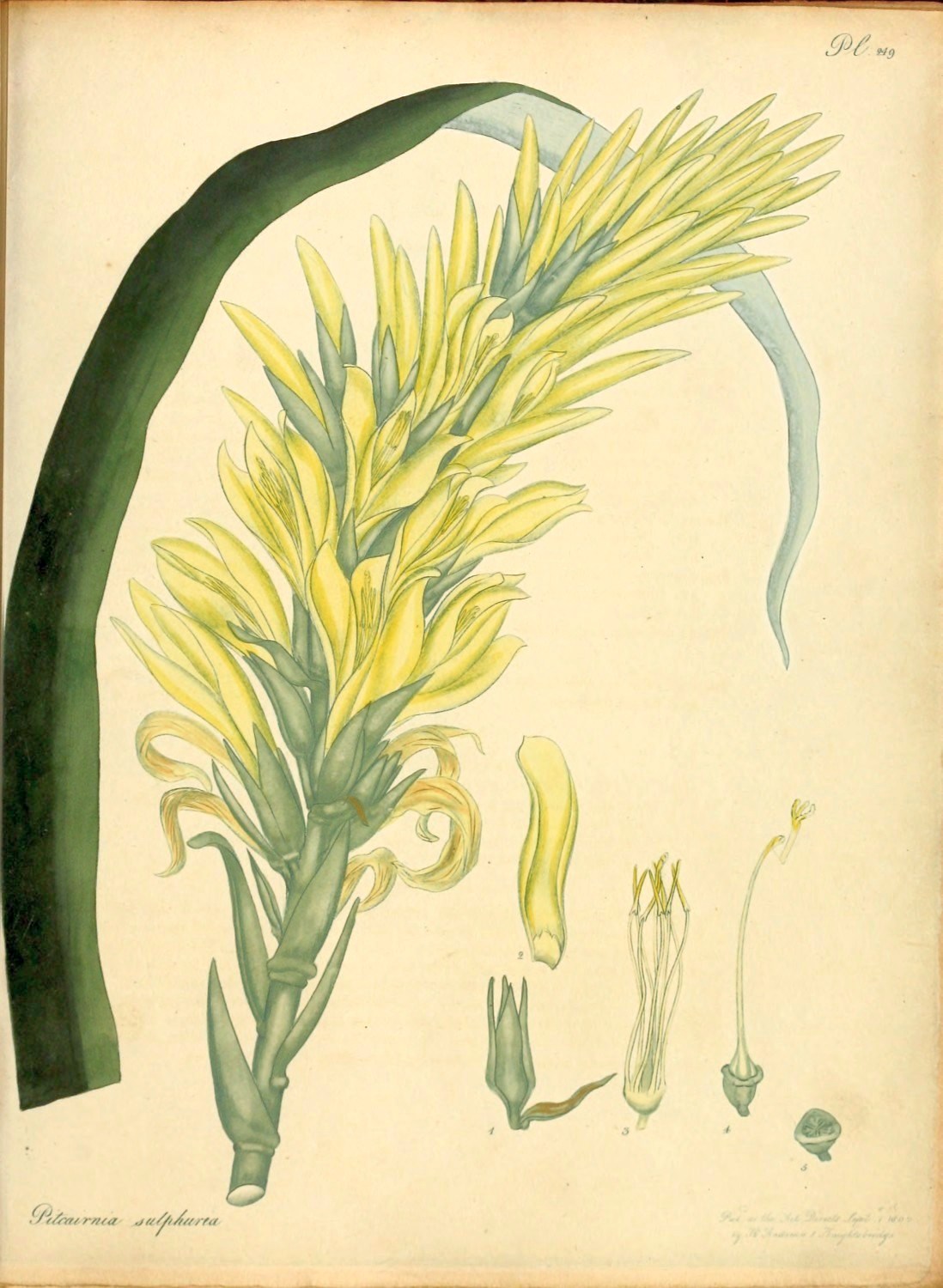
Volume 4 — PLATE CCXLIX. PITCAIRNIA SULPHUREA. Sulphur-coloured Pitcairnia.
Reading edition
CLASS VI. ORDER I.
HEXANDRIA MONOGYNIA. Six Chives. One Pointal.
GENERIC CHARACTER.
Calyx. Perianthium monophyllum, semi-superum, tubulosum, basi ventricosum, trifidum, persistens; laciniis lanceolatis, erectis.
Corolla tubulata, calyce duplo longior, marcessens, trifida, demum tripetala; laciniæ lineari-oblongæ, suberectæ.
Stamina. Filamenta sex, filiformia. Antheræ oblongæ, erectæ.
Pistillum. Germen superum, ovato-triquetrum. Stylus filiformis longitudine staminum. Stigmata tria, contorta.
Pericarpium. Capsula ovatis, obtuse triquetra, trilocularis; loculis sub-cylindraceis, sub-distinctis.
Semina numerosa, alata, linearia.
Empalement. Cup one leafed, half superior, tubular, swelling at the base, three-cleft; segments lance-shaped, erect.
Blossom. tubular, twice the length of the cup, withering, three-cleft, at last three petalled; segments linearly-oblong, nearly upright.
Chives. Threads six, thread-shaped. Tips oblong, erect.
Pointal. Seed-bud above, three-sided-egg-shaped. Shaft thread-shaped the length of the chives. Summits three, twisted.
Seed-vessel. Capsule egg-shaped, bluntly three cornered, three valved; cells nearly cylindrical, not very distinct.
Seeds numerous, winged, linear.
SPECIFIC CHARACTER.
Pitcairnia foliis non spinosis, flaccidis, longissimis; corollis sulphureis.
Pitcairnia with leaves without spines, weak and very long; blossoms sulphur coloured.
REFERENCE TO THE PLATE.
1. The Empalement and floral leaf.
2. One of the Petals shewn from the inside to expose the Honey-cup at its base.
3. The Chives and Pointal.
4. The Pointal and Seed-bud, the three summits detached and untwisted.
5. The Seed-vessel cut across.
This species of Pitcairnia was sent in the year 1799, from the island of St. Vincent, by Mr. Anderson, to T. Evans, Esq. Stepney; at whole gardens the plant has flowered, for the first time, in England this year, in the month of April, and at which time our figure was taken. The Pitcairnias are all natives of West India Islands, and stand, as the link, between the Bromelia or Pine-apple plant, and the Tillandsia; to either of which Genera the first sight of the leaves, only, would consign them. Five species are now in Britain, and we do not doubt, but the species are as numerous, as those of Tillandsia. The cultivation of all the species is perfectly easy, as they require no particular soil, or management, if kept in the hot-house; where they grow luxuriantly and throw out, from the roots, abundance of suckers; which should be taken off, to encourage the flowering of the central shoot.