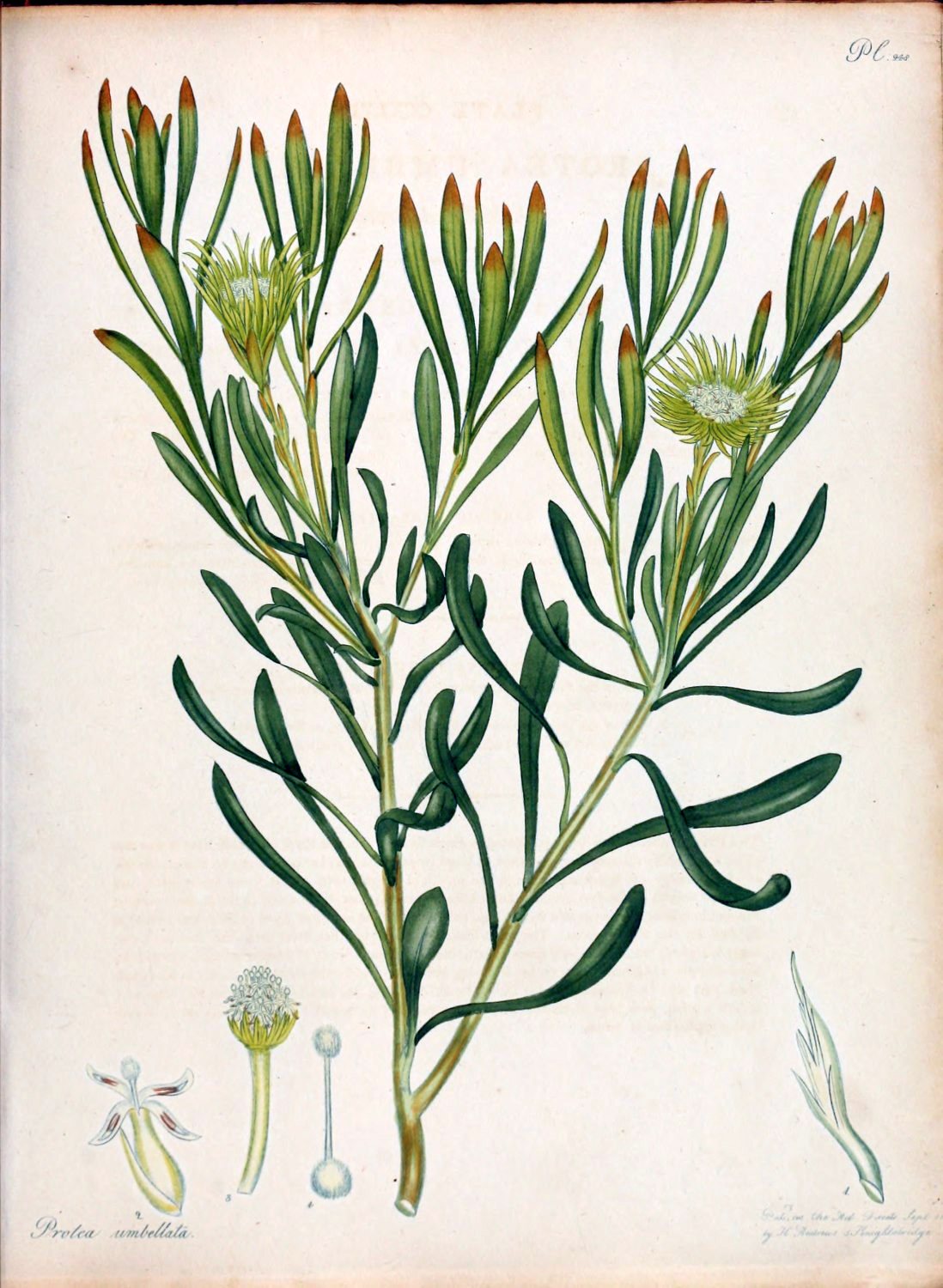
Volume 4 — PLATE CCXLVIII. PROTEA UMBELLATA. Umbellated Protea.
Reading edition
CLASS IV. ORDER I.
TETRANDRIA MONOGYNIA. Four Chives. One Pointal.
ESSENTIAL GENERIC CHARACTER.
Corolla 4-fida seu 4-petala. Antheræ lineares, insertæ petalis infra apicem. Calyx proprius nullus. Semina solitaria.
Blossom 4-cleft or 4 petals. Tips linear, inserted into the petals below the point. Cup proper none. Seeds solitary.
See Protea formosa, Pl. XVII. Vol. I.
SPECIFIC CHARACTER.
Protea foliis lineari-spathulatis, glabris; capitulis terminalibus; bracteis multifidis; floribus luteis.
Protea with linearly-spathulate leaves, smooth; heads of flowers terminate the branches; floral leaves many cleft; flowers yellow.
REFERENCE TO THE PLATE.
1. One of the floral leaves or scales of the general empalement, magnified.
2. A flower, magnified.
3. One of the heads of flowers, divested of the scales, or floral leaves.
4. The Pointal and seed bud, of one of the florets, magnified.
The Protea umbellata has been cultivated in England since the year 1777, at which time it was first raised from seeds; received from the Cape of Good Hope by Messrs. Lee and Kennedy, Hammersmith, at whose nursery our figure was taken in the month of August 1800. It is a very hardy plant, and not at all subject to the very common fate of its congeners; that is, to damp in the leaves, or rot at the root in winter; is propagated by cuttings, to be made in the month of April or May, and treated as directed for the other Proteas. The plant seldom grows higher than three feet, and does not make many branches; but is of a lively green colour, both leaves and stem. We have, as usual, adopted the name this plant is generally known by, it having been so named by the younger Linnæus in his Suppl. Plant. 118, and by Thunberg in his Dissertatio de Protea, p. 34, and his Prodromus 26. But why or how a small, close head of flowers may be denominated an umbel we must confess our ignorance in this application of terms.