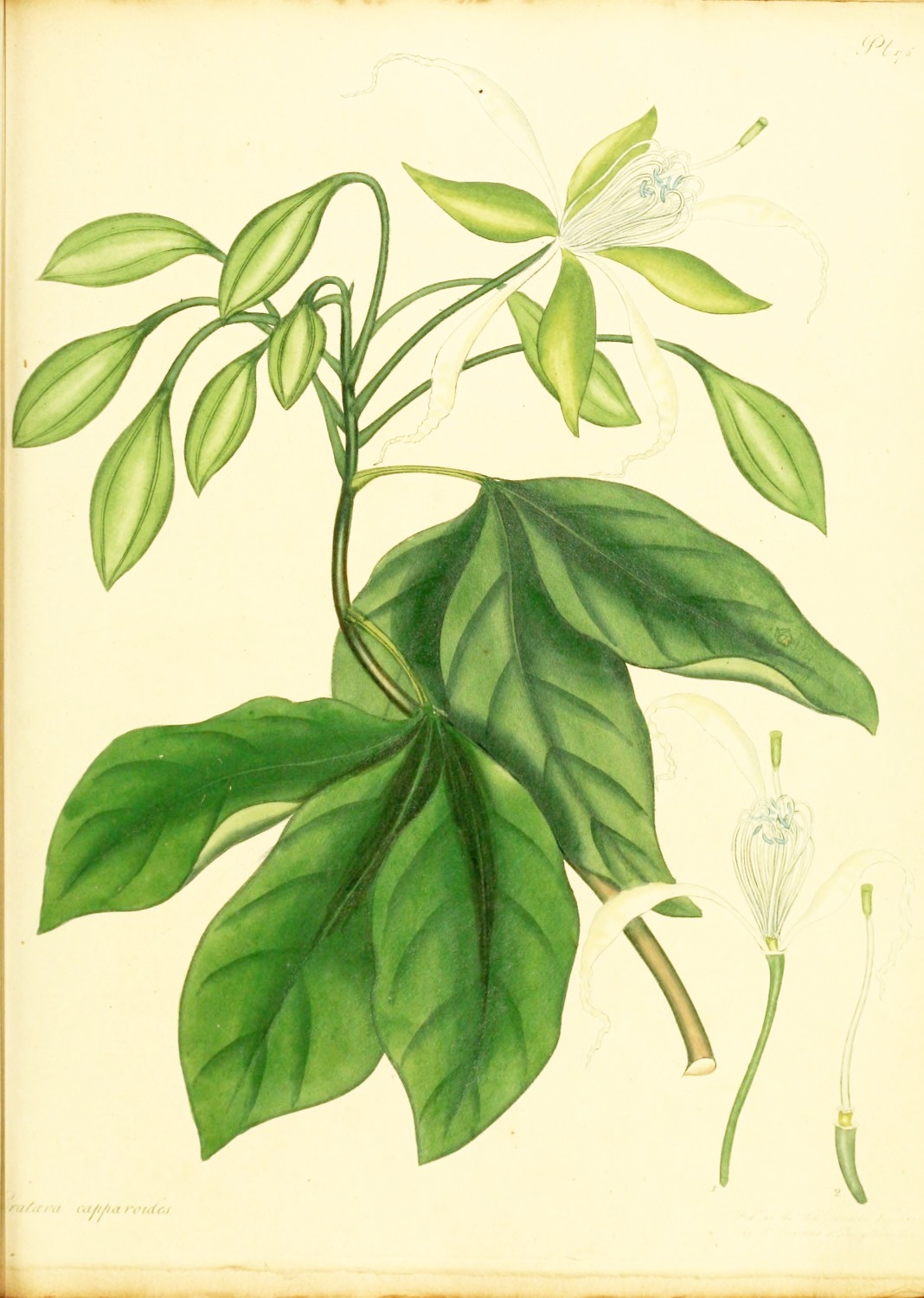
Volume 3 — PLATE CLXXVI. CRATÆVA CAPPAROIDES. Caper-like Cratæva.
Reading edition
CLASS XI. ORDER I.
DODECANDRIA MONOGYNIA. Twelve Chives. One Pointal.
GENERIC CHARACTER. Schreb. Gen. Plant. Vol. I. p. 320.
Calyx. Perianthium monophyllum, quadrifidum, deciduum, basi planum; laciniis patentibus, ovatis, inæqualibus.
Corolla. Petala quatuor, oblonga, unguibus tenuibus, longitudine calycis, divisuris inserta.
Stamina. Filamenta sedecim vel plura, setacea, corolla breviora. Antheræ erectæ, oblongæ.
Pistillum. Germen, pedicello filiformi, longissimo, ovatum. Stylus nullus. Stigma sessile, capitatum.
Pericarpium. Bacca? carnosa, globosa, maxima, pedicellata, unilocularis, bivalvis.
Semina plura, subrotunda, emarginata, nidulantia.
Empalement. Cup one leaf, four-cleft, falling off, flat at the base; segments spreading, egg-shaped, unequal.
Blossom. Four petals, oblong, claws slender, the length of the cup and inserted into the divisions.
Chives. Threads sixteen or more, like bristles, shorter than the blossom. Tips erect, oblong.
Pointal. Seed-bud on a thread-shaped and very long foot-stalk, egg-shaped. Shaft none. Summit sitting on the seed-bud, headed.
Seed-vessel. A Berry? fleshy, globular, large, with a foot-stalk, one-celled, two-valved.
Seeds many, roundish, notched at the end, dispersed in pulp.
SPECIFIC CHARACTER.
Cratæva foliolis elipticis, glabris; floribus umbellatis, terminalibus, luteo-viridibus, petalis longissimis, apicibus crispis.
Cratæva with eliptical, smooth leaflets; flowers grow in umbels, terminal and yellow green; petals very long, crisped at the ends.
REFERENCE TO THE PLATE.
1. Shews the Pointal, part of the Chives, and three Petals of the blossom; a few of the Chives, one of the Petals, and the leaves of the Empalement, being removed, the better to exhibit the structure of the blossom.
2. The Pointal, complete.
To Mr. Eldred Elfzelius, a native of Sweden, we are indebted for this species of Cratæva; by whom it was brought to Great Britain, on his return from Sierra Leone, in the year 1795. As a native of that burning clime, it will not endure our winters, without the protection of the hothouse; to which, as a climber, it is a considerable ornament, both in foliage, and flower; the flowers coming, in succession, from June, till August; perhaps, much later, as we believe, this is the first time its blossoms have been produced in England. The propagation is extremely easy, by cuttings; but, to give the plant sufficient vigour for flowering, it must be planted in a border, prepared of old rotten dung, sandy peat, and loam, of each, equal parts; separated from the tan-bed by a partition of boards, sufficiently strong to support the earth, upon the removal of the tan. This method of treating many of the tropical climbers, and even the common Caper, though a native of the south of Europe, has been found necessary to their production of flowers in this country. Our figure was taken from a plant, treated in the above manner, in the Stepney collection; from whence, through the kind indulgence of the truly urbanic, and indefatigable proprietor, T. Evans, Esq. we are in hopes of gratifying our botanical friends, with the figures of a number of plants, new to this country; and of which he is, at present, the sole possessor.