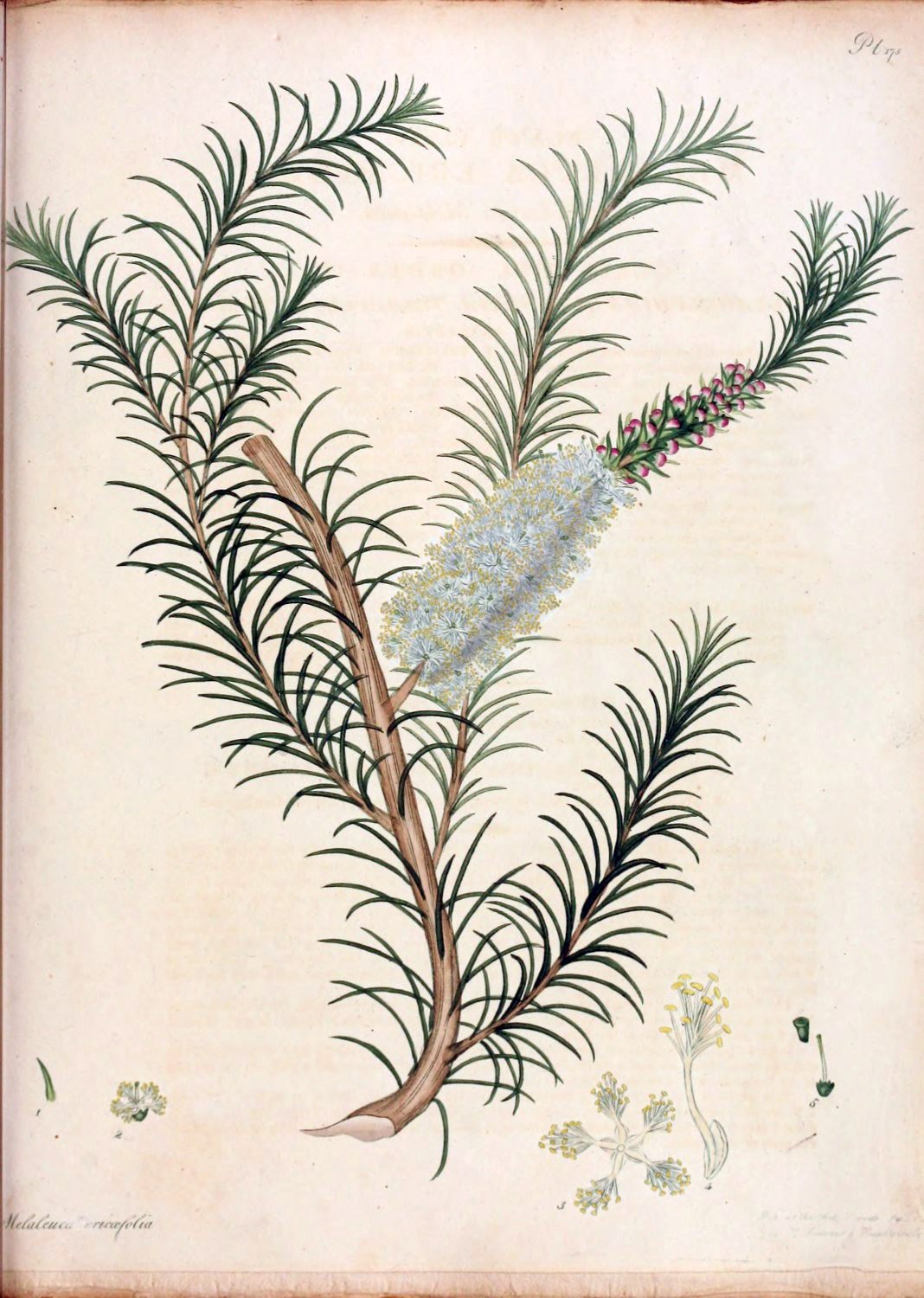
Volume 3 — PLATE CLXXV. MELALEUCA ERICÆFOLIA. Heath-leaved Melaleuca.
Reading edition
CLASS XVIII. ORDER IV.
POLYADELPHIA POLYANDRIA. Threads in many sets. Many Chives.
GENERIC CHARACTER.
Calyx. Perianthium turbinatum, germini adnatum, quinquefidum seu quinquedentatum.
Corolla. Petala quinque, rotundata, calycis margini interiori inserta.
Stamina. Filamenta numerosa, filiformia, in fasciculos quinque connata. Antheræ incumbentes.
Pistillum. Germen turbinatum, fundo calycis adnatum. Stylus filiformis, erectus. Stigma simplex.
Pericarpium. Capsula subglobosa, calycis ventre corticata, summitate nuda, trilocularis, dissepimentis contrariis.
Semina plurima, oblonga, seu rotundato-angulata, seu alata.
Empalement. Cup turban-shaped, growing to the seed-bud, five-cleft or five-toothed.
Blossom. Five petals rounded, inserted into the inner margin of the cup.
Chives. Threads numerous, thread-shaped, united in five bundles. Tips incumbent.
Pointal. Seed-bud turban-shaped, growing to the bottom of the cup. Shaft thread-shaped, erect. Summit simple.
Seed-vessel. Capsule nearly globular, coated by the belly of the cup, the upper part naked, three-celled, partitions contrary.
Seeds many, oblong, or rounded with angles, or winged.
SPECIFIC CHARACTER.
Melaleuca foliis sparsis oppositisve, linearibus, enerviis, subrecurvis, muticis; floribus sessilibus, apicem versus ramulorum confertis, spicatis.
Melaleuca with scattered or opposite leaves, linear, without nerves, a little turned back and beardless; flowers grow close to the stem, crowded together near the end of the smaller branches in spikes.
REFERENCE TO THE PLATE.
1. A Prop, one which is to be found at the base of each flower.
2. A Blossom, natural size.
3. The same magnified.
4. One of the five bundles of Chives, with its Petal, to which it is attached at the base, magnified.
5. The Cup, Seed-bud, Shaft and Summit, natural size, the summit detached and magnified.
The plants from New Holland, of the natural order of Myrti; comprized under the different Genera of Metrosideros, Eucalyptus, Leptospermum, Myrtus, and this present one of Melaleuca; seem, from what we yet know, to constitute a very distinguished part, of the woody vegetable productions of that country: wherefore, we can have little hopes of seeing many of them flower with us, at least, for many years to come. The M. ericæfolia was amongst the first plants raised in 1788, by Messrs. Lee and Kennedy, Hammersmith, from seeds; but, till this year, we believe it has not been seen to flower, in any collection in Great Britain; nor perhaps would it, as yet, had not a large and old plant, been planted out in the novel and elegant conservatory of the Right Hon. the Marquis of Blandford at White Knights, near Reading, Berks, from a branch of which, obligingly communicated by his Lordship, our drawing was taken, the beginning of July, this year.
The Plant grows to the height of six or seven feet, upright, very branching, the branches weeping, and the flowers, which grow in spikes or branches of about six inches in length, project, straight out, from about the middle of the stem.
It grows best in a mixture of two thirds sandy peat, and one third loam; may be propagated by cuttings made, from the tender shoots, in the month of March, and kept under a glass, in the tan bed of the hothouse, or in a melon frame until rooted.
This species of Melaleuca and the Metrosideros Nodosa of Gaertner, 1st Vol. de fruct. p. 172, t. 34, f. 6, we must confider as the same, though made by Dr. Smith, see Linn. Trans. Vol. III. p. 276, distinct species; perhaps from specimens gathered at different times, differently dried, or from different parts of the country.