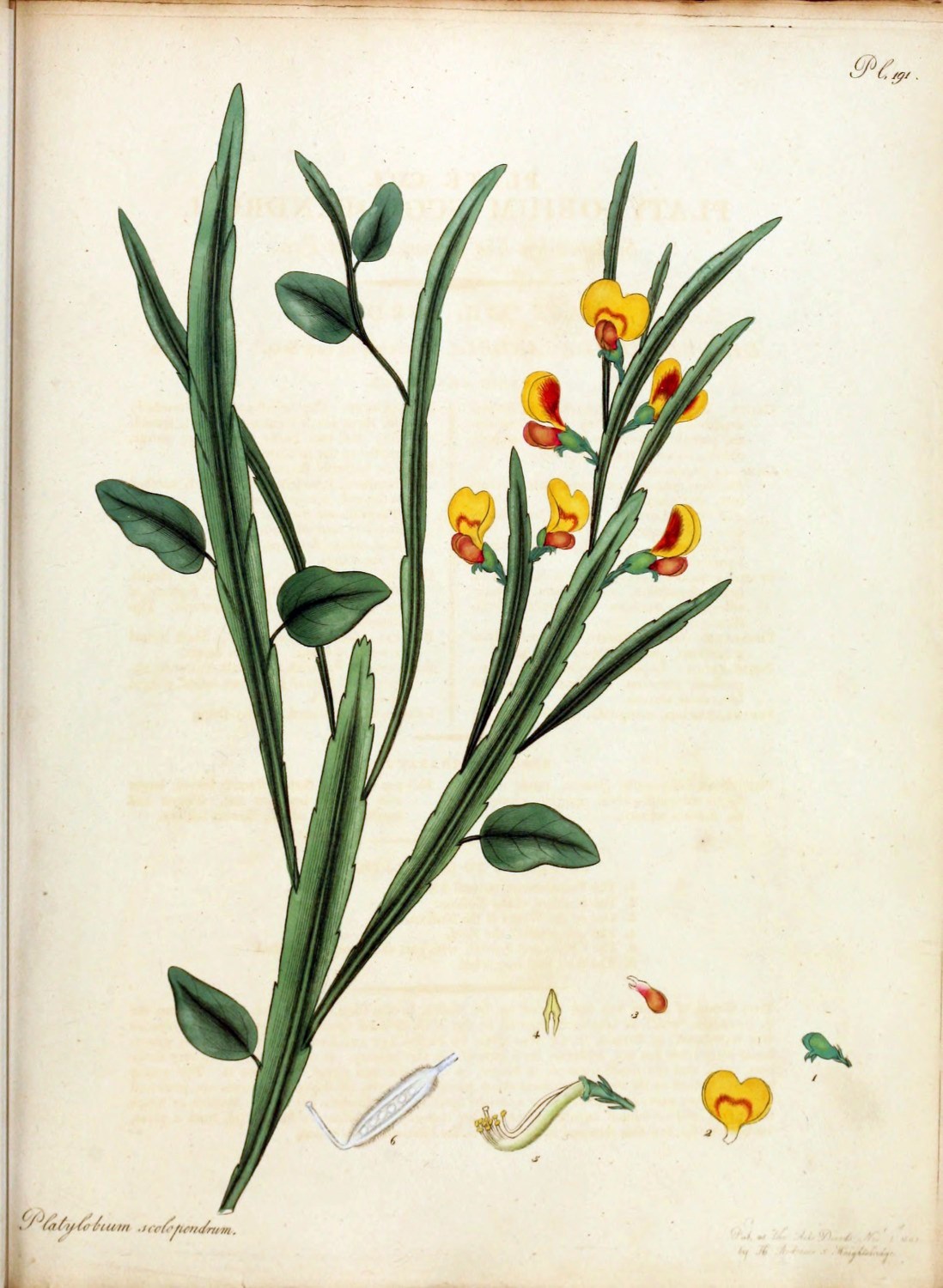
Volume 3 — PLATE CXCI. PLATYLOBIUM SCOLOPENDRUM. Scolopendra-like stemmed Flat-Pea.
Reading edition
CLASS XVII. ORDER IV.
DIADELPHIA DECANDRIA. Threads in two Sets. Ten Chives.
GENERIC CHARACTER.
Calyx. Perianthium, campanulatum quinquedentatum; laciniis tribus inferioribus acutis, patentibus; duabus supremis maximis, obtusis, obovatis, vexillo adpressis.
Corolla papilionacea.
Vexillum, obcordatum, emarginatum, erectum, maximum.
Alæ vexillo breviores, obtusæ, semi-obcordatæ, basi denticulatæ.
Carina obtusa, compressa, longitudine et figura alarum.
Stamina filamenta decem, coalita in vaginam, supra semifissam, apice libera, æqualia, assurentia. Antheræ subrotundæ, versatiles.
Pistillum. Germen lineare, pilosum. Stylus incurvatus, glaber. Stigma simplex.
Pericarpium. Legumen pedicellatum, compressum, obtusum, mucronatum, uniloculare, dorso alatum.
Semina, plurima, compressa, reniformia.
Empalement. Cup bell-shaped, five-toothed; the three lower segments pointed, spreading; the two upper very large, obtuse, pressed to the standard.
Blossom butterfly-shaped.
Standard, inversely heart-shaped, notched at the end, upright, very large.
Wings shorter than the standard, obtuse, half inversely heart-shaped, toothed at the base.
Keel, obtuse, flattened, the length and shape of the wings.
Chives. Ten threads, united into a sheath, half cleft on the upper side, separate at the top, equal and turned upwards. Tips roundish, versatile.
Pointal. Seed-bud linear, hairy. Shaft turned inwards, smooth. Summit simple.
Seed-vessel. Pod with a footstalk, flattened, obtuse, with a small point, one-celled, winged along the back.
Seeds many, flattened, kidney-shape.
SPECIFIC CHARACTER.
Platylobium foliis ovatis, glabris; ramis ramulisque compressis, alatis, margine, cicatrisatis, floribus solitariis.
Flat-pea with egg-shaped smooth leaves, larger and smaller branches flat, winged and hatched at the edges; flowers solitary.
REFERENCE TO THE PLATE.
1. The Empalement, natural size.
2. The Standard of the blossom.
3. One of the Wings of the blossom.
4. The two petals of the Keel.
5. The Chives and Pointal, with part of the cup, magnified.
6. The Seed-bud magnified.
This Genus of plants was first named by Dr. Smith, in the Linn. Trans. Vol. II. 350, from the P. formosum, which he afterwards figured in the New-Holland specimens, Tab. VI. Our species was introduced, to Britain, in the year 1792, by Messrs. Lee and Kennedy. It is a hardy greenhouse plant; but has not, hitherto, been increased in this country. It must be planted in very sandy peat earth, and not much watered, in winter, as too much wet is apt to destroy it. The young branches, which in the old plant appear much more like leaves, (as seldom any leaves are produced from the upper part of the plant, after a certain age,) are very tender; but in time become as tough as leather, and are almost equally pliable. Our drawing was taken in May 1799, from a plant, we believe, the first that flowered in England, in the Hibbertian Collection.