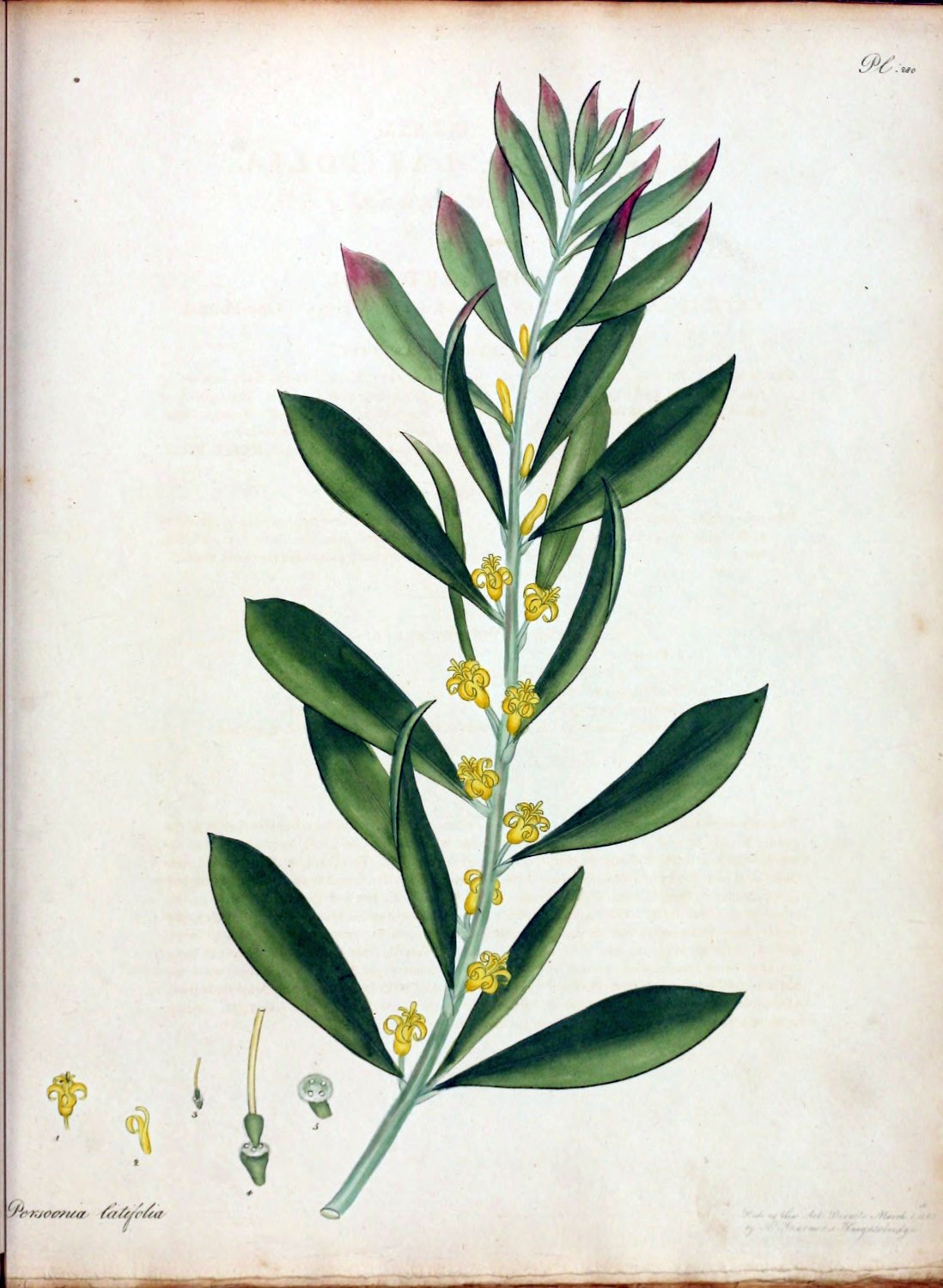
Volume 4 — PLATE CCLXXX. PERSOONIA LATIFOLIA. Broad-leaved Persoonia.
Reading edition
CLASS IV. ORDER I.
TETRANDRIA MONOGYNIA. Four Chives. One Pointal.
ESSENTIAL GENERIC CHARACTER.
Calyx nullus. Petala 4, basin versus staminifera. Glandulæ 4 ad basin germinis. Stigma obtusum. Drupa monosperma.
Empalement none. Petals four, supporting the chives near the base. Four glands at the base of the seed-bud. Summit blunt. A pulpy berry with one seed.
See Persoonia lanceolata, Pl. LXXIV. Vol. II.
SPECIFIC CHARACTER.
Persoonia foliis subovatis, utrinque glabris, crassiusculis, uninerviis; petiolis brevibus, tortis.
Persoonia with leaves approaching to inversely-egg-shaped, smooth on both sides, thickish, one-nerved; foot-stalks short and twisted.
REFERENCE TO THE PLATE.
1. A Flower.
2. One of the Petals, with its Chive.
3. The Pointal and Seed-bud.
4. The same, magnified.
5. The receptacle, with the four glands at the base of the Seed-bud, magnified.
The very exact conformation of the flower in this, when compared with the other two species of the genus, already figured in this work; is a circumstance but seldom to be found, in plants, where the whole habit is so totally different in each species, as we here find it. This plant, until it flowered, was considered as a species of Conchium, (one of the Genera made by Dr. Smith from Banksia,) as nighest in appearance to some species of that Genus. It has flowered, for the first time in England, in the month of October, 1802. The plant being set in the conservatory at the Hammersmith-Nursery, the flowers have continued to succeed each other, progressively, upon the young branches, without intermission, as the shoot grows, from the base of each leaf. It is with great difficulty raised by cuttings; but, from every appearance, seed will be procured in this country; as the seed-buds have already become pretty large, and seeds of the other species have matured with us. It was first raised from seed, communicated by Colonel Paterson, from Port Jackson, New South Wales, in the year 1795. Sandy loam, or a mixture of sandy peat and loam, is the soil it most approves.