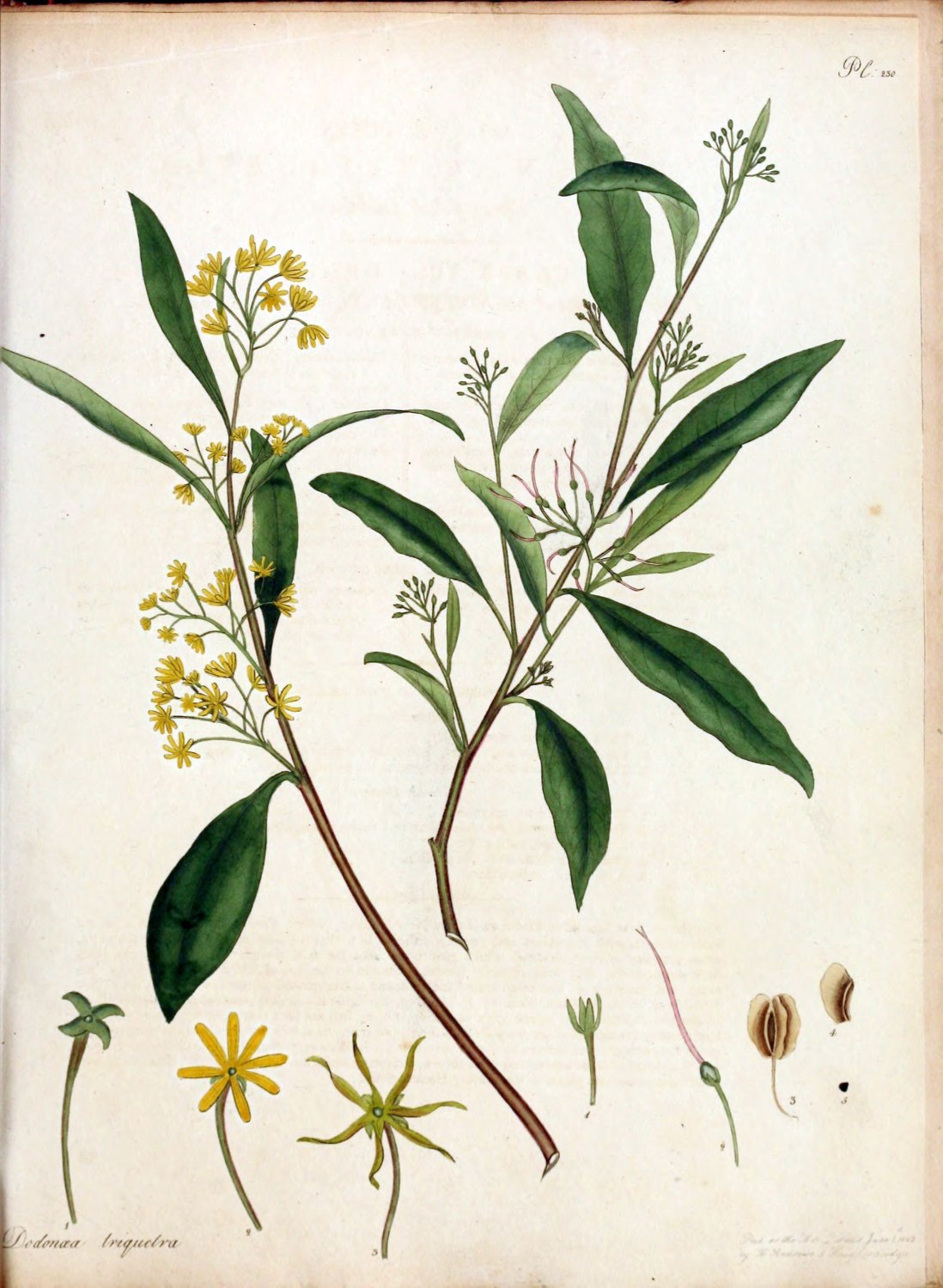
Volume 4 — PLATE CCXXIX. MAGNOLIA FUSCATA. Brown-stemmed Magnolia.
Reading edition
CLASS XIII. ORDER VII. of Schreb. Gen. Plant.
POLYANDRIA POLYGYNIA. Many Chives. Many Pointals.
ESSENTIAL GENERIC CHARACTER.
Calyx 3-phyllus. Petala 6-12. Capsulæ 2-valves, imbricatæ. Semina baccata, pendula.
Cup 3-leaved. Petals 6-12. Capsules 2-valved, tiled. Seeds, berries, pendulous.
See Magnolia pumila, Pl. 226. Vol. IV.
SPECIFIC CHARACTER.
Magnolia foliis elipticis, senioribus glabris, junioribus ramulisque tomentosis, fuscatis; petalis interne subalbidis, marginibus elegantissime coloratis.
Magnolia with eliptical leaves, the old ones smooth, the younger as well as the small branches are downy, and browned; petals whitish within, the margins elegantly coloured.
REFERENCE TO THE PLATE.
1. The outer fence of the flower, which falls off before the flower expands.
2. An outer petal of the blossom.
3. A Chive, with the parts complete, before the pollen has been emitted, a little magnified.
4. The same shewn from the outside.
5. A Chive shewn from the inside with the tips burst, magnified.
6. The Chives and Pointals, natural size.
7. The Pointals as they are placed on the columnar shaft, the Chives being removed, natural size.
Of all the Magnolias with which we are as yet acquainted, this species is the most elegant; whether for the growth of the plant, the brilliancy of the foliage, or the extreme delicacy, fragrance, and beauty of the flowers. It is a native of China; from whence it was first introduced to us, in the year 1796, by T. Evans, Esq. of Stepney; from a plant in whose collection, our figure was taken, this year, 1802, in the month of February, the general season of its flowering in this climate if kept in the hot-house; to which station it has, as yet, been doomed, although, from the general character of the Genus, we should be led to treat it more hardily. It is increased by cuttings, and layers; but the first is the best method, as, in the latter mode the branches do not take root under two years. The plant from which our drawing was made, did not exceed a foot and a half in height, which leads us to suppose it never becomes a large shrub, even in China. It thrives in leaf mould, and light loam. We believe this plant has not hitherto come under the review of any botanical author.