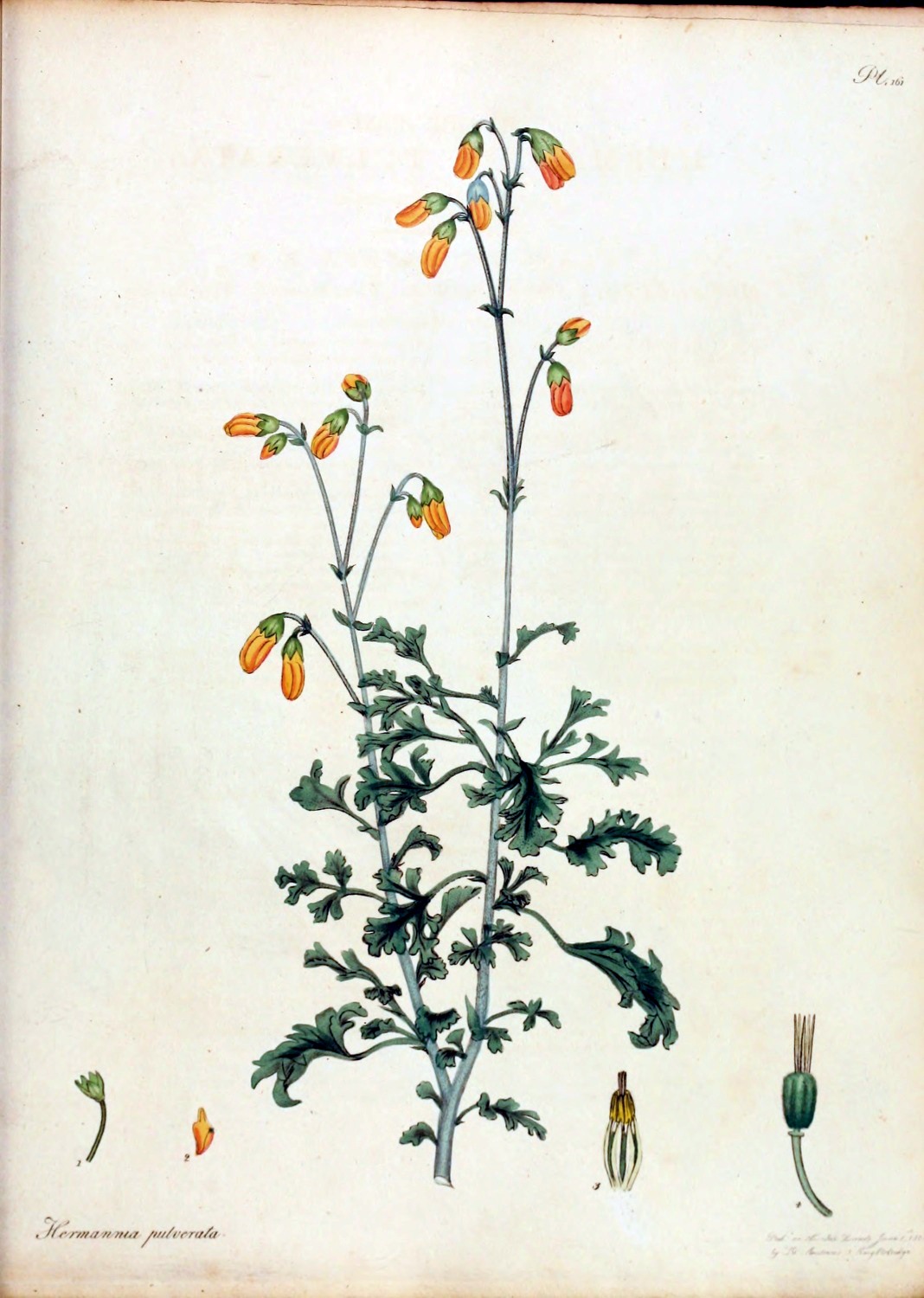
Volume 3 — PLATE CLXI. HERMANNIA PULVERATA. Powdered Hermannia.
Reading edition
CLASS XVI. ORDER II.
MONADELPHIA PENTANDRIA. Threads united. Five Pointals.
GENERIC CHARACTER.
Calyx. Perianthium monophyllum, quinquefidum, subrotundum, inflatum; lacinulis inflexis; persistens.
Corolla pentapetala, spiralis; ungues longitudine calycis, utrinque aucti membranula connivente in tubum cucullatum nectariferum; limbus patens, latiusculus, obtusus.
Stamina. Filamenta quinque, latiuscula, inferne levissime in unum corpus coalita. Antheræ erectæ, acuminatæ, conniventes.
Pistillum. Germen subrotundum, pentagonum, quinquangulare. Styli quinque, filiformes, approximati, subulati, staminibus longiores. Stigmata simplicia.
Pericarpium. Capsula subrotunda, pentagona, quinque-locularis, apice dehiscens.
Semina plurima, parva.
Empalement. Cup one leaf, five-cleft, roundish and swelled out; segments turned inwards; remaining.
Blossom, five petals, spiral; claws the length of the cup, widened on both sides by a small skinny substance forming a honey-bearing, cowl-shaped tube; border spreading, broadish, blunt.
Chives. Five threads, broadish, slightly joined at the base into one body. Tips upright, tapered, and approaching each other.
Pointal. Seed-bud roundish, five-sided, five-angled. Shafts five, thread-shaped, close together, awl shaped, longer than the Chives. Summits simple.
Seed vessel. Capsula roundish, five-sided, five-celled, splitting at top.
Seeds, many, small.
SPECIFIC CHARACTER.
Hermannia foliis bipinnatifidis, scabriusculis, albicantibus; pedunculis bifloris, longissimis; corollis sordidé luteis.
Hermannia with doubly wing-cleft leaves, rather rough and whitish; flower-stems two-flowered, very long; blossoms of a dirty yellow.
REFERENCE TO THE PLATE.
1. The Empalement.
2. A leaf of the Blossom, to shew its incurved character at the base.
3. The Chives, magnified, with the pointals remaining, to shew their length with regard to the Chives.
4. The Seed-bud, Shafts, Summits, magnified.
This plant appears to stand an intermediate character, between Mahernia and Hermannia: the general habit affines most to the former, and indeed, the shape of the threads, on which the essential generical distinction rests, approaches very near to those in Mahernia; for, although they have not absolutely foot-stalks, they are much larger, above the middle, than is usual in Hermannia, as may be seen on the plate; where these parts are shewn, magnified. It has likewise that singularly curious character, seen in Mahernia, of the two blossoms which terminate the flower-stems, each taking a contrary direction, in its spiral twist, to the other. As a greenhouse plant, it is rather tender in regard to damp, though not to cold; therefore, should be kept in the most airy part of the house. It is a native of the Cape, from whence it was introduced in the year 1796, to the Royal Gardens, Kew. By cuttings made in the month of April, it may be preserved, and increased, as it is not a long-lived plant. Loam, with a small portion of old rotten dung, it thrives in most. Our drawing was taken, at the Nursery, Hammersmith, in June 1800.