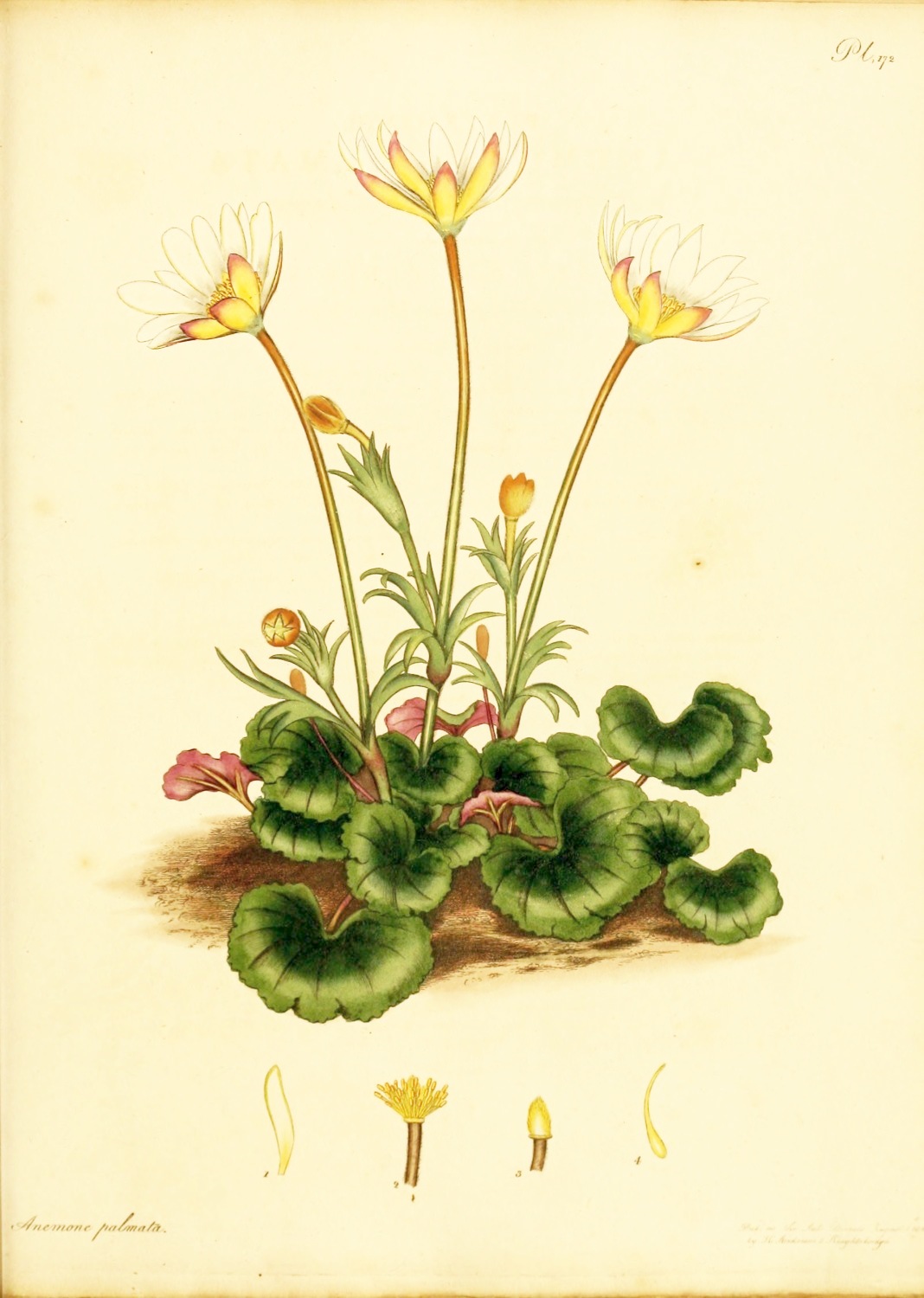
Volume 3 — PLATE CLXXII. ANEMONE PALMATA. Cyclamen-leaved Portugal Anemone.
Reading edition
CLASS XIII. ORDER VII.
POLYANDRIA POLYGYNIA. Many Chives. Many Pointals.
GENERIC CHARACTER.
Calyx nullus.
Corolla. Petala duorum triumve ordinum, in singula serie tria, oblongiuscula.
Stamina. Filamenta numerosa, capillaria, corolla dimidio breviora. Antheræ didymæ, erectæ.
Pistilla. Germina numerosa, in capitulum collecta. Styli acuminati. Stigmata obtusa.
Pericarpium nullum. Receptaculum globosum, sive oblongum, excavato-punctatum.
Semina plurima, acuminata, stylum retinentia.
Empalement none.
Blossom. Petals in two or three rows, three in a row, rather oblong.
Chives. Threads numerous, hair-like, half the length of the blossom. Tips doubled, erect.
Pointals. Seed-buds numerous, collected into a small head. Shafts tapered. Summits blunt.
Seed-vessel none. Receptacle globular or oblong, hollowed and dotted.
Seeds many, tapered, retaining the shaft.
SPECIFIC CHARACTER.
Anemone foliis reniformibus, sub-lobatis crenatis; involucro multifido; petalis exterioribus villosis, majoribus.
Anemone with kidney-shaped leaves, a little lobed, scolloped; fence many-cleft; the outer petals hairy and larger.
REFERENCE TO THE PLATE.
1. An outer Petal of the Blossom, shewn from the inside.
2. The Chives, as they stand on the receptacle.
3. The small Head, as formed by the pointals.
4. A Seed-bud and its appendages, a little magnified.
This species of Anemone, is a native of Portugal, having been brought from thence about the year 1788, and first cultivated at the Hammersmith Nursery; the specific title of Lusitanica obtained for a time, but little doubt rests now of its being the A. palmata of Linnæus’s Sp. Pl. p. 758, and of Vahl, Desfontaines, &c. How the plant could first acquire the name of palmata, is certainly a mystery; unless it might be, from the appearance of the fence, which nevertheless but ill accords with that character. Bauhin’s affination, as Cyclamen-leaved, is certainly the most appropriate, as the leaves both in shape, and the colour of the upper and under part, are exact with C. coum. It is rather too delicate for our winters, if exposed in the open borders; but, makes a pretty appearance, in spring, if kept in a pot, in light, rich earth. Like most Anemonies, it propagates best by dividing the roots, which are long and cylindrical; but, care must be taken not to water the pots, for some time after planting, as they are apt to rot, where they are broken.