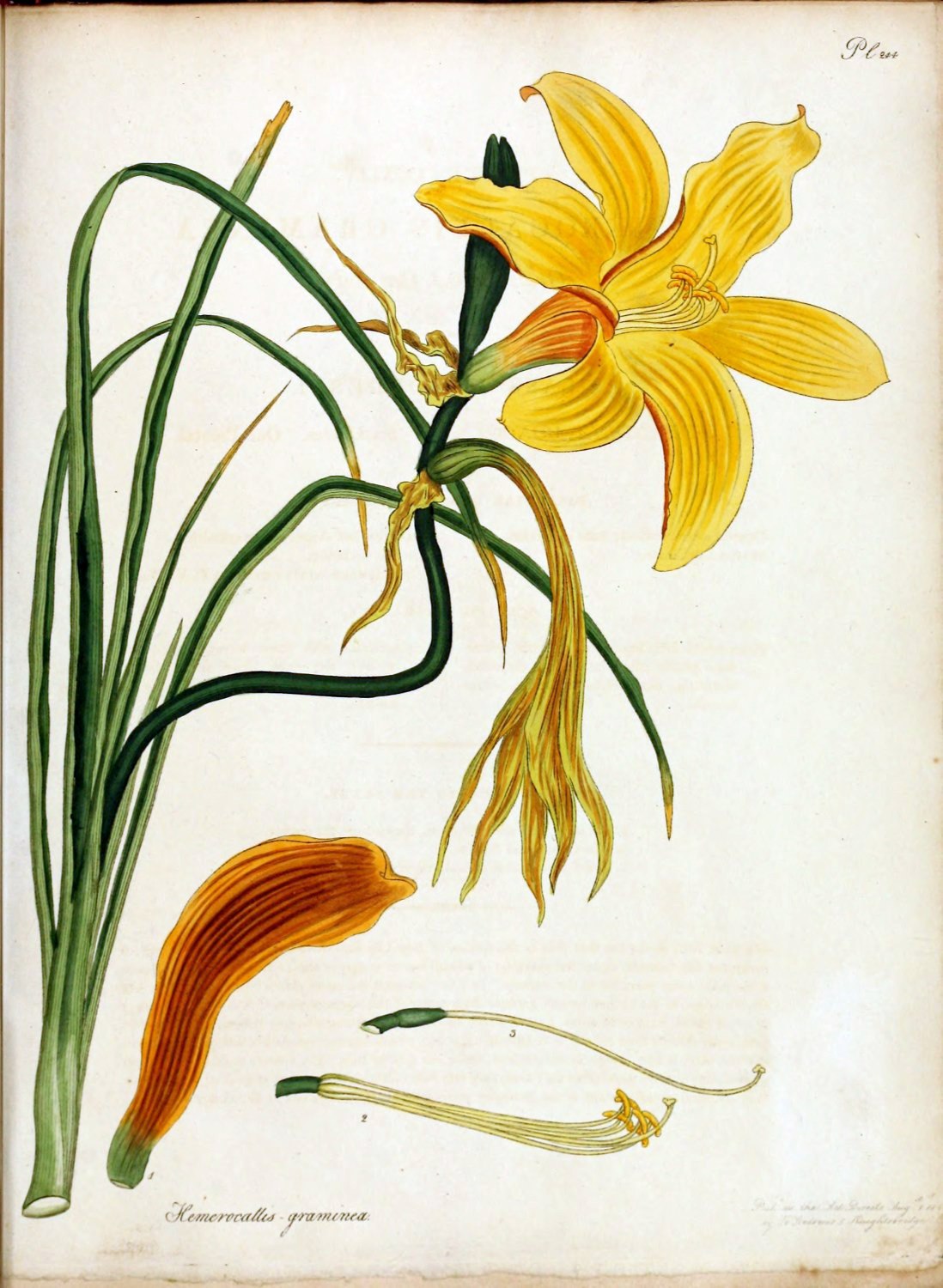
Volume 4 — PLATE CCXLIV. HEMEROCALLIS GRAMINEA. Grass-leaved Day-Lily.
Reading edition
CLASS VI. ORDER I.
HEXANDRIA MONOGYNIA. Six Chives. One Pointal.
ESSENTIAL GENERIC CHARACTER.
Corolla campanulata; tubo cylindrico.
Stamina declinata.
Blossom bell-shaped; tube cylindrical.
Chives declining.
See Hemerocallis cærulea, Pl. VI. Vol. I.
SPECIFIC CHARACTER.
Hemerocallis foliis linearibus, carinatis, gramineis; petalis tribus interioribus majoribus undulatis, exterioribus minoribus, extus bruneis.
Hemerocallis with linear leaves, keeled and grassy; the three inner petals larger, waved, the outer smaller, brown on the outside.
REFERENCE TO THE PLATE.
1. An outer leaf of the Blossom, shewn from the outside.
2. The Chives and Pointal.
3. The Pointal and Seed-bud, cleared of the chives.
We have little doubt but that this is the species of Day-Lily known to botanists, since the days of Parkinson and Gerarde, under the character of a small leaved variety of the Yellow Day-Lily, although it has been many years lost to the country. It is one amongst the many plants introduced by the late Dr. Sibthorpe, to the Oxford botanic garden. As a native of the northern parts of Europe, it is as hardy as either the H. flava or H. fulva, to both which species it bears strong affinity; although, we conceive, sufficiently distinct from either, to constitute a species; which however we should not have done, but that the plant is now known in our gardens, under our specific title. The flowers of this plant last, in general, two or three days before they decay, are very sweet scented, and as large as those of the H. fulva. It is increased as easily as any of the genus, by parting the roots, and thrives in almost any soil.