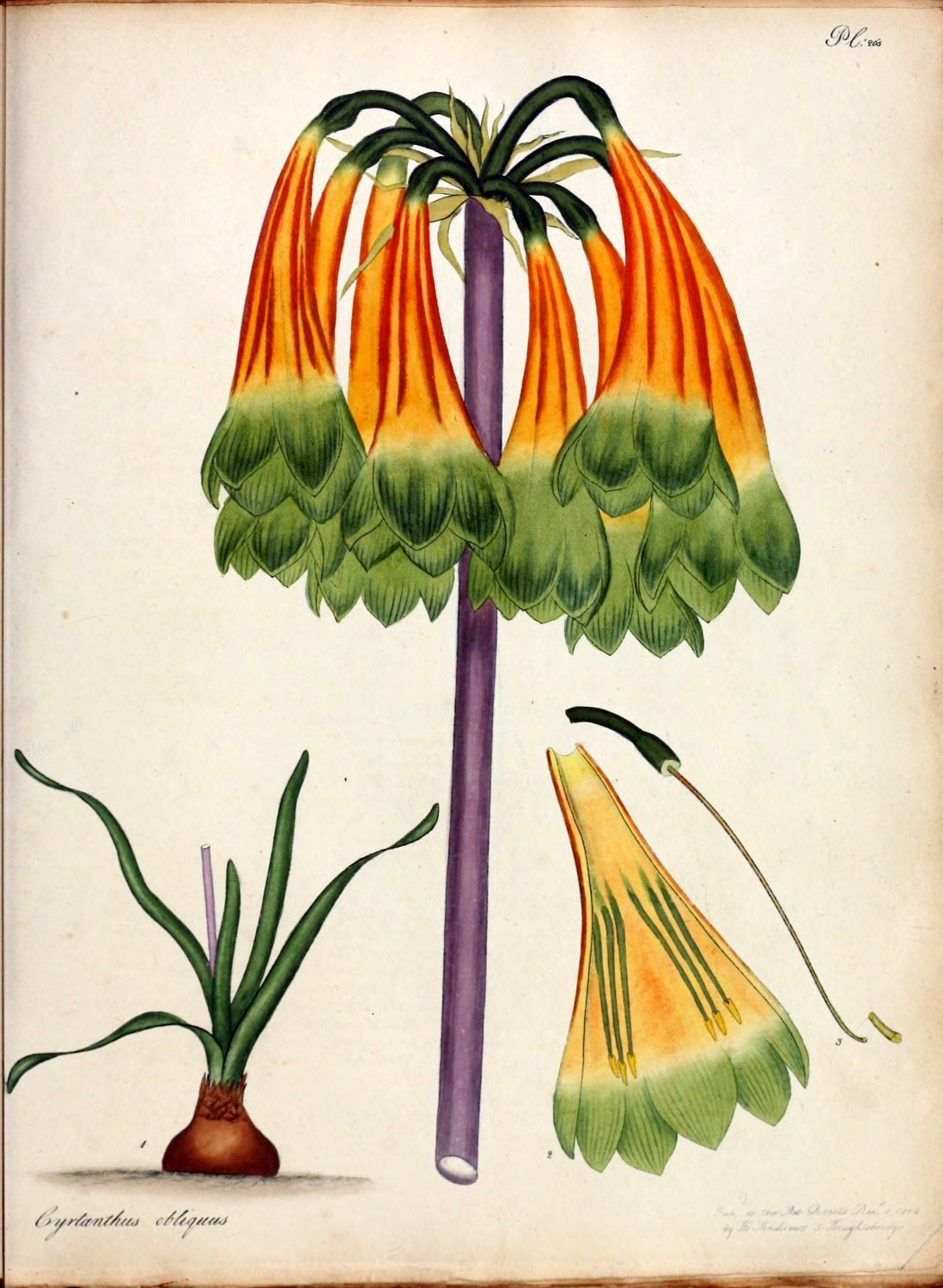
Volume 4 — PLATE CCLXV. CYRTANTHUS OBLIQUUS. Oblique-leaved Cyrtanthus.
Reading edition
CLASS VI. ORDER I.
HEXANDRIA MONOGYNIA. Six Chives. One Pointal.
GENERIC CHARACTER.
Calyx. Involucrum polyphyllum; foliolis lanceolatis, persistentibus.
Corolla monopetala, clavata, curva, apice sexfida; laciniis ovato-oblongis, incurvis, concavis, tribus alternis apice glandulosis.
Stamina. Filamenta sex, tubo corollæ inserta, erecta, subulata, corolla dimidio breviora. Antheræ sagitatæ, erectæ, inclusæ.
Pistillum. Germen inferum, obtuse-trigonum. Stylus filiformis, longitudine floris. Stigma obsolete-trifidum.
Pericarpium. Capsula subovata, trilocularis, trivalvis.
Semina plura, plana, oblonga, incumbentia.
Empalement. Fence many-leaved; leaflets lance-shaped, remaining.
Blossom one petal, club-shaped, bent, six-cleft at top; segments oblong egg-shaped, turned inwards and concave, the three outer ones glandular at the end.
Chives. Six threads inserted into the tube of the blossom, upright, awl-shaped, half the length of the blossom. Tips arrow-shaped, upright, within the blossom.
Pointal. Seed-bud beneath, obtusely three-cornered. Shaft thread-shaped, the length of the flower. Summit obscurely three-cleft.
Seed-vessel. Capsule nearly egg-shaped, three-celled, three-valved.
Seeds many, flat, oblong, lying upon one another.
SPECIFIC CHARACTER.
Cyrtanthus foliis linearibus, obtusis planis, oblique flexis, floribus pendulis, tricoloratis.
Cyrtanthus with linear, obtuse leaves, flat, and bent obliquely; flowers hanging down and three-coloured.
REFERENCE TO THE PLATE.
1. Part of the Bulb, and the leaves of the plant in miniature.
2. A Flower, cut and spread open, with the Chives in their place.
3. The Pointal and Seed-bud, natural size. Summit magnified.
This most beautiful, and rare plant, together with C. angustifolius, (the other species) were introduced, in the year 1774, to the Kew Gardens, by Mr. F. Masson, from the Cape of Good Hope. Mons. L’Heritier, when in England, procured drawings of both species, and figured them in his Sertum Anglicum, tab. 15 and 16, under the names of Amaryllis cylindracea, and A. umbrella: but, as we have had formerly occasion to mention our objections, in following that gentleman in his alterations of accepted Genera, in this country; we have, in the present instance, chose rather the authority of Martyn, Curtis, Willdenow, &c. in preference; who all have followed the Kew Catalogue in the name of this Genus. It is true, Thunberg, in his Prodromus Plantarum Capensium, P. 1. p. 59, has it still under the Genus, Crinum; and, as Crinum pendulum, our present subject, was known for many years. It is a very scarce plant, and is to be found but in few collections; the increase being only from the root, and the importation of the bulbs has been but seldom. The seeds do not come to maturity with us, of this species; although those of the C. angustifolius are constantly perfected. It must be treated as a dry stove plant, or kept on a shelf in the hot-house; should be planted in sandy loam, and have plenty of room in the pot. Flowers in July and August.
From the choice collection of Joseph Cowper, Esq. of Clapton, we were obligingly favoured with the plant, from which this figure was taken.