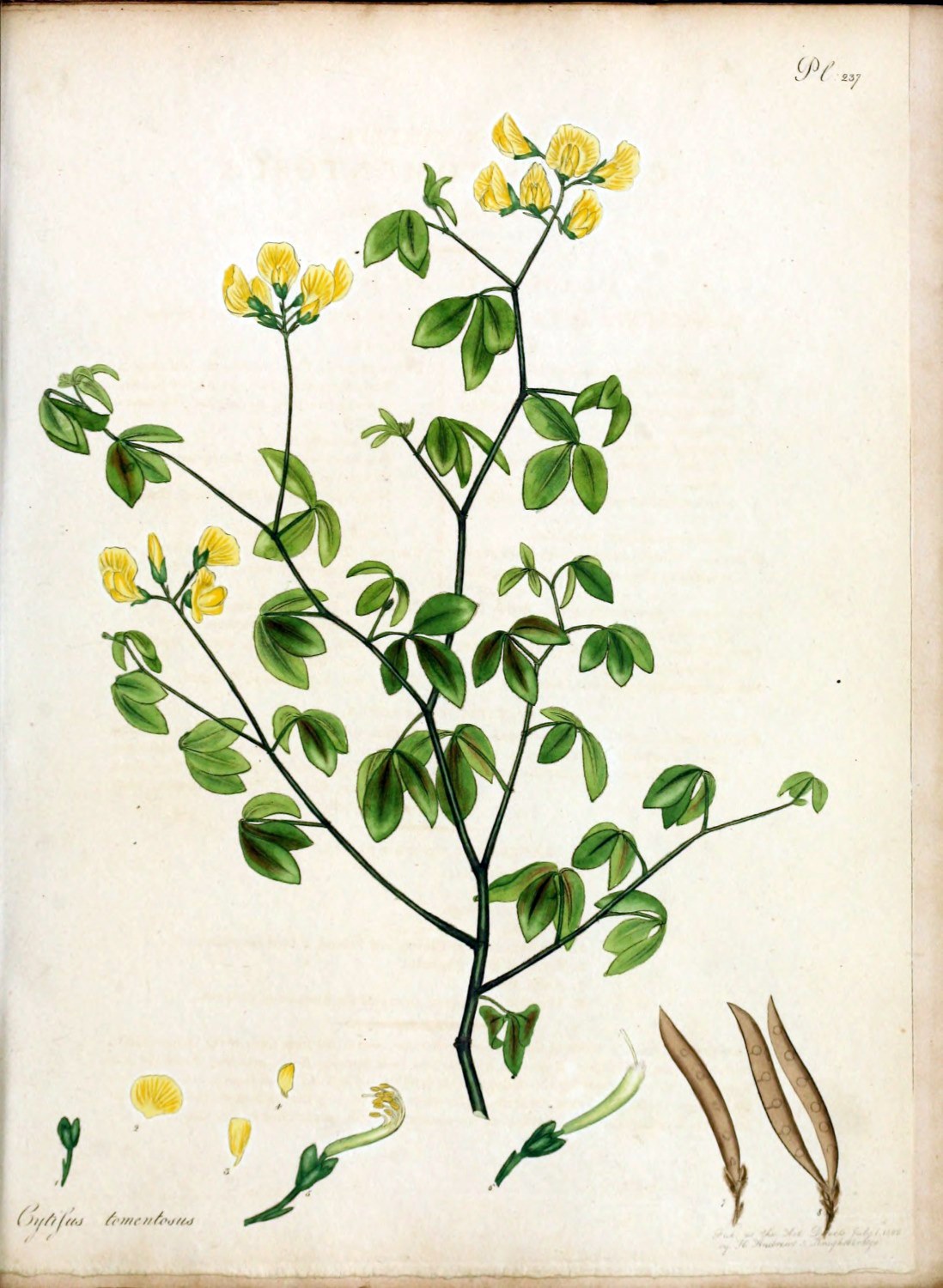
Volume 4 — PLATE CCXXXVII. CYTISUS TOMENTOSUS. Downy-leaved Cytisus.
Reading edition
CLASS XVII. ORDER IV.
DIADELPHIA DECANDRIA. Threads in two sets. Ten Chives.
GENERIC CHARACTER.
Calyx. Perianthium monophyllum, campanulatum, breve, basi obtusum; ore bilabiato; labio superiore bifido, acuminato; inferiore tridentato.
Corolla papillionacea.
Vexillum ovatum, assurgens, laterioribus reflexis.
Alæ longitudine vexilli, rectæ, obtusæ.
Carina ventriculosa, acuminata.
Stamina. Filamenta diadelpha (simplex et novemfidum) assurgentia. Antheræ simplices.
Pistillum. Germen oblongum. Stylus simplex, assurgens. Stigma obtusum.
Pericarpium. Legumen oblongum, obtusum, basi attenuatum, rigidum.
Semina nonnulla, reniformia, compressa.
Empalement. Cup one-leaved, bell-shaped, short, blunt at the base; mouth two-lipped; upper lip two cleft, tapered; lower tip three-cleft.
Blossom butterfly shaped.
Standard egg-shaped, rising upwards, turned back at the sides.
Wings the length of the standard, straight, blunt.
Keel a little bellied, tapered.
Chives. Threads in two sets (one single, the other nine-cleft) turned upwards. Tips simple.
Pointal. Seed-bud oblong. Shaft simple, turned upwards. Summit obtuse.
Seed-vessel. Pod oblong, obtuse, tapered at the base, stiff.
Seeds a few, kidney-shape, flattened.
SPECIFIC CHARACTER.
Cytisus racemis lateralibus, erectis; ramis teretibus, divaricatis; foliolis ovatis, tomentosis; vexillo crenulato; corollis luteis.
Cytisus with the bunches of flowers growing from the sides of the branches, which are round and straddle; leaflets egg-shaped and downy; standard a little scolloped; blossoms yellow.
REFERENCE TO THE PLATE.
1. The Empalement.
2. The standard.
3. One of the Wings.
4. The Keel.
5. The Empalement, Chives, and Pointal, a little magnified.
6. The Seed-bud, magnified.
7. A ripe Pod.
8. The same, split open, to expose the situation of the seeds.
This pretty Cytisus, a native of the Cape of Good Hope, was raised from seeds at the Hammersmith nursery, in the year 1798. It is rather a weak, and loose growing shrub, attaining the height of a foot and a half, and flowering about August. It delights in a light soil, and is propagated with ease by cuttings; it likewise perfects its seeds. The whole habit of the plant much more resembles Crotolaria than Cytisus; but the seed-vessel and empalement preclude its admission to that Genus.