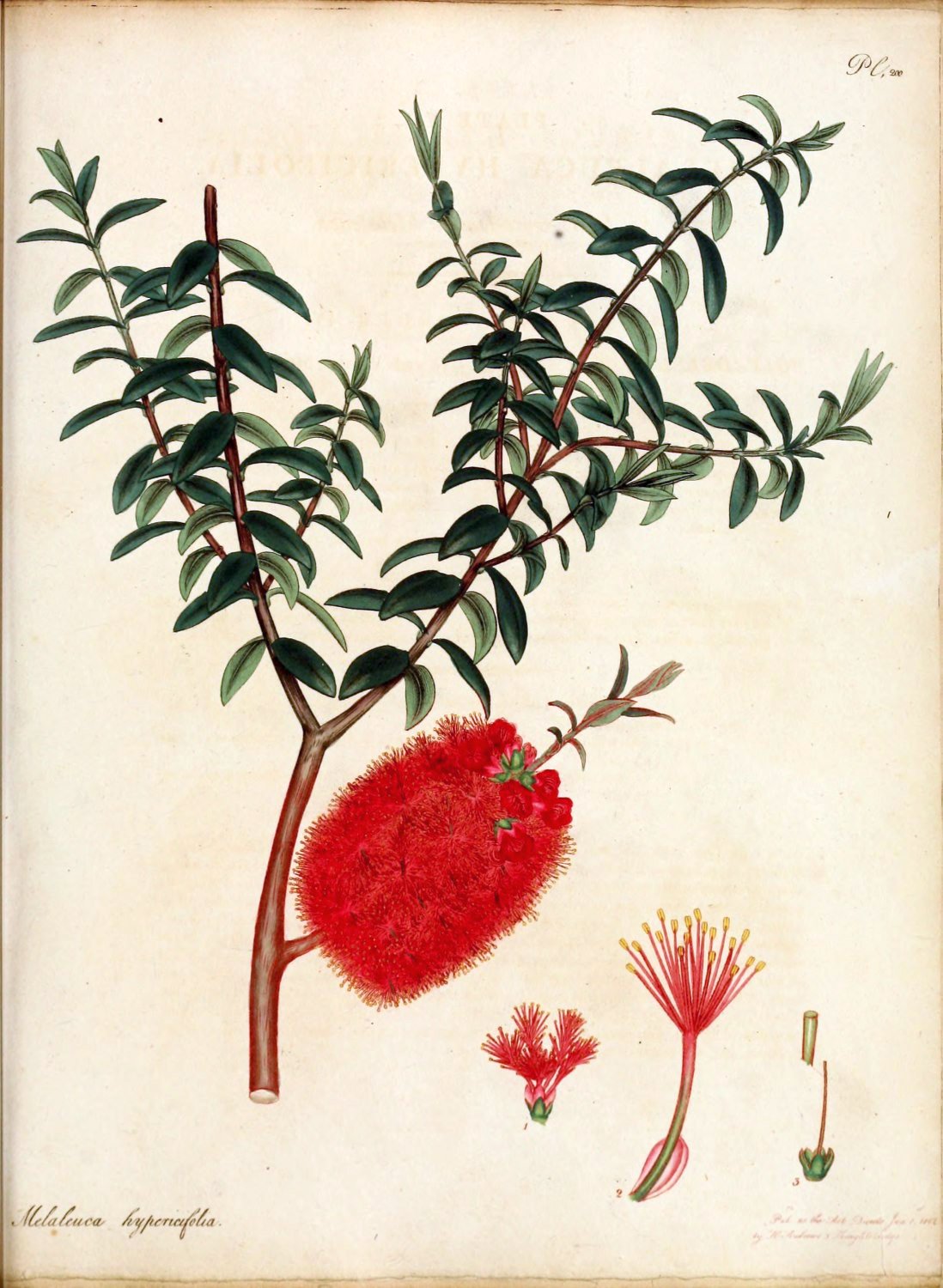
Volume 3 — PLATE CC. MELALEUCA HYPERICIFOLIA. St. John’s-wort-leaved Melaleuca.
Reading edition
CLASS XVIII. ORDER IV.
POLYADELPHIA POLYANDRIA. Threads in many Sets. Many Chives.
ESSENTIAL GENERIC CHARACTER.
Calyx quinquefidus, semisuperus. Petals quinque. Filamenta multa, longissima, connata in quinque corpora. Pistillum unum. Capsula trilocularis.
Cup five-cleft, half above. Petals five. Threads numerous, very long, united into five bodies. Pointal one. Capsule three-celled.
See Melaleuca ericæfolia, Pl. CLXXV. Vol. III.
SPECIFIC CHARACTER.
Melaleuca foliis oppositis, eliptico-oblongis, uninerviis; floribus consertis; filamentis longissimis, linearibus, apice radiato-multifidis.
Melaleuca with opposite leaves, eliptic-oblong, one-nerved; flowers clustered; threads very long, linear, rayed and many-cleft at the top.
REFERENCE TO THE PLATE.
1. A flower, natural size.
2. One of the five bundles of Chives, with its petal, to which it is attached at the base, magnified.
3. The cup, seed-bud, shaft and summit, natural size, the summit detached and magnified.
About the year 1792 this plant was first raised from seeds, by the late Mr. William Malcolm, Nurseryman, at Stockwell, Surry; and was, from the very great resemblance it bears to the St. John’s-worts, so denominated, until it flowered. It has now become one of the commonest, of what are generally termed, Botany Bay plants; yet unquestionably ranks with the handsomest whether for its foliage, form of growth, or flowers, which are of a most beautiful red-purple, scarcely to be imitated in painting. The singular manner in which the flower-stem is thrown out, as it were, from the old wood, in a horizontal direction, is common to many other species of the Genus. It grows to the height of four or five feet, very erect in every part; is easily increased by cuttings, and thrives best in peat earth. Although it is said to grow in swampy grounds in New South Wales, see Linnæan Transactions, Vol. III. p. 279, nevertheless, with us, a dry, or damp situation in the green-house, appears equally congenial to it. In the month of September 1799, our drawing was taken at the Conservatory of R. James, Esq. Grosvenor Place.