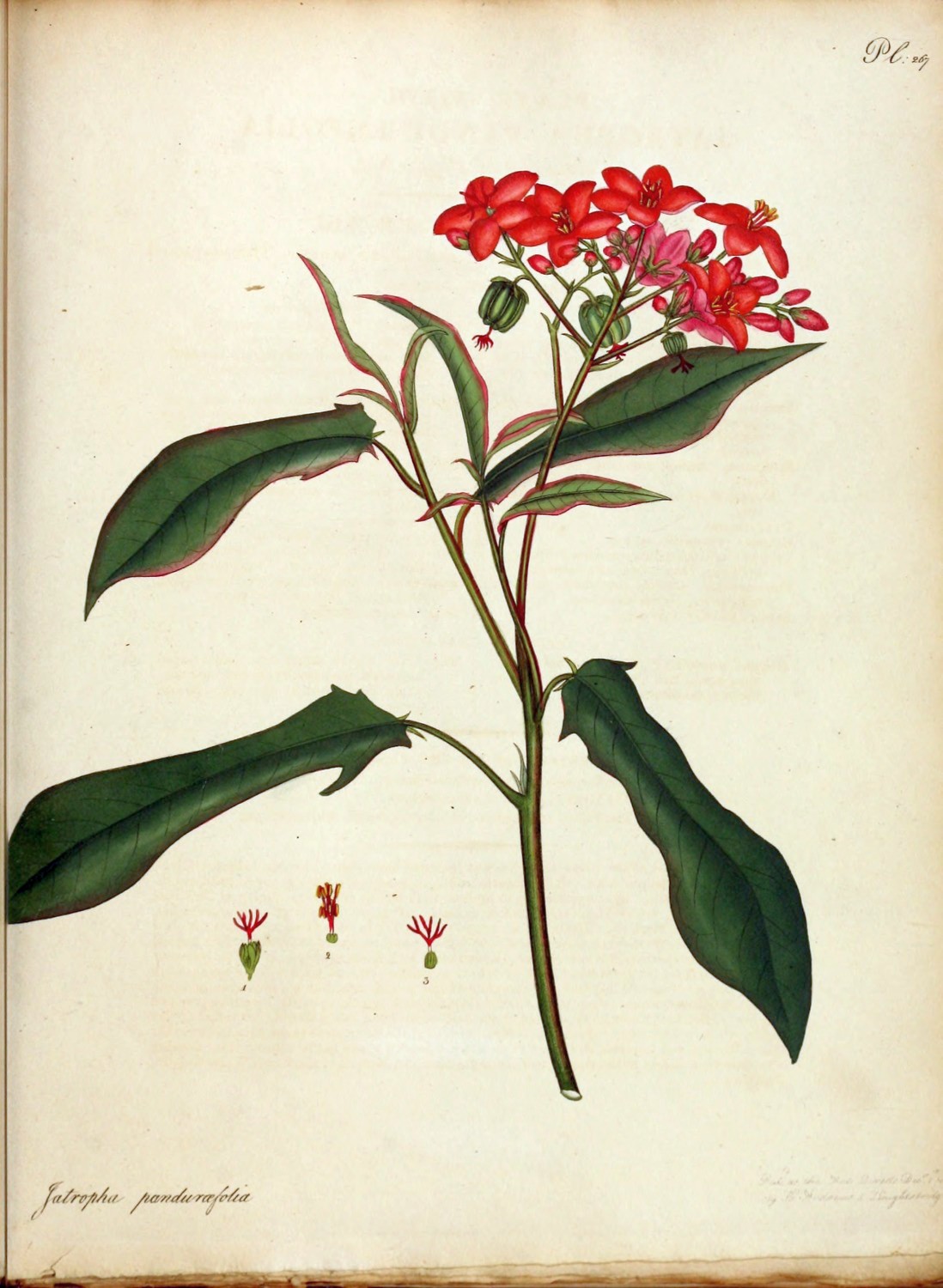
Volume 4 — PLATE CCLXVII. JATROPHA PANDURÆFOLIA. Fiddle-leaved Physic-Nut.
Reading edition
CLASS XXI. ORDER VIII.
MONOECIA MONADELPHIA. Chives and Pointals separate. Threads united.
GENERIC CHARACTER.
Masculi flores.
Calyx. Perianthium vix manifestum.
Corolla monopetala infundibuliformis; tubus brevissimus; limbus quinquepartitus, laciniis subrotundis, patentibus, convexis, subtus concavis.
Stamina. Filamenta decem, subulata, in medio approximata, quinque alterna breviora, erecta, basi connexa. Antheræ subrotundæ, versatiles.
Pistillum. Rudimentum debile in fundo floris latet.
Feminei flores in eadem umbella cum Masculis.
Calyx nullus.
Corolla pentapetala, rosacea.
Pistillum. Germen subrotundum, trisulcatum. Styli tres, bifidi. Stigmata simplicia.
Pericarpium. Capsula subrotunda, tricocca, trilocularis; loculis bivalvibus.
Semina solitaria, subrotunda.
Male flowers.
Empalement. Cup scarcely perceptible.
Blossom one petal, funnel-shaped; tube very short; border five-parted; segments roundish, spreading, convex, concave beneath.
Chives. Ten threads awl-shaped, close together in the middle, the five alternate ones shorter, upright, connected at the base. Tips roundish, versatile.
Pointal. A weak rudiment lies hid in the bottom of the flower.
Female flowers in the same umbel with the males.
Empalement none.
Blossom five-petalled, rosaceous.
Pointal. Seed-bud roundish, three furrowed. Three shafts, two-cleft. Summits simple.
Seed-vessel. Capsule roundish, three-seeded, three celled; cells with two valves.
Seeds solitary, roundish.
SPECIFIC CHARACTER.
Jatropha calyculata; foliis panduræformibus, apice acutis, basi inequaliter acutè-lobatis; floribus atro-coccineis.
Physic-Nut with a flower cup; fiddle-shaped leaves, sharp-pointed at the end, and unequally sharp-lobed at the base; flowers deep crimson.
REFERENCE TO THE PLATE.
1. The Cup and Pointal of a female flower.
2. The Cup and Chives of a male flower.
3. The Pointal and Seed-bud of a female flower, without the cup.
This plant, a native of the Island of Cuba, was imported from thence, by Mr. J. Fraser, King’s Road, Chelsea, in the year 1801. It is, unquestionably, as handsome a plant as any at present cultivated in our hot-houses, and its continuing to produce fresh umbels of flowers, during at least nine months of the year, renders it, perhaps, the most desirable. It grows to the height of near three feet, producing but few branches. The leaves are extremely irregular in their form, and, when the plant is in a sickly state, the older ones are subject to be slightly blotched, on the under side. Few tropical plants that thrive with so little heat, or care; nevertheless, we have not any hopes, of its ever becoming a proper subject for the green-house; but as yet our experience on that point will not permit us to decide upon it. It should be planted in a mixture of leaf mould, rotten dung, and loam; and may be propagated by cuttings. From a plant at the Hammersmith nursery, ripe seeds have been procured this year; they have the exact appearance of the seeds of the lesser Palma Christi, but rather smaller in size and have the same oily character. Indeed, there is so little difference between some species of the Genus Ricinus, and Jatropha, that botanists have been puzzled where to place them. Our drawing was made from a plant in the collection of the Right Hon. the Marquis of Blandford, White Knights, Berkshire.