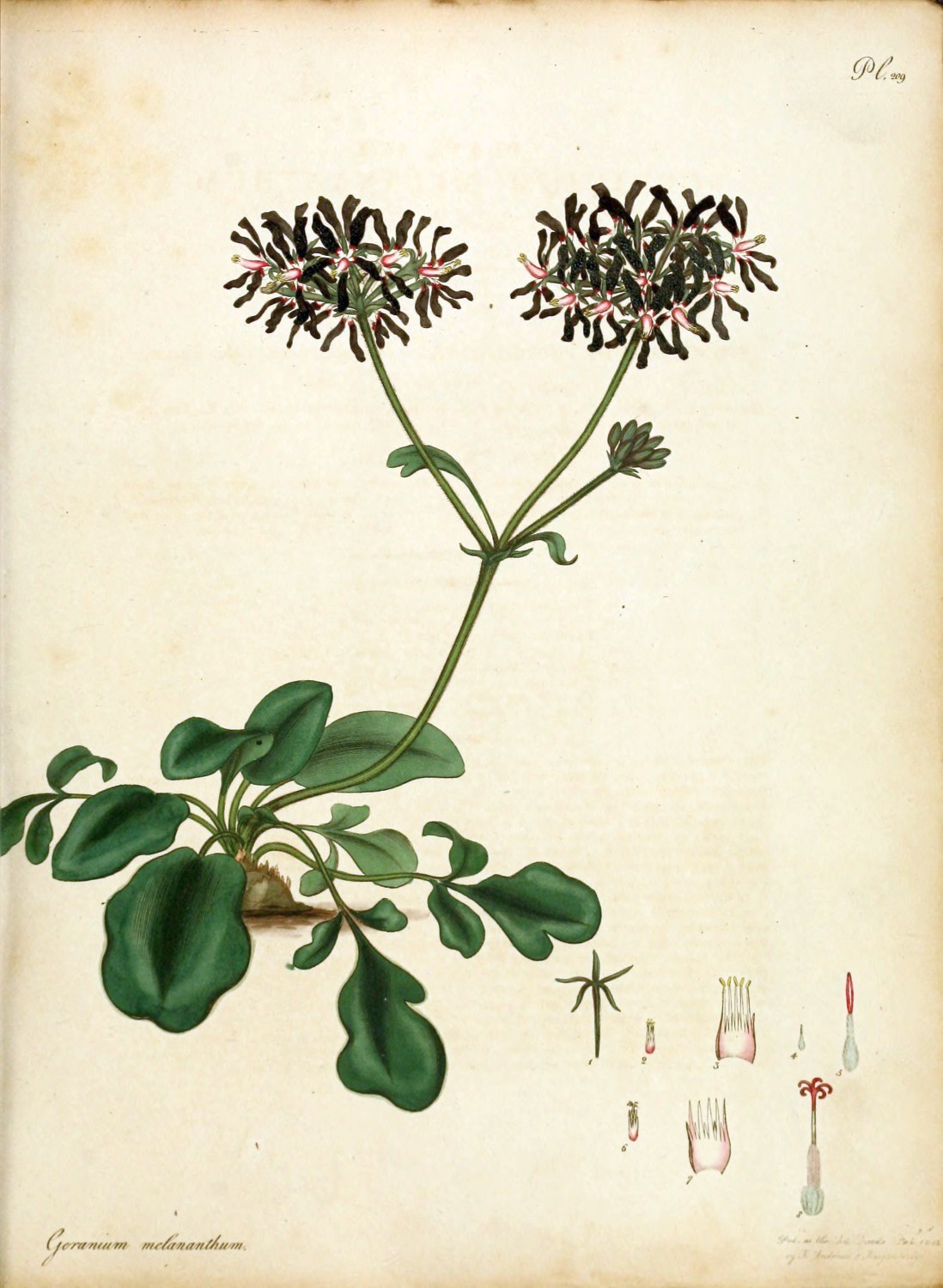
Volume 3 — PLATE CCIX. GERANIUM MELANANTHUM. Black-flowered Geranium.
Reading edition
CLASS XVI. ORDER IV.
MONADELPHIA DECANDRIA. Threads united. Ten Chives.
ESSENTIAL GENERIC CHARACTER.
Monogyna. Stigmata quinque. Fructus rostratus, penta-coccus.
One Pointal. Five Summits. Fruit furnished with long awns, five dry berries.
SPECIFIC CHARACTER.
Geranium foliis lobatis integrisque, hispidis, obtusis; calycibus monophyllis, laciniis linearibus; floribus nigricantibus, dioicis; radice tuberosa.
Geranium with lobed, and entire leaves, hairy and obtuse; cups one leaved, segments linear; flowers blackish, with the chives and pointals distinct; root tuberous.
REFERENCE TO THE PLATE.
1. The Empalement, natural size, the tube cut open.
2. The Chives of a male blossom, natural size.
3. The same, cut open and magnified.
4. The abortive Pointal of a male blossom, natural size.
5. The same, magnified.
6. The abortive Chives of a female blossom, natural size.
7. The same, magnified.
8. The Pointal of a female blossom, magnified.
This species of Geranium has been given by Professor Jacquin in his Icon: rar. 514, and his Collectanea 4. 188; from him, we find it collated by Professor Martyn into his Edit. of Miller’s Dict. under the article Pelargonium, 59. But, as no notice has been taken by Jacquin of so remarkable a circumstance as this species being Dioecious, or with male and female flowers on different plants; we may be led to suppose, that it has not flowered in Germany; or that the specimens he had seen, were from male plants, as he numbers the fertile chives as five, which could not have been discovered from a female specimen. Of five plants we had the good fortune to examine, which were all in flower at the same time, the roots of which had been imported from the Cape of Good Hope in the year 1793; three were male, with five fertile tips, the pointals obsolete; and two female, without the least trace of a tip, in either blossom, or bud. As the tips frequently fall upon the expansion of the flower, in many species, the bud is the only sure situs whence to determine this character. It is increased from seed, procured from female plants only, which are much more unfrequent than the male; likewise from the roots, which, (like to those of most of the species forming this link of the Genus,) are tuberous; forming small bulbs of unequal sizes, connected to the main root by slight radicles, and at a little distance from it: which, indeed, is the reason we have not adopted the term rapaceous, or turnip rooted, although it is a character which has been applied to them by very able Botanists, yet we think unadvisedly, or from their not having had the opportunity of examining them closely; as, we presume, this term cannot with propriety be given to any root which is composed of more than one body, as are the Turnip, Carrot, Parsnip, Radish, &c. where it applies. It must be planted in light peat earth, and kept in the dryest part of the green-house, where it will flower about the month of July. Our figure was taken at Clapham in June, this year, from a male plant in the Hibbertian Collection.