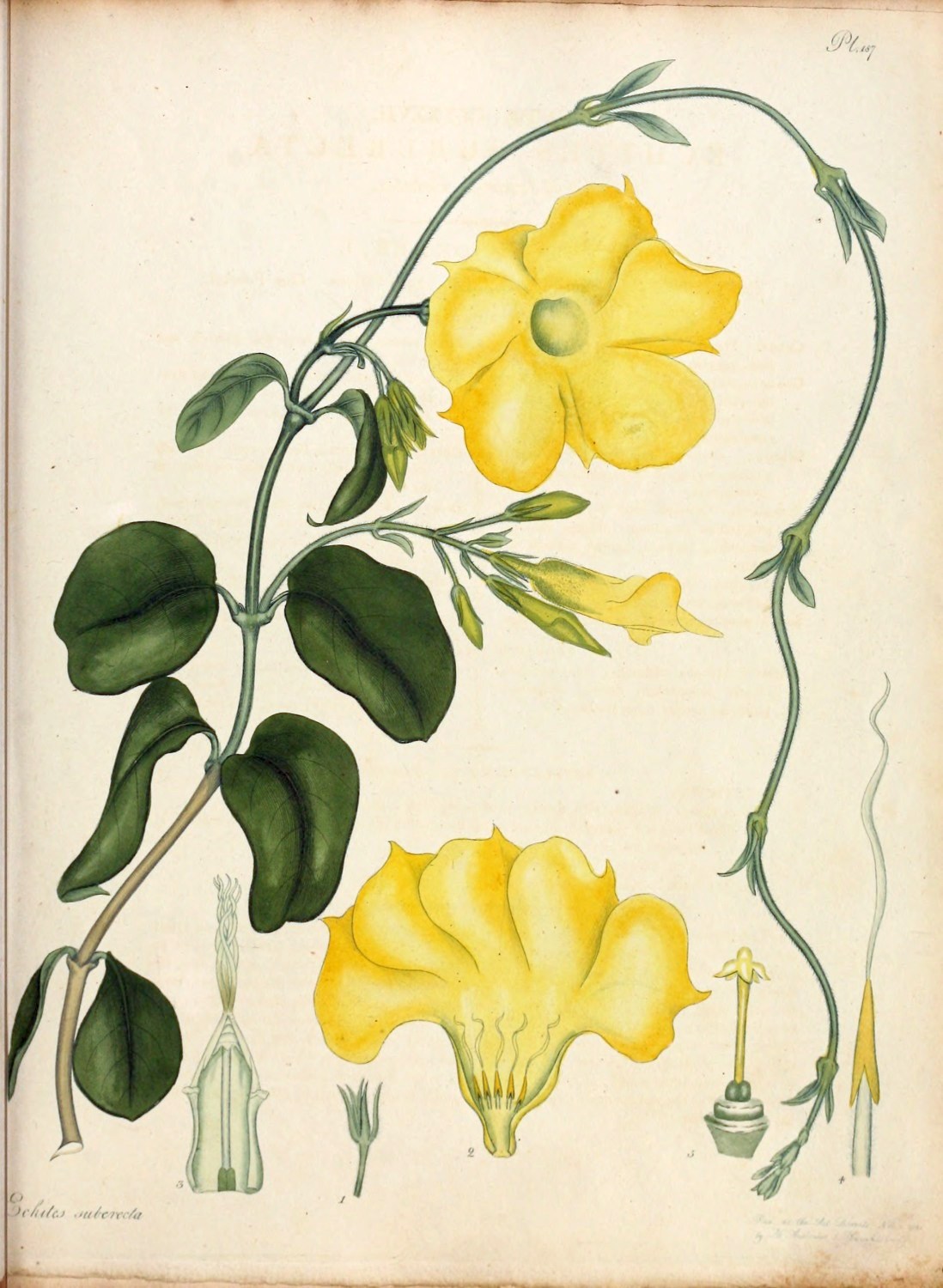
Volume 3 — PLATE CLXXXVII. ECHITES SUBERECTA. Oval-leaved Echites.
Reading edition
CLASS V. ORDER I.
PENTANDRIA MONOGYNIA. Five Chives. One Pointal.
GENERIC CHARACTER.
Calyx. Perianthium quinquepartitum, acutum, parvum.
Corolla monopetala, infundibuliformis; limbus quinquefidus, planus, patentissimus.
Nectarium glandulis quinque, germen circumstantibus.
Stamina. Filamenta quinque, tenuia, erecta. Antheræ rigidæ, oblongæ, acuminatæ, apice convergentes.
Pistillum. Germina duo. Stylus filiformis, longitudine staminum. Stigma oblongo-capitatum, bilobum, glutine antheris adnexum.
Pericarpium. Folliculi duo, longissimi, uniloculares, univalves.
Semina plurima, imbricata, coronata pappo longo.
Empalement. Cup five-parted, pointed, and small.
Blossom one-petal, funnel-shaped; border five-cleft, flat and spreading very much.
Honey-cup five glands, standing round the bud.
Chives. Five threads, slender, erect. Tips stiff, oblong, tapered, and closing together at the top.
Pointal. Seed-buds two. Shaft thread-shaped, the length of the chives. Summit oblong-headed, two-lobed, attached to the tips by a glutinous substance.
Seed-vessel. Two follicles, very long, one celled, one valved.
Seeds many tiled, crowned with a long feather.
SPECIFIC CHARACTER.
Echites pedunculis racemosis; foliis ovalibus, obtusis, mucronatis; floribus luteis, amplissimis; corollæ tubus hirsutus.
Echites with bunched foot-stalks; leaves oval, blunt and pointed at the ends; flowers yellow and very large; the tube of the blossom hairy.
REFERENCE TO THE PLATE.
1. The Cup.
2. A Flower cut open, with the chives remaining, but detached from each other.
3. The Chives and Pointal as they are in the flower, the lower part of the blossom remaining, the upper cut away, magnified.
4. One of the Chives a little magnified.
5. The Pointal and Seed-buds, magnified.
The Lady Dowager De Clifford received this plant from the island of St. Vincent’s, in the year 1794; and we much question, whether it was ever seen in Britain prior to that period; although said to be cultivated in 1759, by Millar, in the 7th Edit. of his Dictionary, and from thence, collated into the Kew Catalogue, p. 289, Vol. I. It is a climbing plant, if supported; but does not grow to any considerable height, if kept in a pot. The best method of treating this plant, is the same as that proposed for the Cratæva capparoides, Pl. 176. Vol. III. The specific name Suberecta, of Jacquin and Browne, must undoubtedly have been taken from the plants which grow in the Savannas; where, they seldom acquire above the height of two feet. The whole plant, from which, if any part is cut or broken, there issues a milky substance, is considered by Dr. Browne as poisonous. Our figure was taken at Messrs. Lee and Kennedy’s, this year, in August. It is propagated by cuttings, put in about the month of May.