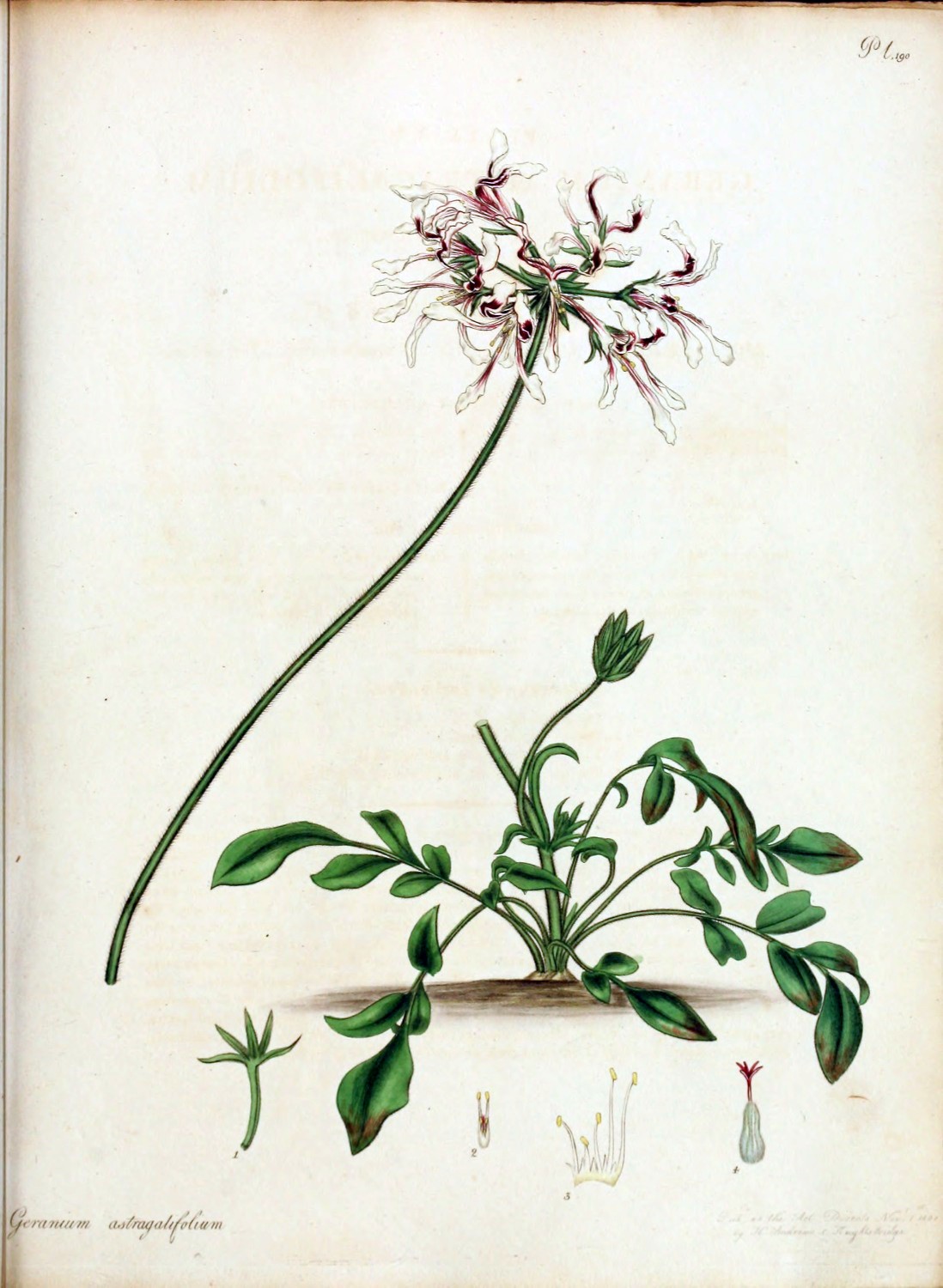
Volume 3 — PLATE CXC. GERANIUM ASTRAGALIFOLIUM. Astragalus-leaved Geranium.
Reading edition
CLASS XVI. ORDER IV.
MONADELPHIA DECANDRIA. Threads united. Ten Chives.
ESSENTIAL GENERIC CHARACTER.
Monogyna. Stigmata quinque.
Fructus rostratus, penta-coccus.
One Pointal. Five Summits.
Fruit furnished with long awns; five dry berries.
See Geranium Grandiflorum, Pl. XII. Vol. I.
SPECIFIC CHARACTER.
Geranium foliis pinnatis, hirsutis, foliolis rotundato-ovatis; calycibus monophyllis; petalis undulatis ad basin tortis; staminibus quinque fertilibus; radice tuberosa.
Geranium with winged, hairy leaves; leaflets of a roundish-oval shape; cups one-leaved; petals waved, twisted at the base; five fertile chives; root tuberous.
REFERENCE TO THE PLATE.
1. The Empalement.
2. The Chives and Pointal.
3. The Chives spread open and magnified.
4. The Seed-bud, Shaft, and Summits, magnified.
By the Kew Catalogue we are informed, that this species of Geranium, was introduced to this country, in the year 1788, by Mr. F. Masson. It is, like many of this branch of the extended family of Geranium, rather a tender Green-house plant; and will not flower, in perfection, without the assistance of the Hot-house. It loses its foliage after flowering, and remains in a state of inaction for at least three months; during which period, it should be watered but seldom, and that sparingly. To propagate it, the only mode is, by cutting small portions of the root off, and putting them into the strong heat of a hot-bed, about the month of March; as hitherto, it has not perfected any seeds with us, and the plant produces no branch, except the flower-stem may be so denominated. Our drawing was made from the Clapham Collection, in July, this year. This species has been considered by Professor Martyn, (see his edition of Mill. Dict. article Pelargonium 2.) as the same with G. pinnatum, and G. prolificum of Linn. Sp. Plan. But, however, the specific characters in Linnæus, of those species, may agree with our figure, the G. Astragalifolium of Jacquin and Cavanilles, they are, unquestionably, all different plants; drawings of the two former we have, and will be given in due course.