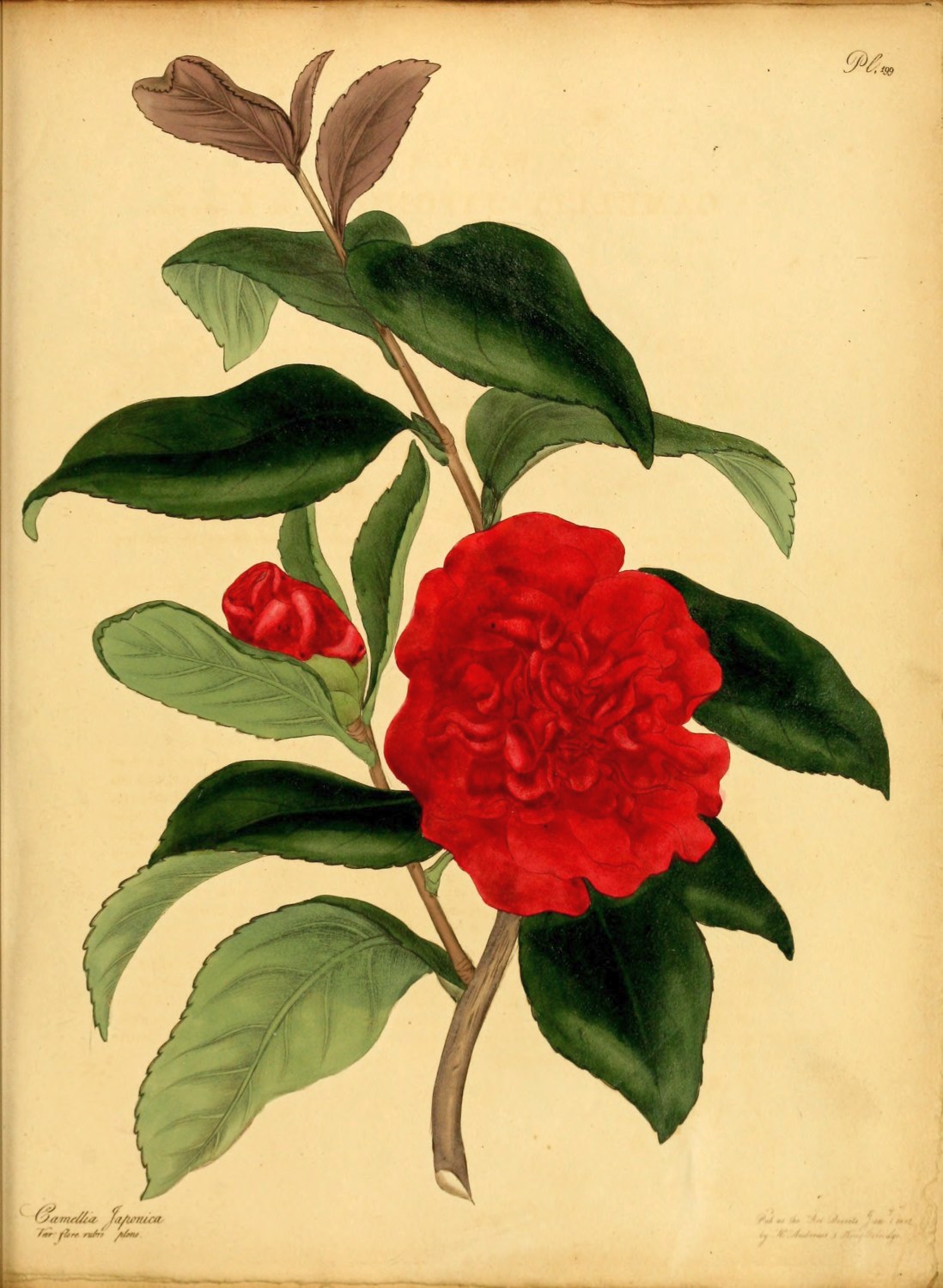
Volume 3 — PLATE CXCIX. CAMELLIA JAPONICA. Var. flo. rubro pleno. Double red Camellia.
Reading edition
CLASS XVI. ORDER VI. of Schreber’s 6th edit. of Gen. Plant.
MONADELPHIA POLYANDRIA. Threads united. Many Chives.
ESSENTIAL GENERIC CHARACTER.
Calyx imbricatus, polyphyllus; foliolis interioribus majoribus.
Empalement tiled, many-leaved; the inner leaflets the largest.
SPECIFIC CHARACTER OF VARIETY.
Camellia foliis senioribus basi attenuatis, junioribus rubentibus; petalis interioribus divaricato-erectis; floribus plenis, rubris.
Camellia with the older leaves tapered at the base, the younger ones reddish; the inner petals stand upright spreading different ways; flowers double and red.
Again have we to call upon the indulgence of our Botanical friends for their sufferance, in a third intrusion on the forms of our own prescription. But, as we had given the two other varieties of this fine plant; and taking it for granted, by judging from our own feelings, that a figure of this very scarce variety would be agreeable to most; that they might be (by comparison) able to decide upon the difference which does exist, but has been denied by many, between this, and the Striped Var.; see our figure, Vol. II. Pl. XCI. It has been thought by most, who have not seen this plant; that it was but the Striped Var. which had lost its variegation. This is certainly not the case; for, it stands as distinct from the Striped, as from the White variety; which may be readily traced, either from the plants themselves, or our figures; by comparing the specific, or rather differing character we have assigned to each. The Double red Camellia was introduced about the year 1794 from China, by R. Preston, Esq. Woodford, Essex.
The largest plant now in Europe, of this variety, is in the select and most valuable collection of the Hon. T. Greville, Esq. Paddington, imported, last year, from China in the highest perfection. It is propagated by cuttings, or layers; and delights in a light, sandy loam; with about one-third of the pot, from the bottom, filled with peat earth. It flowers from November, till February, in the Hothouse; or from January, till April, if kept in the Green-house. Our figure was taken, in November, this year, at the Hammersmith Nursery.