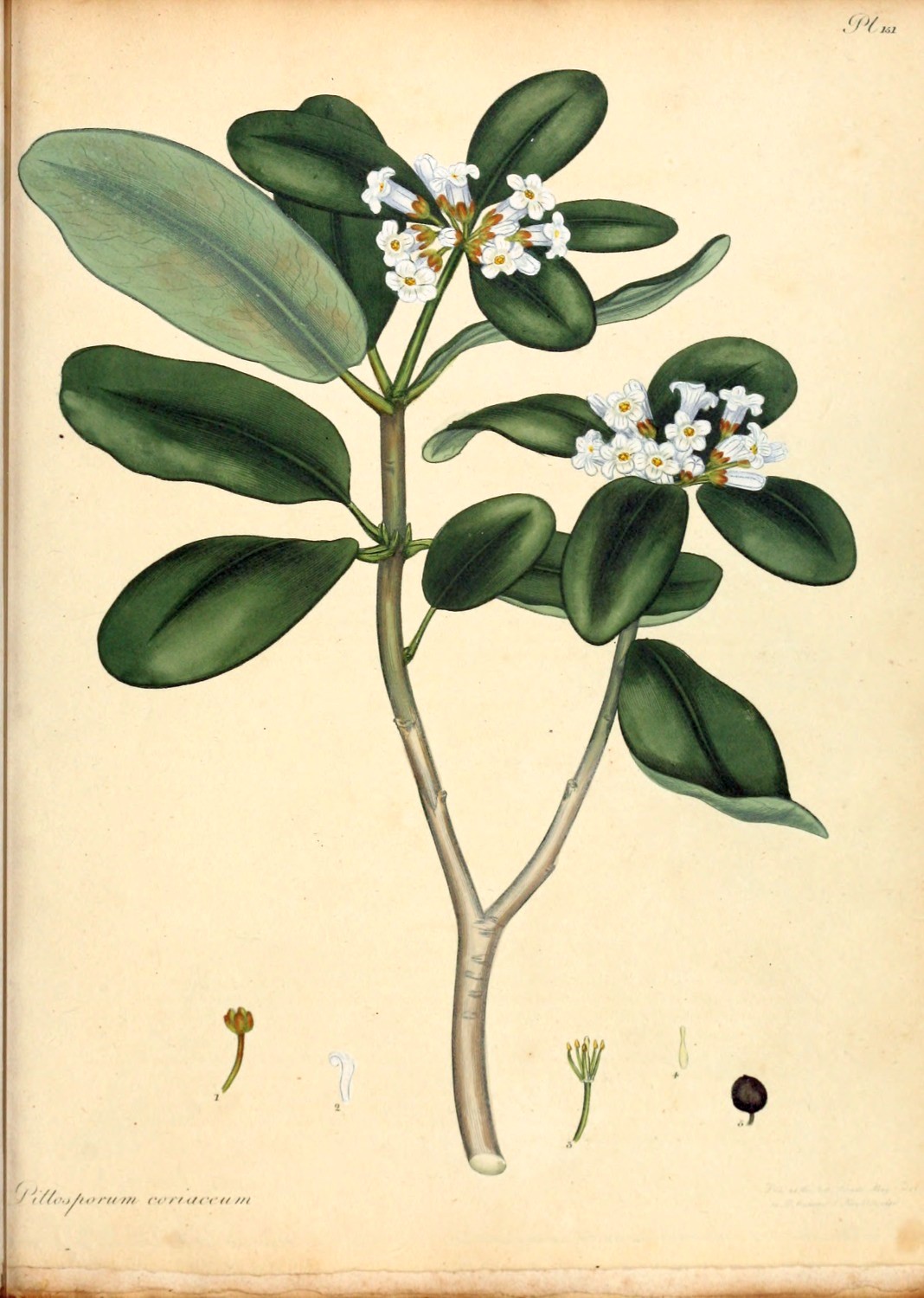
Volume 3 — PLATE CLI. PITTOSPORUM CORIACEUM. Thick-leaved Pittosporum.
Reading edition
CLASS V. ORDER I.
PENTANDRIA MONOGYNIA. Five Chives. One Pointal.
GENERIC CHARACTER.
Calyx. Perianthium pentaphyllum, inserum, deciduum.
Corolla. Petala quinque; ungues concavi, in tubum urceolatum conniventes; laminæ ovato-oblongæ, patentes.
Stamina. Filamenta quinque, subulata, receptaculo inserta. Antheræ sagittatæ, erectæ, filamentis dorso affixæ.
Pistillum. Germen ovatum, superum, compressum. Stylus brevissimus, cylindricus. Stigma capitatum, planum.
Pericarpium. Bacca subglobosa, 2-5 locularis, 2-5 valvis; loculamentis pulpa resinosa scatentibus; dissepimenta valvulis contraria.
Semina, tria seu quatuor, angulata, oblonga, obtusa, ossea.
Empalement. Cup five-leaved, beneath, and falling off.
Blossom. Five petals; claws concave, closing into a tube pitcher-shaped; the borders oblong egg shaped, spreading.
Chives. Threads five, awl-shaped, inserted into the receptacle. Tips arrow shaped, upright, fixed by the back to the threads.
Pointal. Seed-bud egg-shaped, above, flattened. Shaft very short, cylindrical. Summit headed, flat.
Seed vessel. A roundish berry 2-5 cells, 2-5 valves; the cells filled with a resinous pulp; partitions contrary to the valves.
Seeds, three or four, angulated, oblong, obtuse, and bony.
SPECIFIC CHARACTER.
Pittosporum foliis ovalibus, obtusis, glaberrimis, coriaceis, integerrimis.
Pittosporum with oval leaves, blunt ended, very smooth, leathery, and quite entire.
REFERENCE TO THE PLATE.
1. The Empalement.
2. A Petal of the Blossom.
3. The Chives and Pointal.
4. The Pointal separated from the Chives.
5. A Berry of the size when ripe.
About the year 1763, this plant was first raised in Britain, from seeds which had been received from the Island of Madeira, by Messrs. Lee and Kennedy, Hammersmith. It forms one of the most decorative and conspicuous plants, either in the Conservatory, or Green-house; and if encouraged in its growth, by being planted in the border of the one; or kept in rich earth, in a large pot in the other, will attain the height of from 6 to 8 feet. The finest specimen we believe, in England, of this plant is to be found in the elegant Conservatory of the Right Honourable Lord R. Spencer, Woolbedding, Sussex. The flowers, which grow in clusters from the ends of the branches in May, have the flavour of Jasmine; but are rather transitory. It is propagated but slowly and with difficulty, as it does not perfect its seeds with us, and it is not to be increased by laying: the only method is cuttings, which should be taken whilst very young and tender from the plant, about April, and put from 6 to 8 in a pot, fixed very tight, in stiffish loam; they must remain under a hand-glass on a shady border till Autumn, when they may be removed into the hot-house and plunged into the bark bed, where they will begin to grow the ensuing spring.