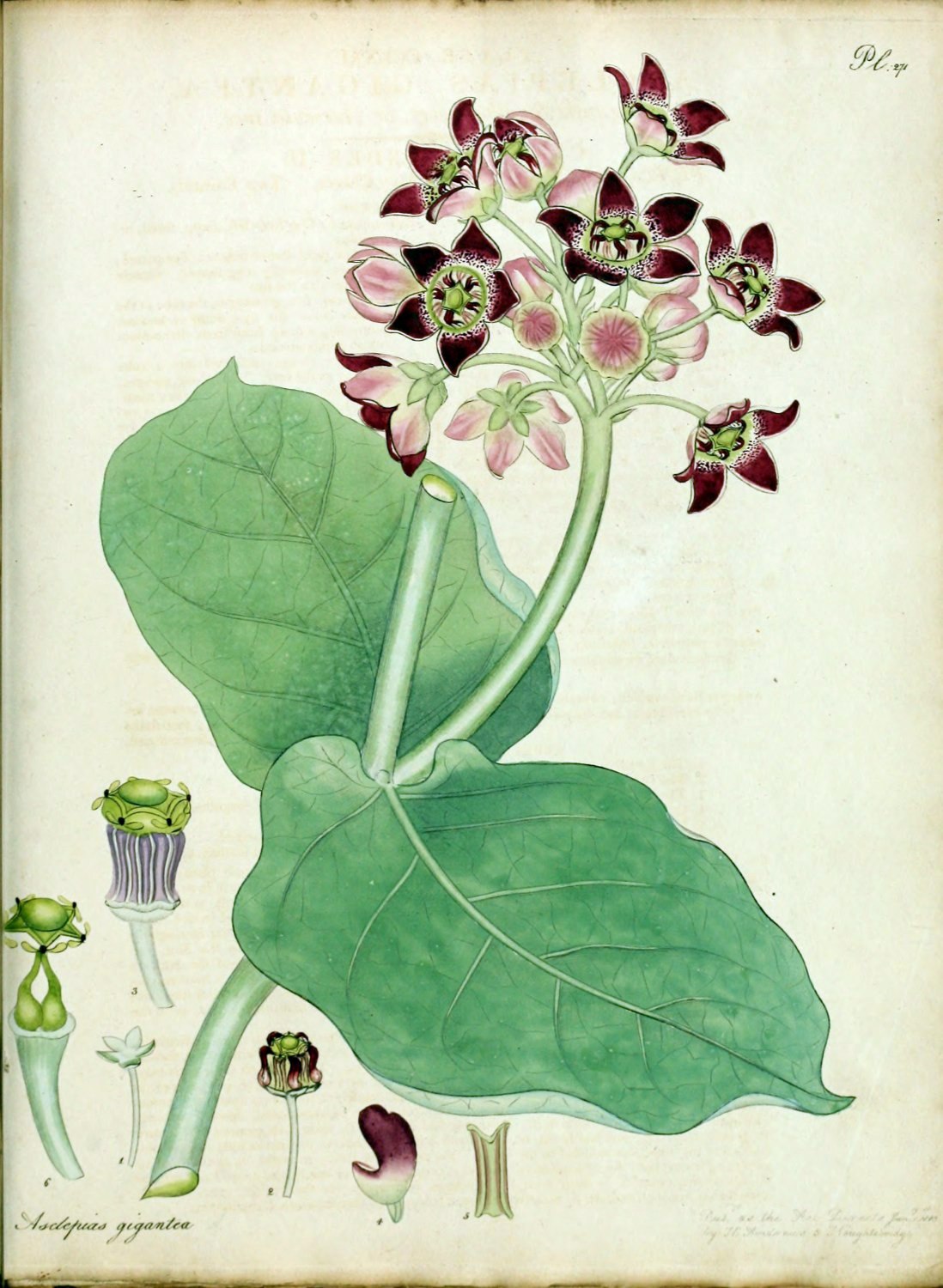
Volume 4 — PLATE CCLXXI. ASCLEPIAS GIGANTEA. Gigantic Swallow-wort, or Auricula tree.
Reading edition
CLASS V. ORDER II.
PENTANDRIA DIGYNIA. Five Chives. Two Pointals.
GENERIC CHARACTER.
Calyx. Perianthium quinquefidum, acutum, parvum, persistens.
Corolla. Monopetala, plana vel reflexa, quinquepartita, laciniis ovato-acuminatis, levitèr cum sole flexis.
Nectaria quinque, tubo filamentorum infra antheras adnata, carnosa seu cucullata, e fundo corniculum acutum introrsum flexum exserentia.
Stamina. Filamenta quinque, in tubum, basi ventricosum, connata. Antheræ oblongæ, erectæ, biloculares, membrana inflexa, stigmati incumbente terminatæ, utrinque ala reversa deorsum latescente. Pollen connatus in corpuscula decem, obverse-lanceolata, plana, in loculis antheræ dependentia e filis brevibus, sæpe flexuosis; quæ per paria annexa sunt tuberculis quinque, cartilagineis, didymis, angulis stigmatis, inter antheras, adhærentibus.
Pistilla. Germina duo, oblonga, acuminata. Styli duo, subulati. Stigma utrisque commune, magnum, crassum, pentagonum, supra apicibus antherarum tectum, medio umbilicatum.
Pericarpium. Folliculi duo, magni, oblongi, acuminati, ventricosi, uniloculares, univalves.
Semina numerosa, imbricata, pappo coronata. Receptaculum membranaceum, liberum.
Empalement. Cup five-cleft, sharp, small, remaining.
Blossom one petal flat or reflexed, five-parted; divisions pointedly egg-shaped, slightly bending with the sun.
Honey-cups five, growing to the tube of the threads below the tips, fleshy or hooded, protruding a sharp horn from the bottom which bends inwards.
Chives. Five threads collected into a tube swelling at the base. Tips oblong, upright, two-celled, terminated by an inflex membrane laying on the summit, having a reversed wing on each side, growing broader downwards. The pollen is collected into ten small bodies inversely lance-shaped, flat, hanging down into the cells of the tips by short threads, often flexible, which are fixed by pairs to five skinny twin tubercules, adhering to the angles of the summit, between the tips.
Pointals. Seed-buds two, oblong, tapered. Shafts two, awl-shaped. Summit common to both, large, thick, five-cornered, covered at top by the ends of the tips, umbilicate in the middle.
Seed-vessel. Two pods, large, oblong, tapered, bellied, one celled, one valved.
Seeds numerous, tiled, crowned with a feather. Receptacle skinny, free.
SPECIFIC CHARACTER.
Asclepias foliis candidis, obovato-oblongis; petiolis brevissimis; laciniis corollæ reflexis.
Swallow-wort with whitened leaves, between inversely egg-shaped and oblong; foot-stalks very short; segments of the blossom reflexed.
REFERENCE TO THE PLATE.
1. The Empalement.
2. The Chives and Pointal, natural size.
3. The Chives and Pointal, without the five outer scales or honey-cups, magnified.
4. One of the outer scales, magnified.
5. One of the inner, upright scales, which surround the seed-buds, magnified.
6. The Seed-buds, Shafts and Summit, with the chives attached to the summit, magnified.
The Gigantic Swallow-wort, a native of the East Indies, is a very tender hot-house plant; is very subject to lose its leaves in winter, and requires the assistance of the bark-bed to keep it in perfection. In the Kew Catalogue, it is said to have been cultivated so long ago as the year 1690, at the Royal Gardens, Hampton Court. To render it vigorous and flourishing, it should be planted in rich earth; composed of, one half rotten dung, and the other leaf mould and loam; and watered but sparingly in winter. It is seldom propagated but from seeds, which are frequently procured from the East, and as often from the West Indies. In the island of Jamaica, it is known by the name of the Auricula tree, where it attains to the height of six or seven feet. Our drawing was taken from a most magnificent specimen, obligingly sent us by Mrs. Methuen, (of which our figure represents but a small side bunch), measuring above a foot in diameter. The plant, we believe the finest in England, is in the collection of Paul Methuen, Esq. Corsham, Wilts.
Much as we are inclined to tread in the beaten path of our predecessors, and, more particularly, that of the greatest luminary of this intricate science, Linnæus, yet can we, but with regret, forbear an alteration we think so necessary, in the classification of this genus. That the class Gynandria may, or ought to be excluded from the twenty-four, we shall not be forward to give our suffrage, in conjunction with some modern reformers; and, as they term themselves, improvers upon the Linnæan system; but, whilst it is retained, this genus has stronger claims, in our opinion, upon it, than any which has hitherto been thrown to it. Indeed we had so classed it, upon such grounds had formed its generic character; and had hopes, no one would have disputed our position as just, upon an inspection of the dissections annexed to the figure. Yet fearing, by some, it might be considered as a perplexing innovation; for innovation in all cases is certainly more or less so, the genus having passed the scrutinising ordeal of so many botanists; we have, reluctantly, for the present, given up what, nevertheless, we shall consider as necessary for some bolder hand than ourselves to undertake.