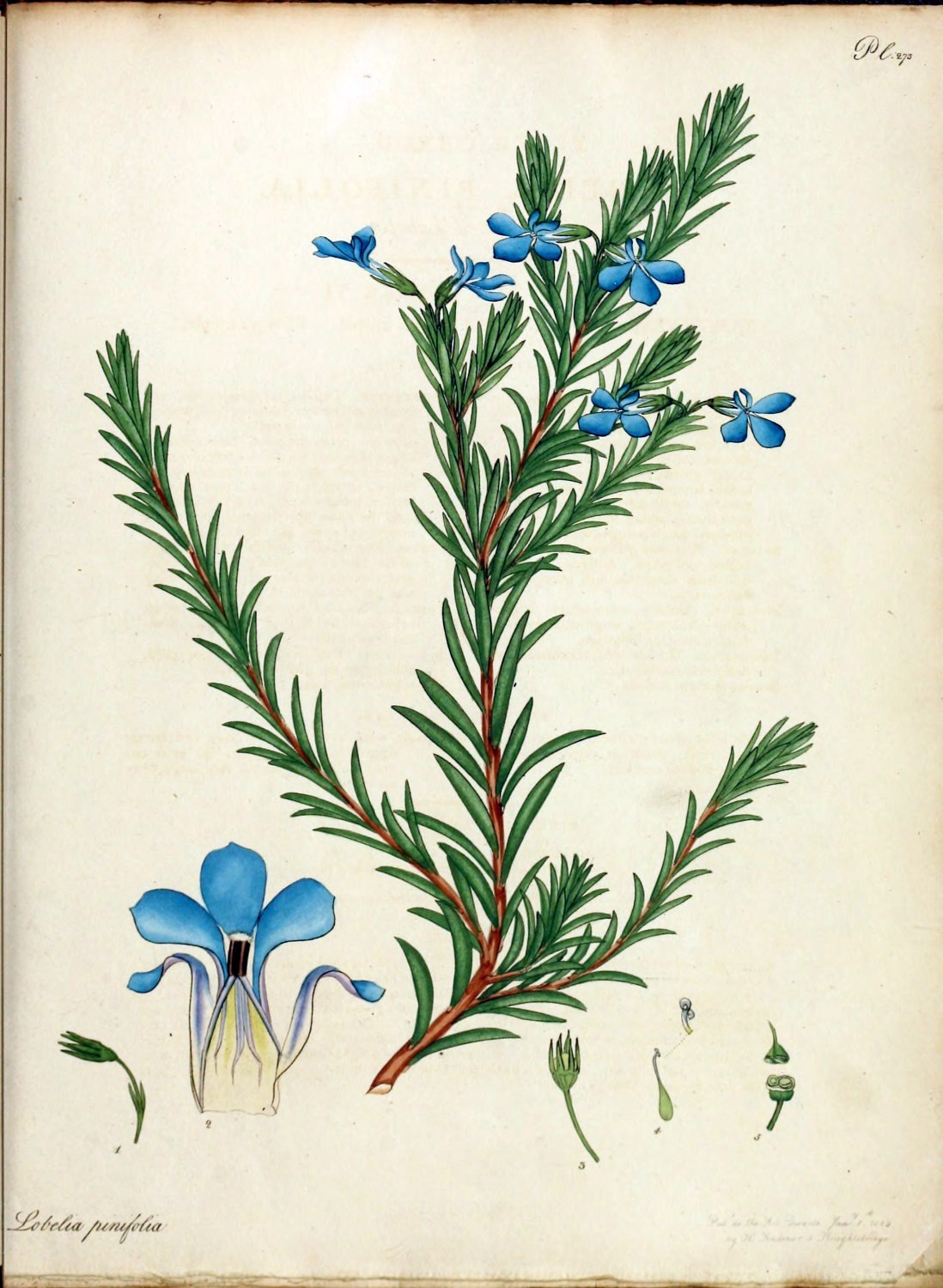
Volume 4 — PLATE CCLXXIII. LOBELIA PINIFOLIA. Pine-leaved Lobelia.
Reading edition
CLASS XIX. ORDER VI.
SYNGENESIA MONOGAMIA. Tips united. Flowers simple.
GENERIC CHARACTER.
Calyx. Perianthium monophyllum, quinquedentatum, minimum, germini circumnatum, marcescens; denticulis subæqualibus.
Corolla monopetala, irregularis; tubus cylindraceus, calyce longior, superne longitudinaliter divisus; limbus quinquepartitus; laciniis lanceolatis, quarum superiores dure minores, magis reflexæ, profundius divisæ, constituentis labium superius; tres reliquæ inferiores magis patentes, sæpius majores.
Stamina. Filamenta quinque, subulata, longitudine tubi petali. Antheræ connatæ in cylindrum oblongum, basi quinquefariam dehiscentem.
Pistillum. Germen acuminatum, inferum. Stylus cylindraceus, longitudine staminum. Stigma obtusum, hispidum.
Pericarpium. Capsula ovata, biloculariis, apice dehiscens, cincta calyce.
Semina plurima, minima.
Empalement. Cup one leaf, five-toothed, very small, growing round the seed-bud, withering; toothlets nearly equal.
Blossom one petal, irregular; tube cylindric longer than the cup, divided longitudinally above; border five-parted; segments lance-shaped, of which the two upper ones are smaller, more reflexed, deeper divided and form the upper lip; the three other lower ones spread more, and often are larger.
Chives. Five threads, awl shaped, the length of the tube of the petal. Tips joined together forming an oblong cylinder, splitting into five divisions at the base.
Pointal. Seed-bud tapered, beneath. Shaft cylindrical the length of the chives. Summit blunt, hairy.
Seed-vessel. Capsule egg-shaped, two celled, splitting at top, girt by the cup.
Seeds numerous, small.
SPECIFIC CHARACTER.
Lobelia foliis lanceolato-linearibus, confertis, integerrimis; denticulis calycinis longissimis; floribus cæruleis.
Lobelia with leaves between lance and linear-shaped, crowded together, and quite entire; toothlets of the cup very long; flowers blue.
REFERENCE TO THE PLATE.
1. The Empalement.
2. A Blossom spread open, with the chives in their place.
3. A half ripe seed-pod.
4. The Pointal, with the summit detached and magnified.
5. A ripe seed-vessel, cut transversely.
About the year 1786, this plant was sent by Mr. F. Masson, to the royal gardens at Kew; as we find it in the catalogue of that collection. Nevertheless a single plant of it was not to be found in any of our botanic gardens, for these few years back; until the recent introduction of it, by Mr. Niven, to the Hibbertian Collection in 1789. It is a very delicate shrub; grows to the height of eighteen inches; branching but little, and producing mostly two flowers at the termination of each branch. It may be increased by cuttings, or from the seed, which ripens in this country; but, like most of the species of this genus, it is not a long lived plant. It approves most of a light sandy peat, with a small mixture of loam; and to be kept in rather a small pot, in proportion to the general size used for plants of the same bigness. Flowers in July.