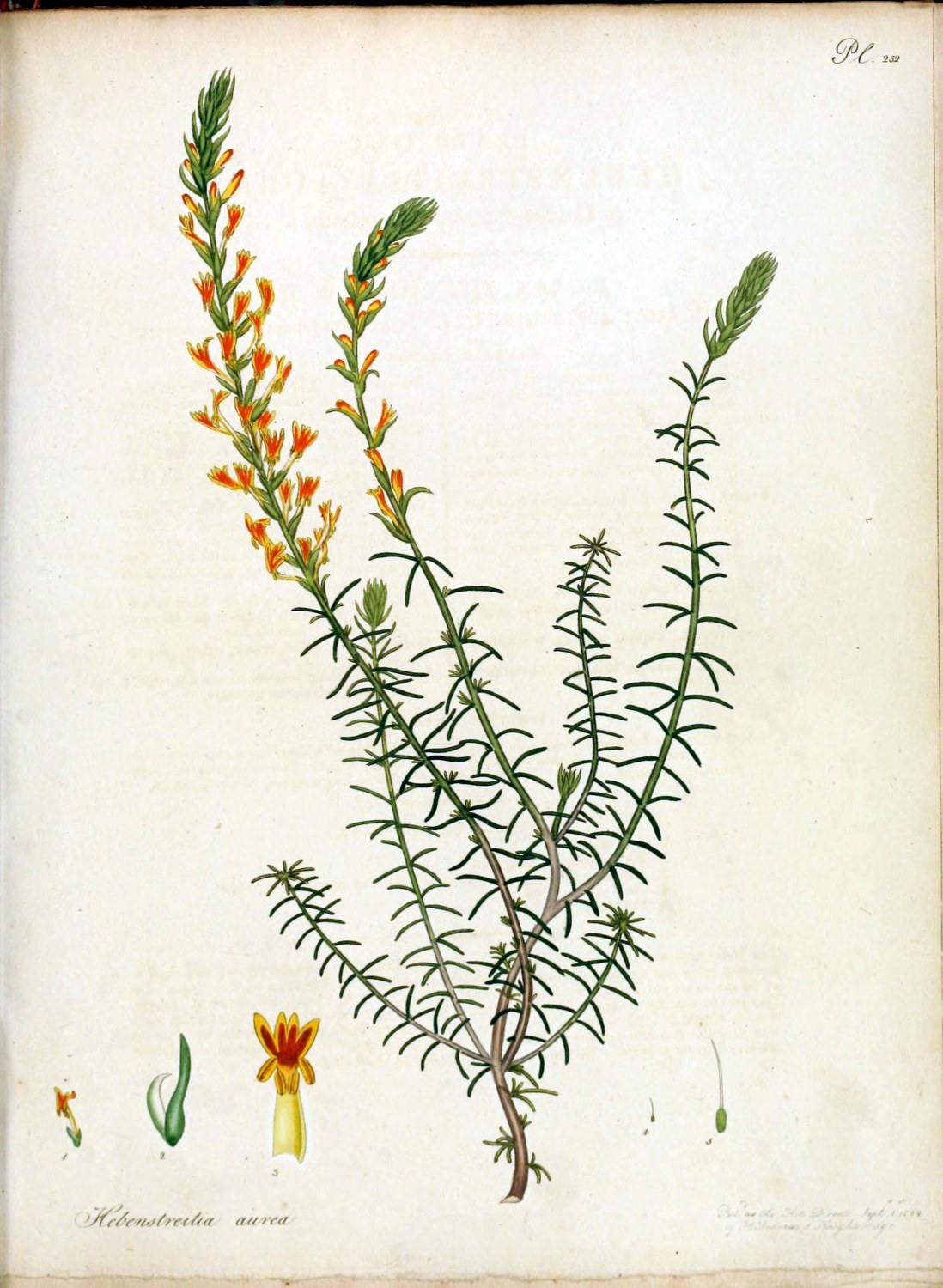
Volume 4 — PLATE CCLII. HEBENSTREITIA AUREA. Golden-flowered Hebenstreitia.
Reading edition
CLASS XIV. ORDER II.
DIDYNAMIA ANGIOSPERMIA. Two Chives longer. Seeds covered.
GENERIC CHARACTER.
Calyx. Perianthium monophyllum, tubulosum, membranaceum, emarginatum, subtus longitudinaliter dehiscens.
Corolla monopetala, unilabiata; tubus cylindricus, calyce longior, latere inferiore ad dimidium dehiscens; limbus unilabiatus, adscendens, planiusculus, quadrifidus, subæqualis.
Stamina. Filamenta quatuor, horum duo priora sub fauce margini corollæ inserta, extantia; duo seriora, interiora, inferiora, reflexa ad latera. Antheræ lunares, compressæ, extrorsum truncatæ.
Pistillum. Germen minimum. Stylus filiformis, per fissuram corollas reflexus. Stigma simplex.
Pericarpium. Capsula oblonga, unilocularis, bivalvis.
Semina duo, oblonga, hinc convexa, trisulca, inde plana.
Empalement. Cup one-leafed, tubular, membranaceous, notched at the end, splitting lengthways from beneath.
Blossom one-petalled, one-lipped; tube cylindric, longer than the cup, splitting from the lower side half way; border one-lipped, ascending, flattish, four-cleft, the clefts nearly equal.
Chives. Threads four, of which the upper pair is inserted into the edge of the blossom under the throat, standing out; the lower anterior pair is bent back to the sides. Tips crescent-shaped, flattish, appearing cut off on the outside.
Pointal. Seed-bud very small. Shaft thread-shaped, bent back through the fissure of the blossom. Summit simple.
Seed-vessel. Capsule oblong, one-celled, two-valved.
Seeds two, oblong, convex on one side, three-furrowed and flat on the other.
SPECIFIC CHARACTER.
Hebenstreitia foliis linearibus, integris, sub-teretibus, obtusis, glabris; floribus congestis, racemosis, aurantiis.
Hebenstreitia with linear leaves entire, roundish, blunt, smooth; flowers grow crowded together in long bunches, of a gold colour.
REFERENCE TO THE PLATE.
1. A flower.
2. The Empalement magnified.
3. A Blossom cut open with the chives remaining attached, magnified.
4. The Pointal natural size.
5. The same, magnified.
The Hebenstreitias may all be reckoned as rather biennial plants than perennial shrubs; they must be increased every year to keep up a succession, which is a matter of no difficulty; as, if cuttings of any of the species are put into separate small pots, and kept from the air by a hand-glass, for about a month, they will become flowering plants by September, if the cuttings are made in May. Our present plant was introduced in 1796 by Messrs. Lee and Kennedy, Hammersmith, at whose nursery the drawing was made this year in the month of March. They mostly flower in spring, and autumn; the flowers are very fragrant at night. They are natives of the Cape of Good Hope.