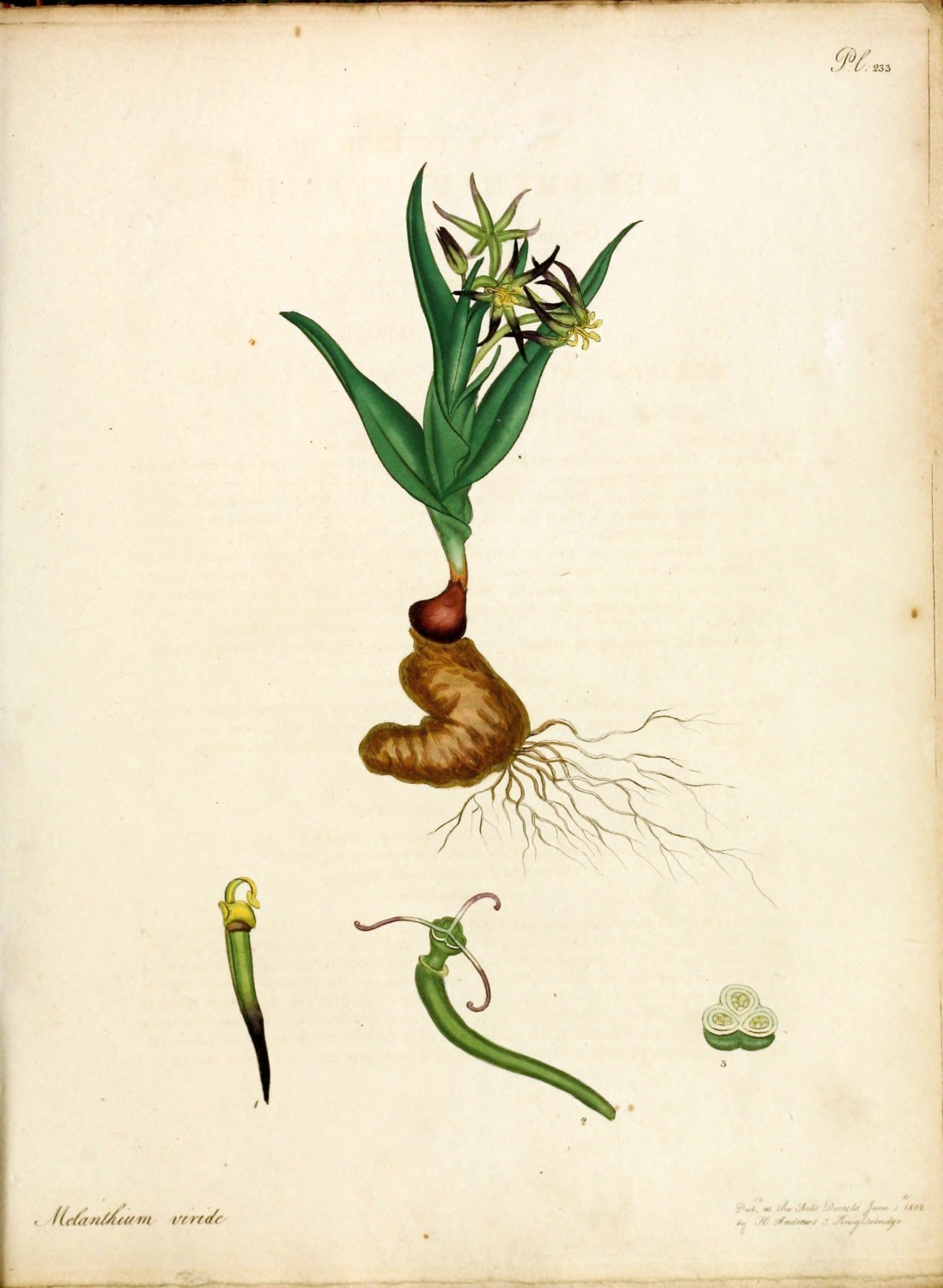
Volume 4 — PLATE CCXXXIII. MELANTHIUM VIRIDE. Green-flowered Melanthium.
Reading edition
CLASS VI. ORDER I.
HEXANDRIA MONOGYNIA. Six Chives. One Pointal.
GENERIC CHARACTER.
Calyx nullus.
Corolla. Petala sex, ovato-oblonga, patentia, unguibus linearibus longioribus, persistentia.
Stamina. Filamenta sex, filiformia, erecta, longitudine corollæ, cui inserta supra ungues. Antheræ globosæ.
Pistilla. Germen conicum, striatum. Styli tres, distincti, curvi. Stigmata obtusa.
Pericarpium. Capsula ovata, trigona, trisulca, trilocularis, ex capsulis tribus introrsum unitis.
Semina plurima, compressa, semiovata.
Empalement, none.
Blossom. Six petals, oblong egg-shaped, spreading, with linear longer claws remaining.
Chives. Threads six, thread-shaped, upright, the length of the blossom into which they are inserted above the claws. Tips globular.
Pointals. Seed-bud conical, streaked. Shafts three, distinct, curved. Summits blunt.
Seed-vessel. Capsule egg-shaped, three-sided, three furrowed, three-celled, formed of three capsules united within.
Seeds numerous, flattened, half egg-shaped.
SPECIFIC CHARACTER.
Melanthium foliis ovato lanceolatis, scapo vaginantibus, erectis; corollis viridi-purpureis, reflexis.
Melanthium with leaves between lance and egg-shaped, sheathing the stem and upright; blossoms greenish-purple, reflexed.
REFERENCE TO THE PLATE.
1. A Petal with its Chive attached, magnified.
2. The Seed-bud, Shaft, and Summits, magnified.
3. The Seed-bud cut transversely, magnified.
The Green-flowered Melanthium was introduced to the Kew collection, by Mr. F. Masson, in the year 1788, as we are informed by the catalogue of that garden, from the Cape of Good Hope. The plant from which our figure was taken, had been sent to the Clapham collection amongst other bulbs which were received from Mr. Niven in the year 1800; it flowered the succeeding year, when our drawing was made. We believe, at present, it is in no other collection than that of Mr. Hibbert; nor do we think, without a fresh supply, it will be long seen in this country, as it has been often introduced, and as often lost; nor does it increase with us by the root, and the seeds have not, as yet, matured in this country; it appears to grow luxuriantly in sandy peat earth, and flowers in July.