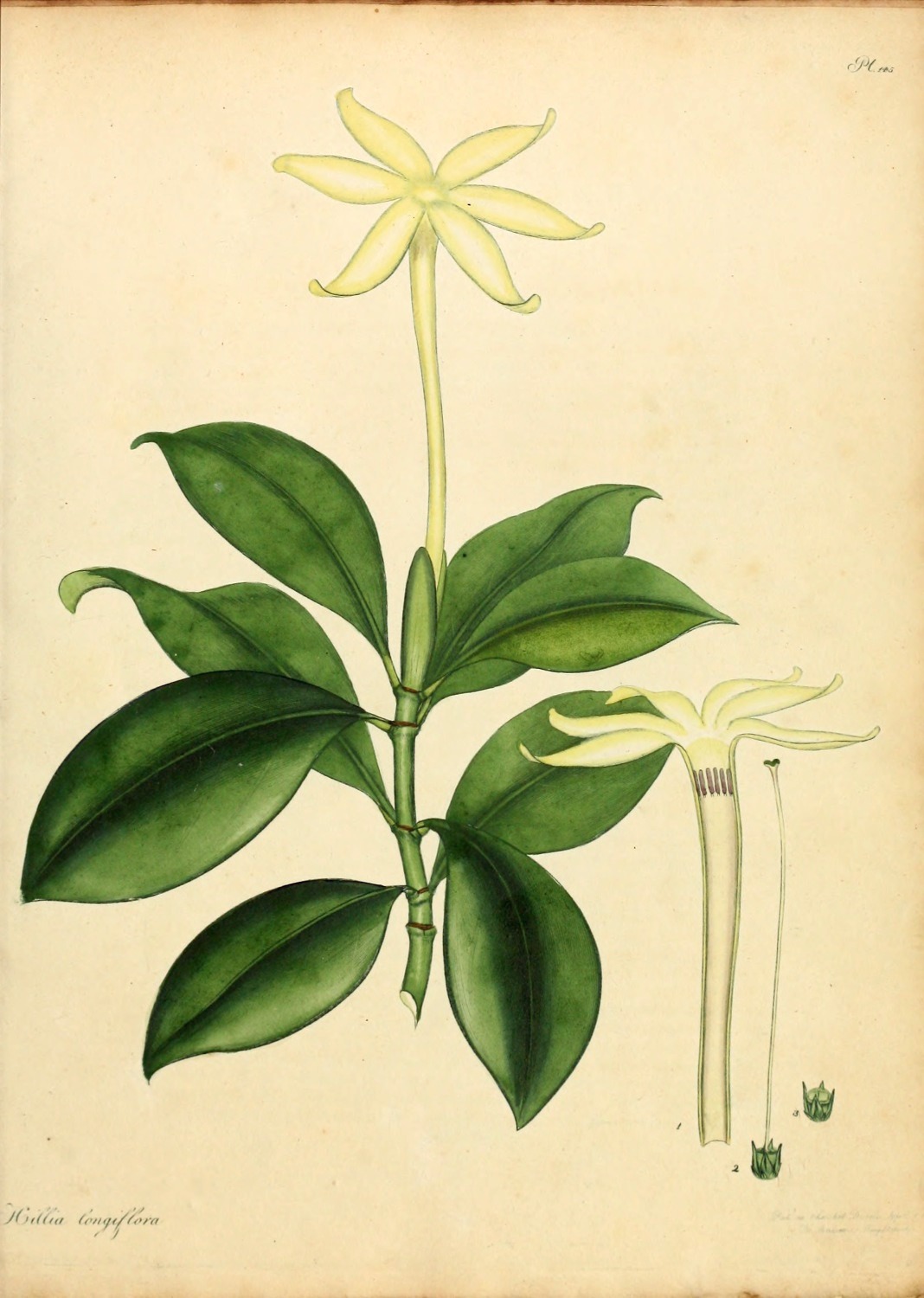
Volume 3 — PLATE CXLV. HILLIA LONGIFLORA. Long-Flowered Hillia.
Reading edition
CLASS VI. ORDER I.
HEXANDRIA MONOGYNIA. Six Chives. One Pointal.
GENERIC CHARACTER.
Calyx. Perianthium hexaphyllum; foliolis oblongis, acutis, erectis.
Corolla monopetala; tubus cylindricus, longissimus; limbus sexfidus; laciniis oblongis, planis.
Stamina. Filamenta sex, brevissima. Antheræ oblongæ, erectæ, intra faucem corollæ.
Pistillum. Germen inferum, oblongum, obsolete hexagonum. Stylus filiformis, longitudine tubi. Stigma capitatum.
Pericarpium oblongum, compressum, biloculare.
Semina numerosa, minima.
Empalement. Cup six-leaved; leaflets oblong, sharp pointed and upright.
Blossom one petal, tube cylindrical, very long; border six-cleft; segments oblong, flat.
Chives. Threads six very short. Tips oblong, upright, within the mouth of the blossom.
Pointal. Seed-bud beneath oblong, slightly six-sided. Shaft thread-shaped, the length of the tube. Summit headed.
Seed-vessel oblong, flattened and two celled.
Seeds many, very small.
SPECIFIC CHARACTER.
Hillia corollis sexfidis, laciniis lanceolatis, supra convexis; foliis ovatis, acutis, glabris.
Hillia with blossoms six cleft, segments lance-shaped, convex above; leaves egg-shaped, pointed and smooth.
REFERENCE TO THE PLATE.
1. A flower cut open, to expose the number and situation of the Chives.
2. The Shaft and its summit, natural size, placed by the flower, to shew its proportional length to the tube.
3. The Seed-bud, with the leaflets of the Empalement attached, cut transversely, to shew the division of the cells in the center.
This species of Hillia was first introduced to our gardens in the year 1789, from the Island of Barbadoes, sent in plants, by Mr. J. Elcock, to Messrs. Lee and Kennedy, Hammersmith. Originally this shrub was specifically termed, parasitica by professor Jacquin, when he first formed, and titled the Genus, after Dr. J. Hill, of voluminous memory; from a supposition that it was to be found growing, only, upon some other plant; a circumstance, which being denied by Swartz, he has altered it to longiflora. We have followed the latter name that ours may go in unison with the author of the last Species plantarum now publishing by Willdenow, as well as professor Martyn, who in his edition of Miller’s Dictionary has followed Swartz; they appearing to be the most accurate, as well as the most read and followed of any modern Botanical authorities. It is a tender hot-house plant, strikes easily from cuttings, thrives in rich mould and flowers about the end of February. To the Right Hon. Lord Viscount Valentia we are indebted, for the specimen from which our figure was taken, sent from his Lordship’s famed collection at Arley near Bewdley, Staffordshire; where, we believe, it has flowered for the first time in England.