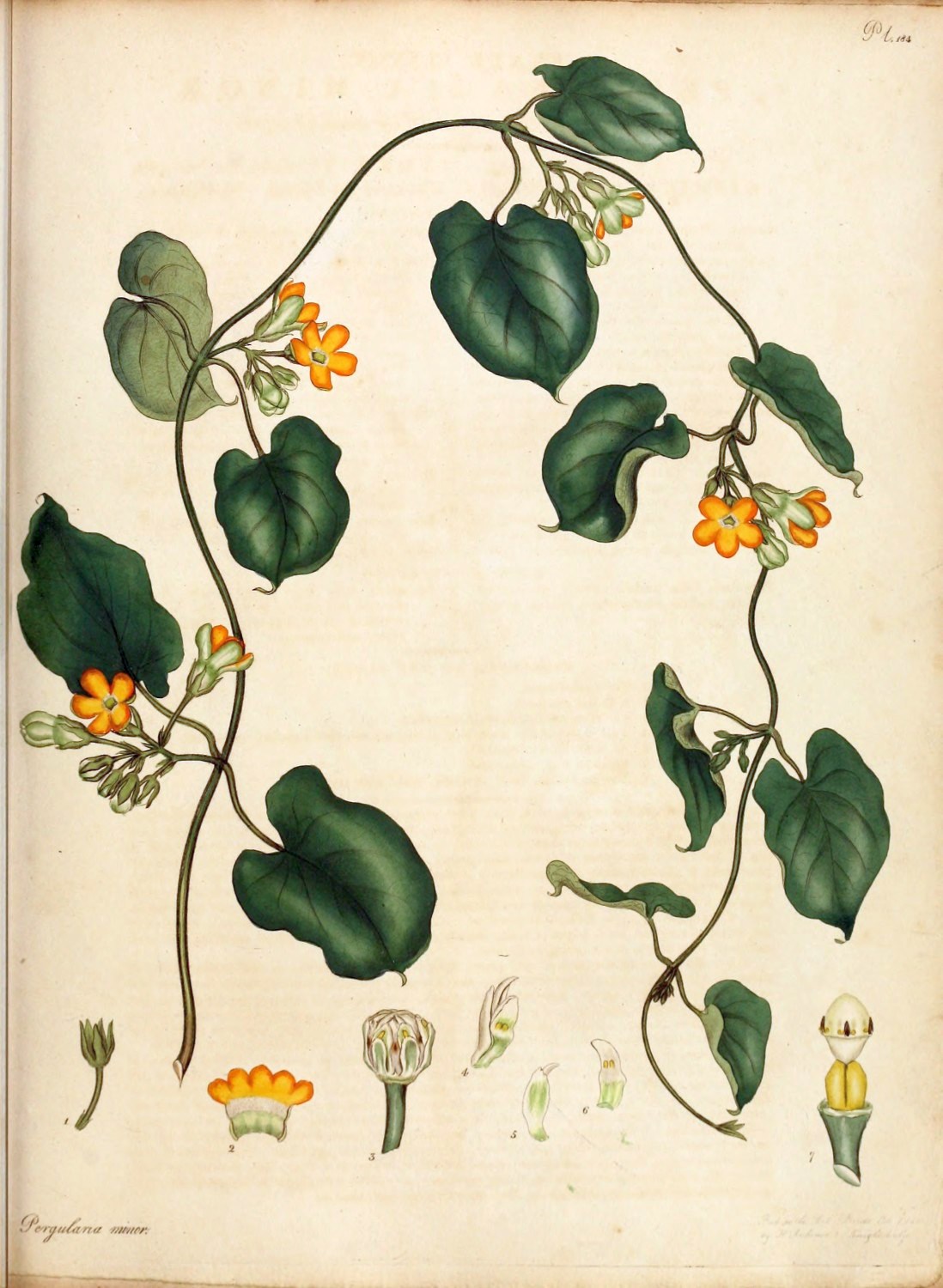
Volume 3 — PLATE CLXXXIV. PERGULARIA MINOR. Smaller Pergularia, or West-coast Creeper.
Reading edition
CLASS XX. ORDER VI. of Linn. Gen. Plan. 1764.
GYNANDRIA DECANDRIA. Chives on the Pointal. Ten Chives.
GENERIC CHARACTER.
Calyx. Perianthium monophyllum, quinquefidum, erectum, acutum, persistens.
Corolla monopetala, hypocrateriformis; tubus cylindricus, calyce longior; limbus quinquepartitus, planus; laciniis oblongis.
Nectarium, duplex; exterium quinquefidum, quinquedentatum, plicato-angulatum, dentibus acutis, incurvis, apice corniculis nutantibus, approximatis; interium quinquefidum, exteriori basi adnatum, squamulæ membranaceæ, apice denticulatæ, obtusæ, singula involvens stamina duo, alterna.
Stamina. Filamenta decem, capillaria, brevia, divaricata, per paria adnexa glandulis quinque stigmati affixis. Antheræ pellucidæ, luteæ, subrotundæ.
Pistillum. Germina duo oblonga. Stylus brevissimus, carnosus. Stigma corpusculum conicum, obtusum, carnosum.
Pericarpium. Folliculi duo, uniloculares, introrsum dehiscentes per longitudinem.
Semina numerosa, parva, subrotunda.
Empalement. Cup one leaf, five-cleft, upright, pointed and remaining.
Blossom one petal, salver-shaped; tube cylindrical, longer than the cup; border five-divided, flat, segments oblong.
Honey-cup, double; the outer, five-cleft, five-toothed, plaited into angles, with the teeth pointed, incurved, approaching at the point by small nodding horns; the inner five-cleft, growing to the base of the outer, scales skinny, toothed at the end, blunt, each covering two opposite chives.
Chives. Threads ten, hair-like, short, straddling, connected by pairs to five glands fixed to the summit. Tips transparent, yellow, roundish.
Pointal. Seed-buds two, oblong. Shaft very short, fleshy. Summit a conical, obtuse, fleshy substance.
Seed-vessel. Two follicles, one-valved, splitting lengthways from the inside.
Seeds numerous, small, roundish.
SPECIFIC CHARACTER.
Pergularia foliis cordatis, acutis, apicibus tortis; laciniis corollæ ovatis, erectis, luteis.
Pergularia with heart shaped leaves, sharp-pointed and twisted at the ends; the segments of the blossom are egg-shaped, upright, and yellow.
REFERENCE TO THE PLATE.
1. The Empalement.
2. A flower cut open.
3. The parts of fructification magnified.
4. Two Scales of the honey-cup as they are attached together, magnified.
5. An outer Scale magnified.
6. An inner Scale magnified.
7. The Seed-buds, Shaft, Summit, and Chives magnified.
That a just judgment may be formed, upon what grounds we have taken up a specific distinction, between the only two species we possess of this genus; so dissimilar in our opinion, but, which have been considered as scarcely to be deemed varieties, by much abler botanists than ourselves profess to be; we have given the figures of both in consequence. Much is it to be regretted, that the whole natural order of plants forming the Apocineæ of Jussieu, so charactered in themselves, have not undergone a proper revision, in classification, upon the original Linnæan sexual principles; which, we must suppose, have been left in the present bewildered chaos, from the intricacy, singularity and minuteness of the parts, being so difficult to develope. From critical and actual observations, taken from the living plants, we are in hopes of being able to illustrate, and correct where necessary, the characters of such as may come under our review.
Upon the changing the class of this genus, there needs no comment; as most authors seem to allow, though they have not followed the hint, that it is properly Gynandrous; although they have not equally agreed as to the Order; some taking the glands, surrounding the summit, for the chives, and some, for the summits themselves, of a columnar shaft. Dr. Smith, who has figured our other species, has justly taken, the parts fixed to the five glands, for what they certainly are; as may be easily traced through the whole order of Orchideæ, where the chives are nearly similarly placed and so hooded.
The Genus is by no means new, in name, having been so titled by Linnæus, from the names of Pergulans and Pergulanus of Burman and Rumphius; who derived them from the use made of the plants by the natives, of the western coast of the peninsula of India; where, they are cultivated to form arbors, for the agreeable flavour of their flowers. This species was first introduced about the year 1784, by Sir Joseph Banks, Bart. some time before the other species; wherefore, we have given it the preference. It is propagated by cuttings, and should be treated in the same manner as directed for the Cratæva capparoides of our last Number, to have it flower in perfection. The figures of both species were taken, in August, from two plants in the collection of J. Vere, Esq. Kensington Gore; where, Mr. Anderson (to whom we must beg our sincere acknowledgments for his frequent and ready observations and assistance) informs us, they are treated in such manner.