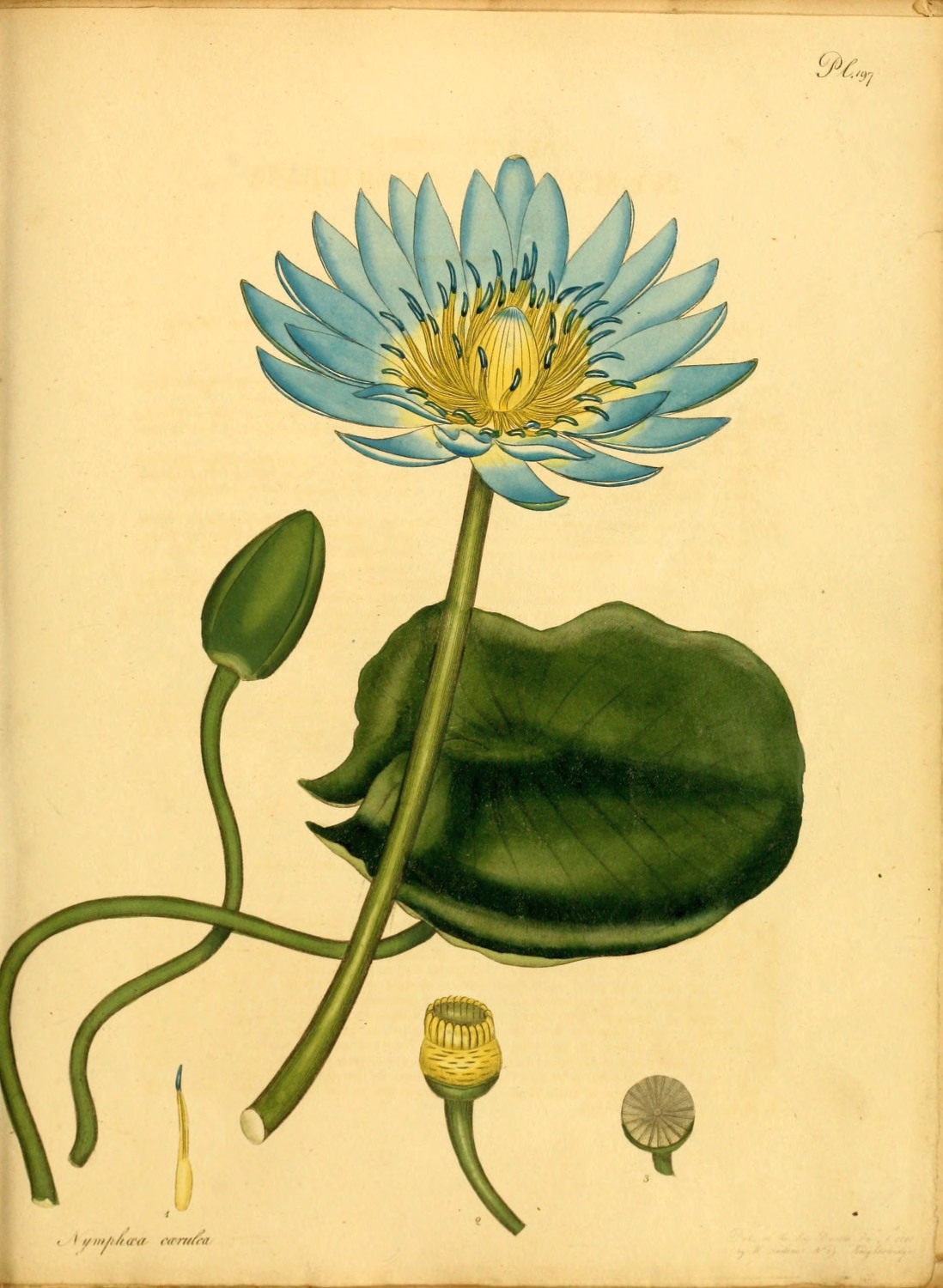
Volume 3 — PLATE CXCVII. NYMPHÆA CŒRULEA. Blue Water-Lily.
Reading edition
CLASS XIII. ORDER I.
POLYANDRIA MONOGYNIA. Many Chives. One Pointal.
GENERIC CHARACTER.
Calyx. Perianthium inferum, tetraphyllum, magnum, supra coloratum, persistens.
Corolla. Petala numerosa (quindecem sæpe,) germinis lateri insidentia, serie plus quam simplici.
Stamina. Filamenta numerosa (septuaginta sæpe,) plana, curva, obtusa, brevia. Antheræ oblongæ, filamentorum margini adnatæ.
Pistillum. Germen ovatum, magnum. Stylus nullus. Stigma orbiculatum, planum, peltato-sessile, radiis notatum, margine crenatum, persistens.
Pericarpium. Bacca dura, ovata, carnosa, rudis, collo angustata apice coronata, multilocularis (decem ad quindecem loculis,) pulpa plena.
Semina plurima, subrotunda.
Empalement. Cup beneath, four leaved, large, coloured above, permanent.
Blossom. Petals numerous (often fifteen,) placed on the side of the seed-bud, in more than one row.
Chives. Threads numerous (often seventy,) flat, curved, blunt, short. Tips oblong, fixed to the margin of the threads.
Pointal. Seed-bud egg-shaped, large. Shaft, none. Summit round, flat, central, sitting, marked in rays, scolloped at the edge, remaining.
Seed-vessel. Berry hard, egg-shaped, fleshy, rough, narrowed at the neck, crowned at the top, many-celled (from ten to fifteen cells,) full of pulp.
Seeds many, roundish.
SPECIFIC CHARACTER.
Nymphæa foliis cordato-orbiculatis, senioribus crenatis, lobis acutis imbricatis, acuminatis; petalis acutis, lanceolatis, cæruleis.
Nymphæa with between heart-shaped and round leaves, the old ones scolloped, lobes sharp, tiled, and tapered; petals sharp, lance-shaped, and blue.
REFERENCE TO THE PLATE.
1. A Chive.
2. The Seed-bud and Summit.
3. The Seed-bud, cut transversely, to shew the number of cells.
Amongst aquatic or water plants, the Nymphæas are undoubtedly the most desirable in cultivation; although, we should agree to the exclusion of N. Nelumbo, &c. now forming a distinct genus in the Sp. Plant. of Willdenow; taken from Usteri’s Ed. of Jussieu’s Gen. Plant. classed from the natural characters, under the title of Nelumbium’s. This plant may be kept in the green-house, or hot-house, in a large tub filled with water and a small portion of mud at the bottom. It propagates by the root, and the flowers, which are extremely fragrant, are produced in August, in which month, this year, our drawing was made, from a large plant in the Hibbertian collection; but, from an omission in the figure, we were obliged to finish the plate from a plant, in the collection of J. Vere, Esq. Kensington Gore, still in flower, the beginning of October. The leaves of this species are most beautifully scolloped, and near a foot in diameter; but the indentitions are scarcely to be perceived in the younger; one of which, as we could not introduce the larger, is shewn on the plate of the natural size.
It is a native of the Cape of Good Hope, and was introduced to the Royal Gardens, Kew, by Mr. F. Masson, about the year 1792.