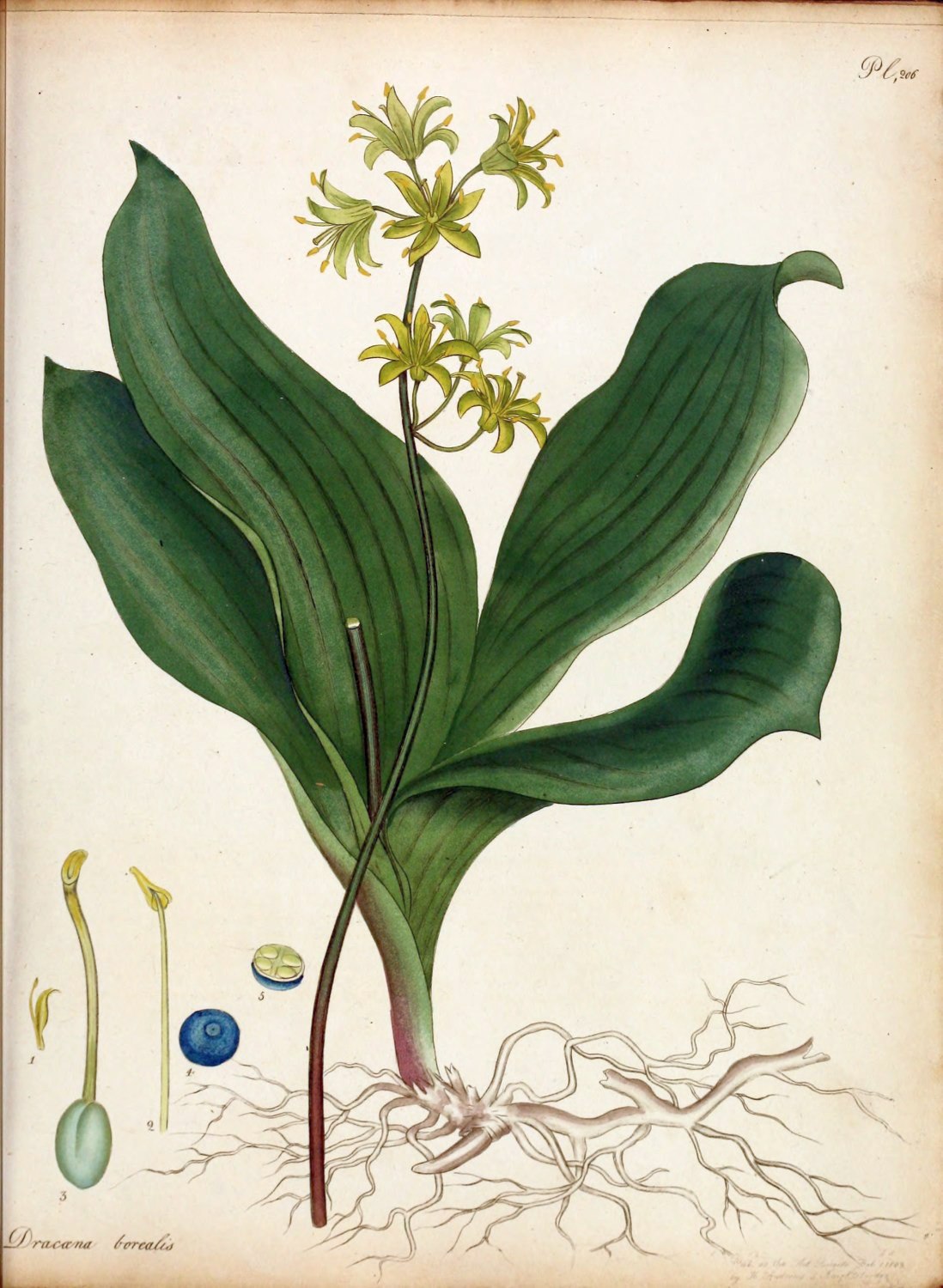
Volume 3 — PLATE CCVI. DRACÆNA BOREALIS. Oval leaved Dracæna.
Reading edition
CLASS VI. ORDER I.
HEXANDRIA MONOGYNIA. Six Chives. One Pointals.
GENERIC CHARACTER.
Calyx nullus.
Corolla. Petala sex, oblonga, erectiuscula, æqualia, unguibus cohærentia.
Stamina. Filamenta sex, unguibus inserta, subulata, medio crassiora, basi membranacea, longitudine vix corollæ. Antheræ oblongæ, incumbentes.
Pistillum. Germen ovatum, sexstriatum. Stylus filiformis, longitudine staminium. Stigma trifidum, obtusum.
Pericarpium. Bacca ovata, sexsulcata, trilocularis.
Semina solitaria, ovato-oblonga, apice incurvata.
Obs. Character fere Asparagi, habitus diversus.
Empalement none.
Blossom. Petals six, oblong, rather upright, equal, cohering by the claws.
Chives. Threads six, inserted into the claws, awl-shaped, thicker about the middle, skinny at the base, almost the length of the blossom. Tips oblong, incumbent.
Pointal. Seed-bud egg-shaped, six-streaked. Shaft thread shaped, the length of the chives. Summit three-cleft, obtuse.
Seed-vessel. Berry egg-shaped, six-furrowed, three-celled.
Seeds solitary, oblong-egg-shaped, turned inward at the end.
Obs. The Character is very near Asparagus, the habit different.
SPECIFIC CHARACTER.
Dracæna, herbacea, subcaulescens, foliis elipticis.
Dracæna, herbaceous, rather aspiring to a stem, leaves eliptic.
REFERENCE TO THE PLATE.
1. A Petal with its chive.
2. A Chive, magnified.
3. The Pointal, magnified.
4. A ripe Berry.
5. The same, cut transversely.
About the year 1776, this plant was first received in England, by Messrs. Lee and Kennedy from Montreal, Canada, N. America. It is a native of all the northern parts of that country, as far as New England; propagates itself by the root, and flowers in July. It will not thrive but on a shady border, which should be made of light sandy peat.
Much we revere the name of Solander, and highly rate his merit as a Botanist; yet we cannot forbear stating our dissent from the arrangement of this plant, as a Dracæna, certainly nothing can be more dissimilar, in every part; this may be easily traced by comparing our figure and dissections, as connected with the Generic character. The whole natural habit of the plant, points out Convallaria for its genus, to which it is much nearer allied than Dracæna, even in the sexual characters. However, we only state our opinions, without even thinking of change, as the plant is known as Dracæna, having been figured and described in the First Vol. of the Kew Catalogue, page 454, under the present title.