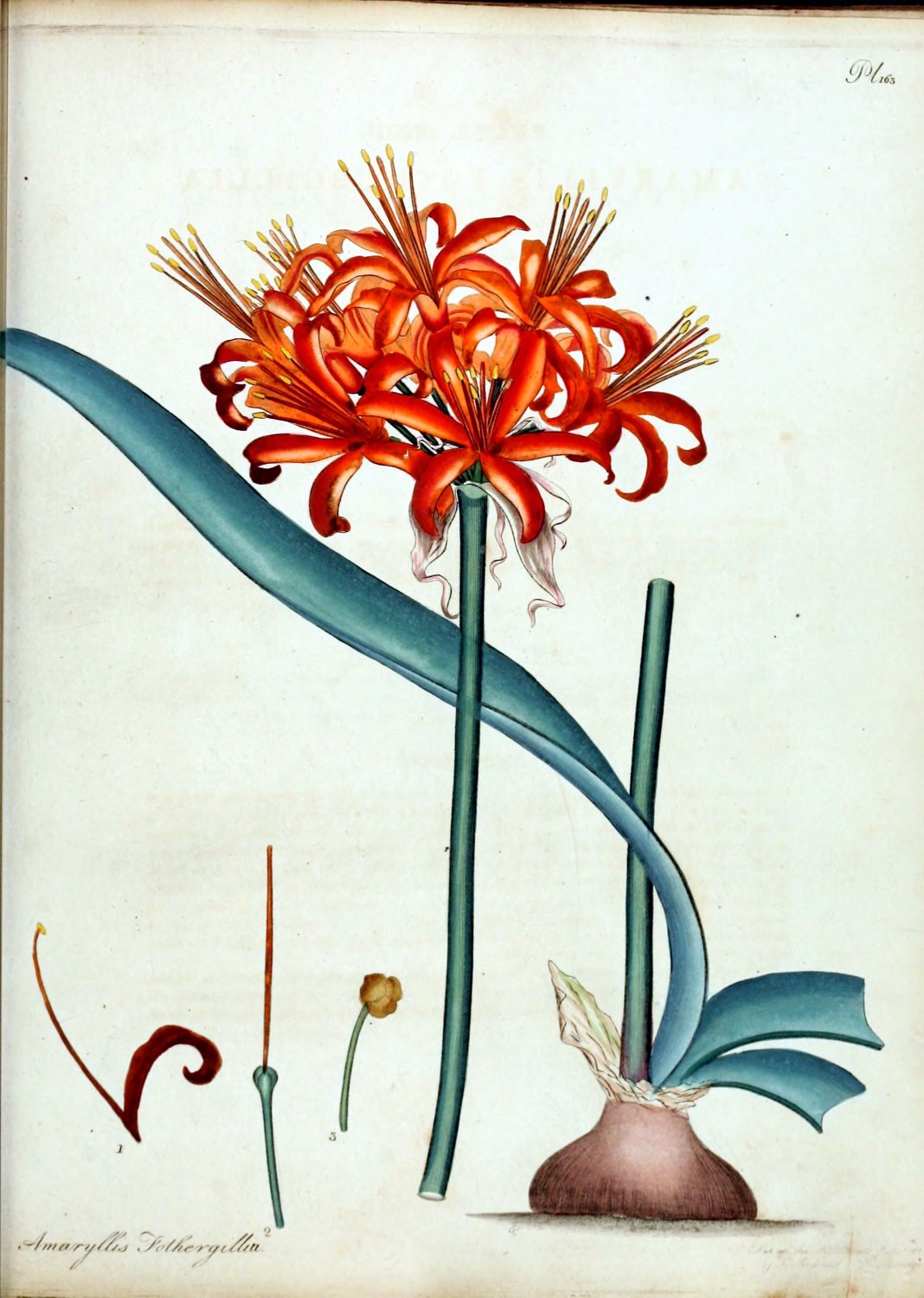
Volume 3 — PLATE CLXIII. AMARYLLIS FOTHERGILLIA. Fothergillian Lily Daffodil.
Reading edition
CLASS VI. ORDER I.
HEXANDRIA MONOGYNIA. Six Chives. One Pointal.
ESSENTIAL GENERIC CHARACTER.
Corolla 6-petala, campanulata. Stigma trifidum.
Blossom 6-petalled, bell shaped. Summit three-cleft.
See Amaryllis radiata, Pl. XCV. Vol. II.
SPECIFIC CHARACTER.
Amaryllis spatha multiflora; petalis lanceolatis, apice revolutis; genetalibus erectis; foliis linearibus, sub-canaliculatis, obtusis, glaucis.
Lily Daffodil with many flowers in the sheath; petals lance-shaped, rolled back at the point; parts of fructification upright; leaves linear, rather channelled, obtuse, and of a sea-green colour.
REFERENCE TO THE PLATE.
1. A Petal, with its Chive attached.
2. The Seed bud, and Pointal.
3. A ripe Seed-vessel, with the Seeds.
Even amidst this splendid family, Amaryllis Fothergillia stands conspicuously preeminent; the flowers have the same vivid character of refulgence, when exposed to the sun’s rays, which is perceived in A. Sarniensis, or the Guernsey Lily, to which it is nigh affined. The late Dr. Fothergill (to whom the botanical world is so much indebted, for the zeal and extraordinary liberality he constantly manifested, in advancing the science) received this plant from China at the same time with A. aurea, A. radiata, &c. about the year 1777. It is rather a scarce and tender bulb, as it is subject to rot by overmuch wet. It has hitherto been kept, as are most plants on their first arrival from China, in the hot-house; but, from every appearance, we should be led to suppose, it would not perish if kept in the Green-house, as we question much, whether it is not equally hardy with the Guernsey Lily, and a native, originally, as well as the latter, of Japan.
It should be planted in sandy loam, with a small quantity of rough peat, above the tiles in the pot, to make it flower. The propagation is from offsets, which are produced but rarely from the old bulbs. Our figure was taken from a plant in the Hammersmith nursery this year, 1801, in the month of May.