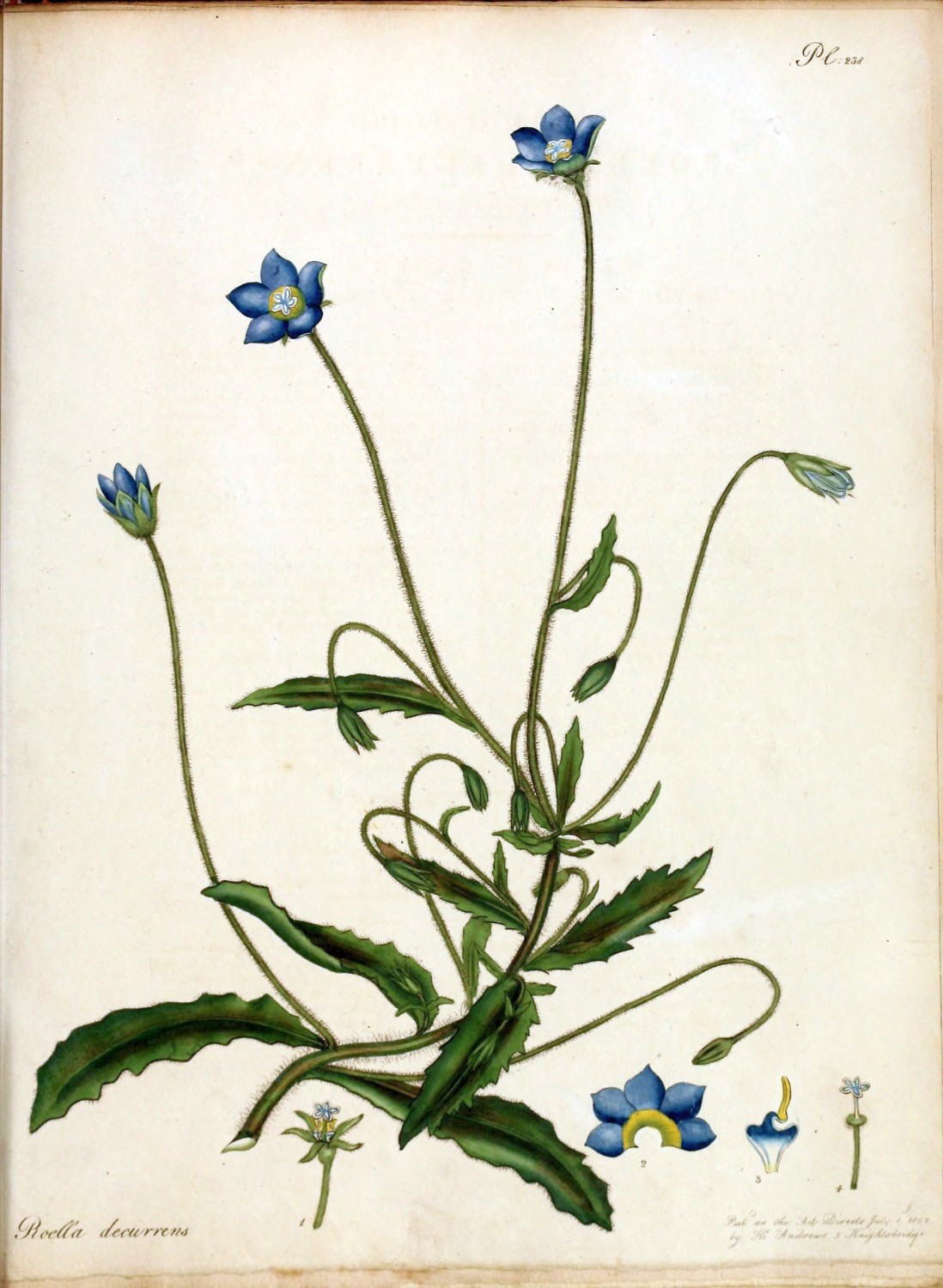
Volume 4 — PLATE CCXXXVIII. ROËLLA DECURRENS. Decurrent-leaved Roella.
Reading edition
CLASS V. ORDER I.
PENTANDRIA MONOGYNIA. Five Chives. One Pointal.
GENERIC CHARACTER.
Calyx. Perianthium monophyllum, turbinatum, quinquepartitum, persistens; laciniis lanceolatis, acutis, dentatis, magnis.
Corolla monopetala, infundibuliformis, decidua; tubus calyce paulo brevior; limbus erecto-patens, quinquepartitus, calyce longior.
Nectarium e squamis quinque, conniventibus, in fundo corollæ.
Stamina. Filamenta quinque, subulata, nectario insidentia. Antheræ subulatæ, conniventes, longitudine filamentorum, altitudine calycis.
Pistillum. Germen oblongum, inferum. Stylus filiformis, longitudine staminum. Stigmata duo, oblonga, depressa, patentia.
Pericarpium. Capsula cylindracea, calyce brevior, coronatacalyce patentimajoreque facto, bilocularis.
Semina plurima, angulata.
Obs. Campanulæ valde affinis.
Empalement. Cup one leaf, top-shaped, five-divided, remaining; segments lance-shaped, pointed, toothed, large.
Blossom one petal, funnel-shaped, deciduous, tube a little shorter than the cup; border between upright and spreading, five-divided, longer than the cup.
Honey-cup formed of five scales, approaching, at the bottom of the blossom.
Chives. Five threads, awl-shaped, placed upon the honey-cup. Tips awl-shaped, approaching the length of the threads, the height of the cup.
Pointal. Seed-bud oblong, beneath. Shaft thread-shaped, the length of the chives. Summits two, oblong, flattened, spreading.
Seed-vessel. Capsule cylindrical, shorter than the cup, crowned with the spreading cup which has become larger, two celled.
Seeds many, angled.
Obs. This Genus is very nigh affined to campanula.
SPECIFIC CHARACTER.
Roëlla foliis lanceolatis, ciliatis, integerrimis, decurrentibus; floribus solitariis, pedunculis longissimis, axillaribus.
Roella with lance-shaped leaves, fringed, quite entire, decurrent; flowers solitary, foot-stalks very long, growing from the base of the leaves close to the stem.
REFERENCE TO THE PLATE.
1. The Empalement, Chives, and Pointal, the blossom removed.
2. A Blossom cut on one side, and spread open.
3. One of the scales of the Honey-cup, with its Chive magnified.
4. The Pointal, cleared of the other parts of fructification.
As an annual, this is a most beautiful little plant; but, although the seeds have been received several times, from the Cape of Good Hope, where it is native; and first at the Royal Gardens, Kew, in 1787, sent by Mr. F. Masson; yet, has it never been seen the second year; owing, we suppose, to the impracticability of procuring ripe seeds in our climate. Perhaps future trials, by different treatment, may meet with a happier issue. The figure was taken at the Clapham Garden, in August 1800; when the plant had apparently attained its greatest perfection; but unfortunately, no seeds ripened; and at present, we believe, there is no vestige of the plant in Britain. It appears to delight in sandy peat, and to be kept under cover, even in the summer season.