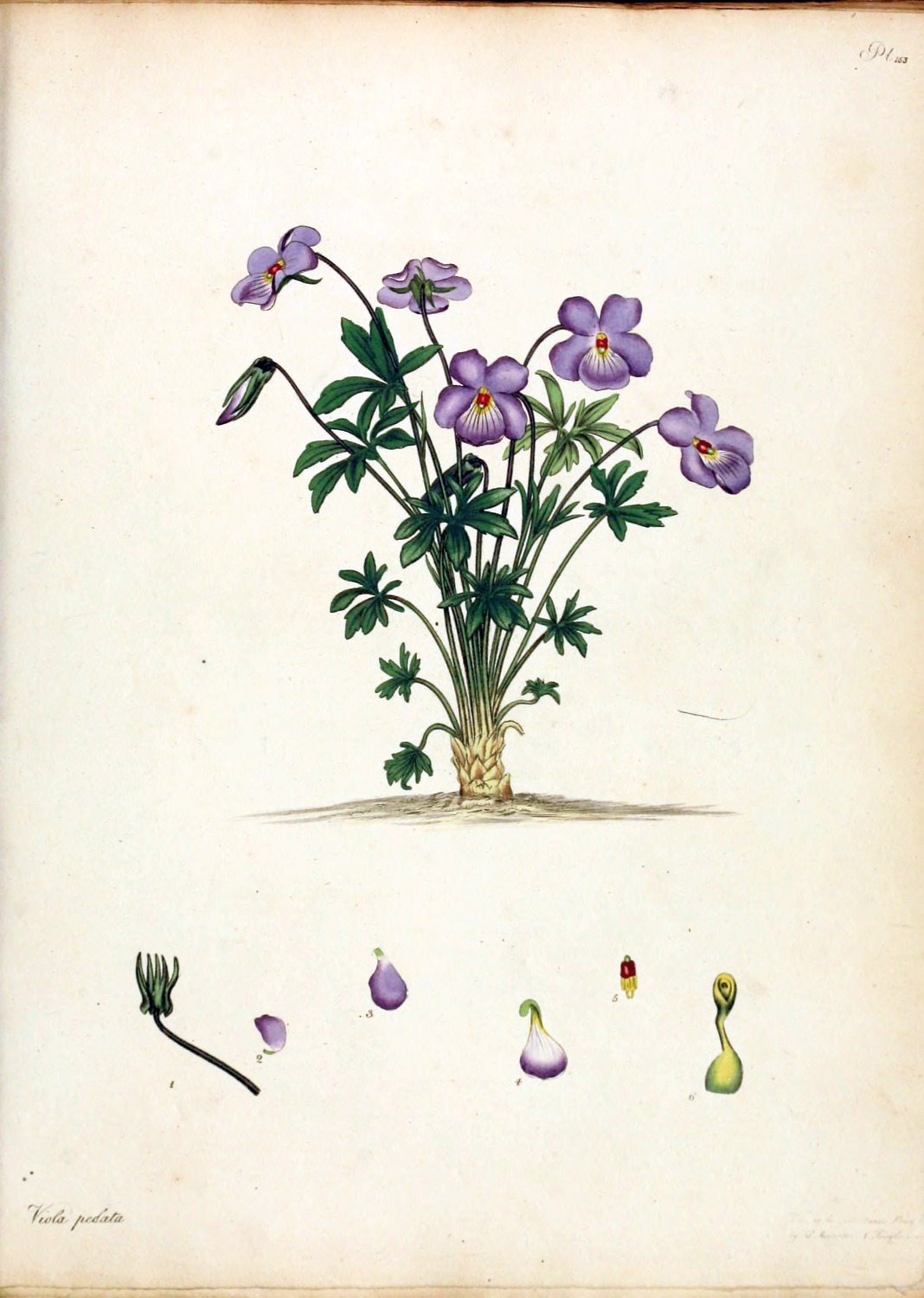
Volume 3 — PLATE CLIII. VIOLA PEDATA. Bird’s-foot-leaved Violet.
Reading edition
CLASS XIX. ORDER VI.
SYNGENESIA POLYGAMIA MONOGAMIA. Tips united. Flowers simple.
GENERIC CHARACTER.
Calyx. Perianthium pentaphyllum, breve, persistens; foliolis ovato-oblongis, erectis, apice acutioribus, basi obtusis, supra basin affixis, æqualibus, sed dispositione variis: quorum duo fulciunt petalum α; singula singulum petalum β. γ.; unicum duo petala δ. ε. simùl.
Corolla pentapetala, irregularis, petalis inæqualibus; quorum.
Petalum α. supremum rectum, deorsum spectans, latius, obtusius, emarginatum, desinens basi in nectarium corniculatum, obtusum, inter calycis foliola prominens.
β. γ. Lateralia paria, obtusa, opposita, recta.
δ. ε. Insima paria, majora, sursum reflexa.
Stamina. Filamenta quinque, minima, quorum duo petalo α. proxima appendicibus annexis intrant nectarium. Antheræ sæpius connexæ, obtusæ, membranis ad apicem auctæ.
Pistillum. Germen subrotundum. Stylus filiformis, extra antheras prominens. Stigma obliquum.
Pericarpium. Capsula ovata, trigona, obtusa, unilocularis, trivalvis.
Semina plura, ovata, appendiculata, valvis affixa. Receptaculum lineare, per singulam valvulam lineæ instar excurrens.
Obs. Stigma vel in hamum simplicem reflectitur, vel capitulum est concavum apice perforato.
Cup five-leaved, short, permanent; leaflets oblong-egg-shaped, erect, sharpish at the point, blunt at the bottom, joined together above the base, equal, but variously disposed; of which, two support petal α. one each petal β. γ. and one the two petals δ. ε. together.
Blossom five petals, irregular, unequal petals, of which
The upper petal α. is upright, bent back, broader, and blunter than the rest, notched at the end, terminating at the base in a blunt horn-shaped honey-cup, protruding between the leaflets of the cup.
The lateral petals β. γ. grow in pairs, obtuse, opposite, upright.
The lower petals δ. ε. grow in pairs, larger, and reflexed upwards.
Chives. Five threads, very small; of which the two nearest to the petal α. have small appendages which enter the honey-cup, Tips generally united, blunt, enlarged by skinny substances at the end.
Pointal. Seed-bud roundish. Shaft thread-shaped, projecting beyond the tips. Summit oblique.
Seed-vessel. Capsule egg-shaped, three-sided, blunt, one cell and three valves.
Seeds many, egg-shaped, having appendages, fixed to the valves. Receptacle linear, running like a line along each valve.
Obs. The summit is either reflexed into a simple hook, or a concave small head perforated at the end.
SPECIFIC CHARACTER.
Viola acaulis; foliis pedatis, septempartitis; laciniis dentatis.
Violet without a stem, leaves formed like a bird’s foot, with seven divisions; segments toothed.
REFERENCE TO THE PLATE.
1. The Empalement.
2. One of the upper Petals of the Blossom.
3. One of the lateral Petals.
4. The lower Petal, with its Honey-cup.
5. The Chives and Pointal with the Appendages that fall into the Honey-cup from the two hinder threads.
6. The Pointal magnified.
The Bird’s-foot-leaved Violet is a native of North America near Philadelphia; and (according to the Kew Catalogue) was cultivated by Mr. P. Miller, in 1759, at the Physic Gardens, Chelsea. It is a hardy herbaceous plant, but is sometimes destroyed by the wetness of our autumnal months: the flowers, if kept in the open air, expand about May, or the beginning of June; but if kept in pots they, with a slight protection from the Spring frosts, will be produced in April. Peat earth is the soil it approves most, and it should not be exposed to too much wet, whether planted in the borders or in pots. The roots may be parted in March.