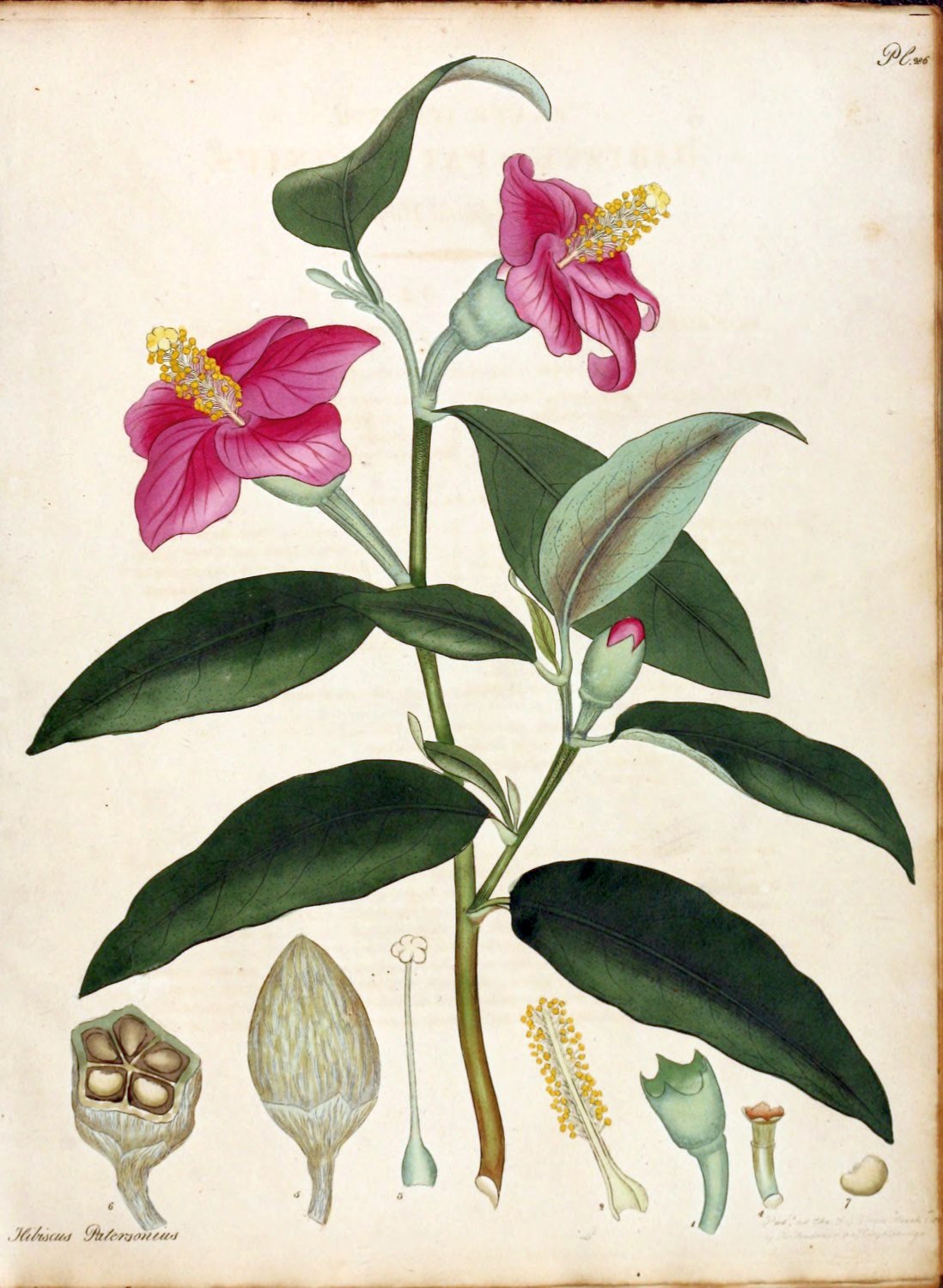
Volume 4 — PLATE CCLXXXVI. HIBISCUS PATERSONIUS. Norfolk Island Hibiscus.
Reading edition
CLASS XVI. ORDER VI.
MONADELPHIA POLYANDRIA. Threads united. Many Chives.
ESSENTIAL GENERIC CHARACTER.
Calyx duplex; exterior polyphyllus. Stigmata 5. Capsula 5-locularis, polysperma.
Empalement double; outer one many-leaved. Five Summits. Capsule five-celled, many-seeded.
See Hibiscus mutabilis, Pl. CCXXVIII. Vol. IV.
SPECIFIC CHARACTER.
Hibiscus foliis acuminato-lanceolatis, coriaceis, supra punctatis, subtus tomentosis: floribus axillaribus; calycibus monophyllis, quinquedentatis.
Hibiscus with tapering lance-shaped leaves, leathery, dotted above and downy underneath; flowers grow from the insertion of the leaves; cups one-leaved, five-toothed.
REFERENCE TO THE PLATE.
1. The Cup with its foot-stalk.
2. The columnar part of the Chives cut open, the pointal taken away.
3. The Pointal.
4. A skinny membrane, which surrounds the seed-bud at the base.
5. A ripe capsule, with the enlarged cup attached.
6. The same, cut through the middle horizontally.
7. A ripe seed.
The Norfolk Island Hibiscus is a tender greenhouse plant; was introduced to Britain, in the year 1792, having been raised from seeds communicated by Col. Paterson, then stationed on that Island. It attains the height of 13 feet, or more, becoming a small tree; may be increased readily from cuttings, and should be planted in a mixture of loam and sandy peat. Our figure is from a specimen received from the Right Hon. Lord Viscount Courtenay, in whose collection at Powderham, near Exeter, it flowered for the first time in the year 1800; and where also the seeds ripened.
We have no doubt but this plant belongs to the Genus Lagunæa, of Schreber; but as he proposes himself, and as L’Heritier as justly observes, the simplicity of the cup is not a sufficient ground, on which to found a new genus; so we have rather given our present subject, the name under which it is in general known, than adopt a title for it which is acknowledged by the author, as rather unwarrantable.