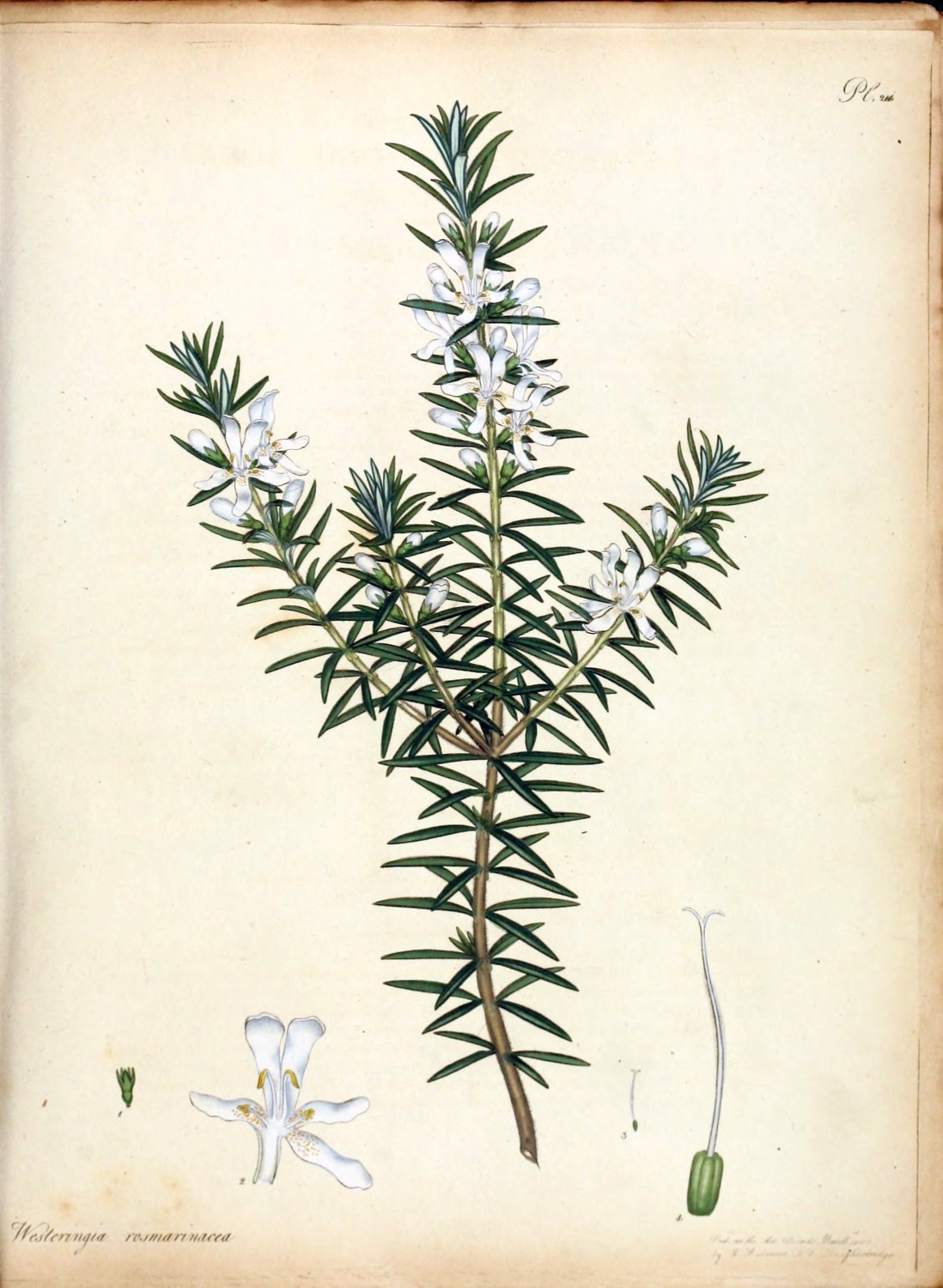
Volume 3 — PLATE CCXIV. WESTERINGIA ROSMARINACEA. Rosemary-like Westeringia.
Reading edition
CLASS II. ORDER I.
DIANDRIA MONOGYNIA. Two Chives. One Pointal.
GENERIC CHARACTER.
Calyx. Perianthium monophyllum, sub-cylindricum, erectum, persistens, quinquedentatum, æquale; bracteis binis suffultum.
Corolla monopetala; petalum tubulatum calyce paulo longius; limbus patens, quinquepartitus, sub æqualis; laciniis duabus superioribus emarginatis.
Stamina. Filamenta quatuor, filiformia, fauci tubi inserta, quorum duo superiora longiora, fertilia; duo breviora sterilia. Antheræ loculis oblongis, duæ superiores dependentes; duæ inferiores erectæ, sagittatæ, squamiformes.
Pistillum. Germen tetragonum. Stylus filiformis, parum curvatus, longitudine tubi. Stigma bifidum, reflexum.
Pericarpium nullum. Calyx in fundo semina continens.
Semina quatuor, ovalia.
Empalement. Cup one-leaf, nearly cylindrical, upright, remaining, five-toothed, equal; supported by two leaflets.
Blossom one petal; petal tubular, rather longer than the cup; border spreading, five-divided, nearly equal; the two upper segments notched at the end.
Chives. Four threads, thread-shaped, inserted into the mouth of the tube, of which the two upper ones are longer, and fertile; two shorter, and sterile. Tips with oblong cells, the two upper ones hang down; the two lower are upright, arrow-shaped, and like thin scales.
Pointal. Seed-bud four-sided. Shaft thread-shaped, a little curved, the length of the tube. Summit two-cleft, reflexed.
Seed-vessel none. Cup containing the seeds at the bottom.
Seeds four, oval.
SPECIFIC CHARACTER.
Westeringia foliis verticillatis, sub-linearibus, acutis, subtus sericeis; floribus axillaribus, spicatis.
Westeringia with leaves growing in whorls, nearly linear, pointed and silky underneath; flowers grow from the base of the leaves close to the stem, in spikes.
REFERENCE TO THE PLATE.
1. The Empalement, with the two props attached to the base.
2. A Flower spread open, with the chives in their place, magnified.
3. The Pointal, natural size.
4. The same magnified.
The present plant was introduced to our gardens, in the year 1791, from New South Wales, by Messrs. Lee and Kennedy, Hammersmith. It was first named Cunila verticillata, and, from what we can judge, it might, without much forcing of the characters of the genus, have been so continued; but our opinions shall always give way, when the decision is past from such superior talents as those of Dr. Smith; by whom it has been thought to possess a sufficiency of distinctive character, on which to form a new genus, under the title it here bears. It is a bushy shrub, grows to the height of three feet, the branches standing out almost horizontally, in whorls, and the whole plant bearing a great resemblance to the Rosemary. It is propagated by cuttings made in March from the end of the small branches; approves most of light sandy peat, and is in flower from March till November. The whole plant is scentless.