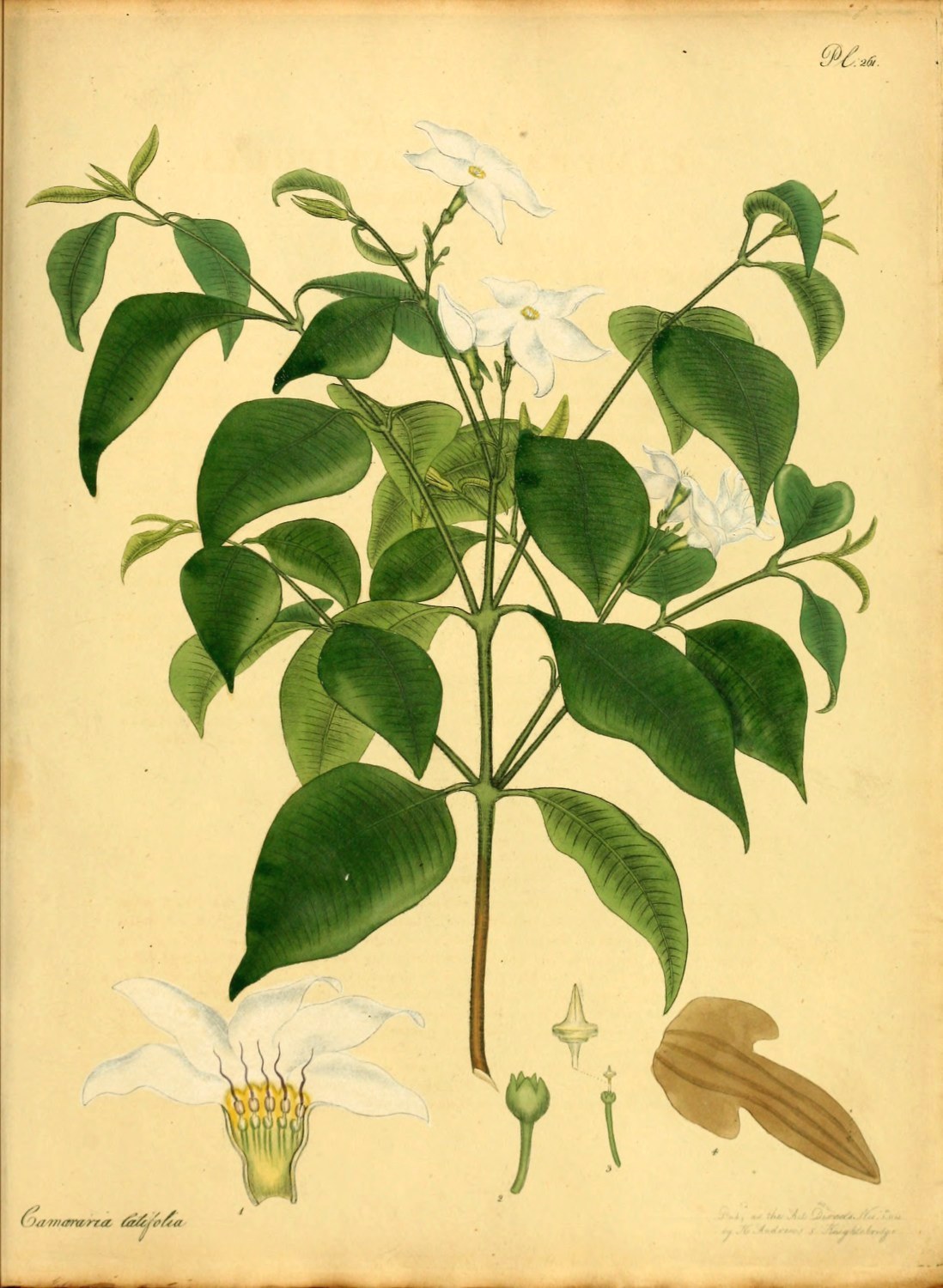
Volume 4 — PLATE CCLXI. CAMERARIA LATIFOLIA. Bastard Mangeneel.
Reading edition
CLASS V. ORDER I.
PENTANDRIA MONOGYNIA. Five Chives. One Pointal.
GENERIC CHARACTER.
Calyx. Perianthium quinquefidum, acutum, connivens, minimum.
Corolla monopetala, infundibuliformis; tubus cylindricus, longus, basi apiceque ventricosus; limbus quinquepartitus, planus; laciniis lanceolatis, obliquis.
Stamina. Filamenta quinque, minima, e medio tubi. Antheræ conniventes, filo longo terminatæ.
Pistillum. Germina duo, cum appendicibus ad latera. Stylus cylindricus. Stigma capitatum, apice acutum, bifidum.
Pericarpium. Folliculi duo, horizontaliter reflexi, oblongi, juxta latera baseos utrinque lobum emittentes, uniloculares, univalves.
Semina numerosa, ovata, membranæ majori ovatæ ad basin insertæ, imbricata.
Empalement. Cup five-cleft, pointed, converging, very small.
Blossom one-petal, funnel-shaped; tube cylindrical, long, bellied out at the base and top, border five-parted, flat; segments lance-shaped, oblique.
Chives. Threads five, very small from the middle of the tube. Tips converging, terminated by a long thread.
Pointal. Seed-buds two, with lateral appendages. Shaft cylindrical. Summit headed, pointed at top, and two-cleft.
Seed-vessel. Seed-pods two, horizontally reflexed, oblong, sending forth a lobe each way near the side of the base, one-celled, one-valved.
Seeds numerous, egg-shaped, inserted on the larger egg-shaped membrane at the base, tiled.
SPECIFIC CHARACTER.
Cameraria foliis ovatis, nitidis, acuminatis, parallelo-costatis; floribus corymbosis, terminalibus.
Bastard Mangeneel with egg-shaped leaves, shining, tapered, and ribbed transversely; flowers grow in broad-topped spikes, terminal.
REFERENCE TO THE PLATE.
1. A Flower cut open, magnified, with the Chives in their place.
2. The Cup, magnified.
3. The Pointal and Cup, the summit magnified.
4. One of the Seed-pods, natural size.
The genus Cameraria, seems to have been rather hastily taken up by Plumier, as a distinct genus from Nerium; for certainly, the small difference in the shape of the seed-pod, in which consists the whole distinctive character of this genus, can hardly be thought of sufficient moment to that end. As we have found it, we leave it; but could not refrain from the foregoing remark, as it appears so singular, that amongst so many who have published the plant, not one should have discovered the surrounding nectary, or honey-cup, to the mouth of the blossom, and the long threads at the end of the tips; two such very powerful features, which distinguish Nerium, from all the rest of this natural order.
It is a native of Jamaica, Cuba, and Domingo; grows to the height of thirty feet, and is considered as a timber tree in those islands. The whole plant is full of a milky juice, similar to what is found in most plants of this natural order. In England, it must be treated as a hot-house plant; may be increased by cuttings; flowers in August, and should be planted in rich earth.
Our figure was taken from a plant in the Stepney collection, belonging to Thos. Evans, Esq.