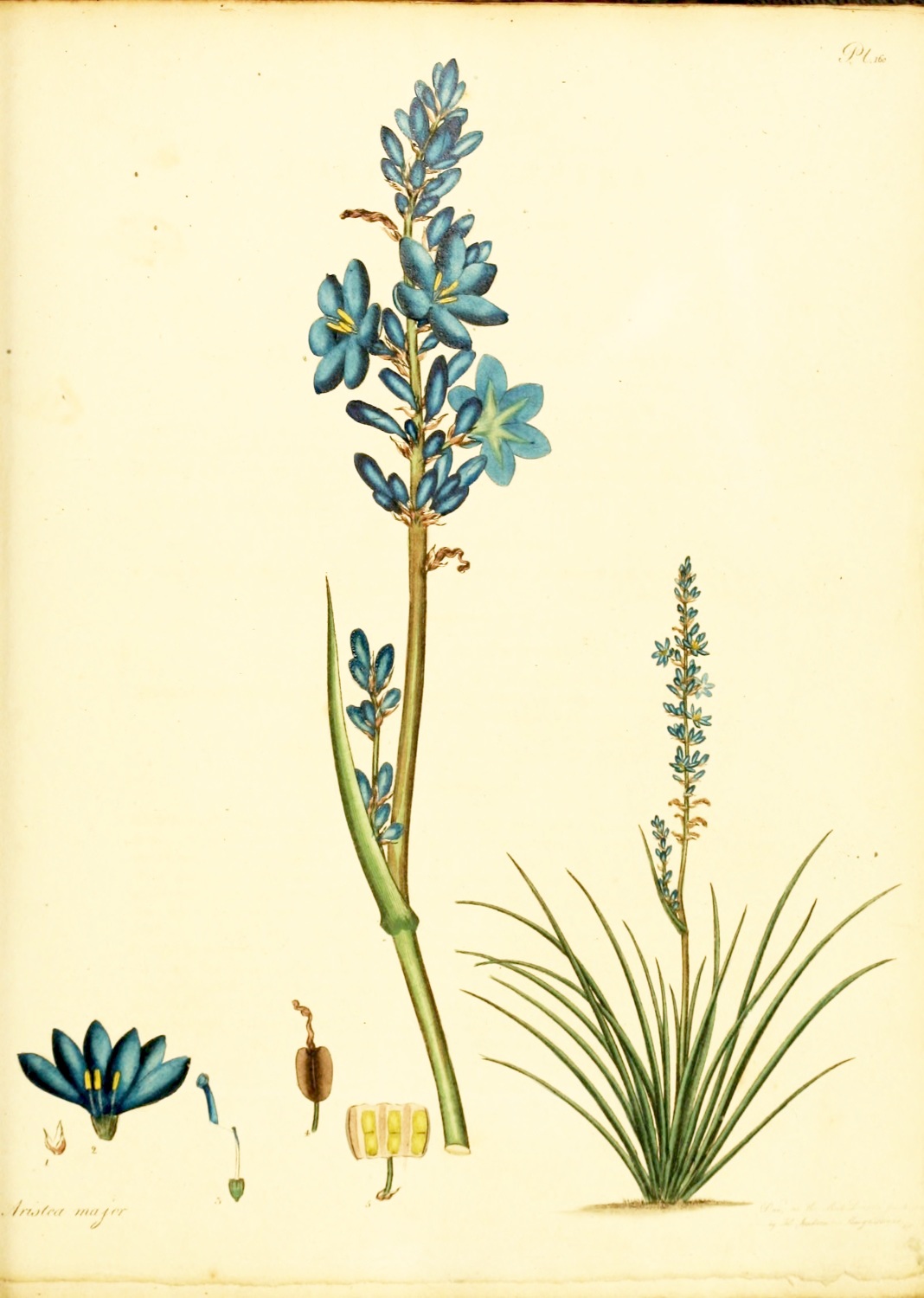
Volume 3 — PLATE CLX. ARISTEA MAJOR. Spike-flowered Aristea.
Reading edition
CLASS III. ORDER I.
TRIANDRIA MONOGYNIA. Three Chives. One Pointal.
ESSENTIAL GENERIC CHARACTER.
Petala 6. Stigma concavum. Capsula triloba, trilocularis, loculis compressis. Semina in singulo loculo bina, compressa truncata.
Petals 6. Summit concave. Capsule three-lobed, three-celled; cells flattened. Seeds two in each cell, flattened and appearing cut off at the end.
See Aristea Cyanea, Pl. X. Vol. I.
SPECIFIC CHARACTER.
Aristea foliis ensiformibus longissimis; floribus spicatis, cæruleis.
Aristea with very long leaves; flowers grow in spikes, and blue.
REFERENCE TO THE PLATE.
1. The two sheaths of the Empalement.
2. A Blossom with the Seed-bud, both cut open and remaining attached, the Shaft removed.
3. The Pointal natural size, with the summit detached magnified.
4. A ripe seed-vessel, natural size.
5. The same with the cells laid open to shew the situation of the seeds.
The Genus Aristea, having certainly been formed from a dried specimen of the plant, the alterations we have made in our Generic and Essential characters, will, upon inspecting the dissections, appear absolutely necessary; as the shaft is not bent, in either species we have examined, whilst the flower is perfect; but assumes that appearance on its decay, as it becomes involved with the petals, which twist up in the manner of Morœa, Iris, &c. The Summit likewise, is not funnel-shaped, but merely a little concave, with a border; other small variations have been made, in the character of the seed-vessel and seed. In the year 1794, this fine plant was raised by Messrs. Lee and Kennedy, from seeds received by them from the Cape of Good Hope, where it is native. It is one of the very hardiest inhabitants of the greenhouse, and is propagated, either from the seed, which ripens with us; or by the offsets made from the root. The plant is persistent, but does not acquire a stem; the leaves growing to the length of from two, to three feet, the flower-stem sometimes to the height of four feet; which was nearly that of the plant in the Collection of G. Hibbert, Esq. Clapham, from which our drawing was taken in the month of July 1800. It should be planted in sandy peat.