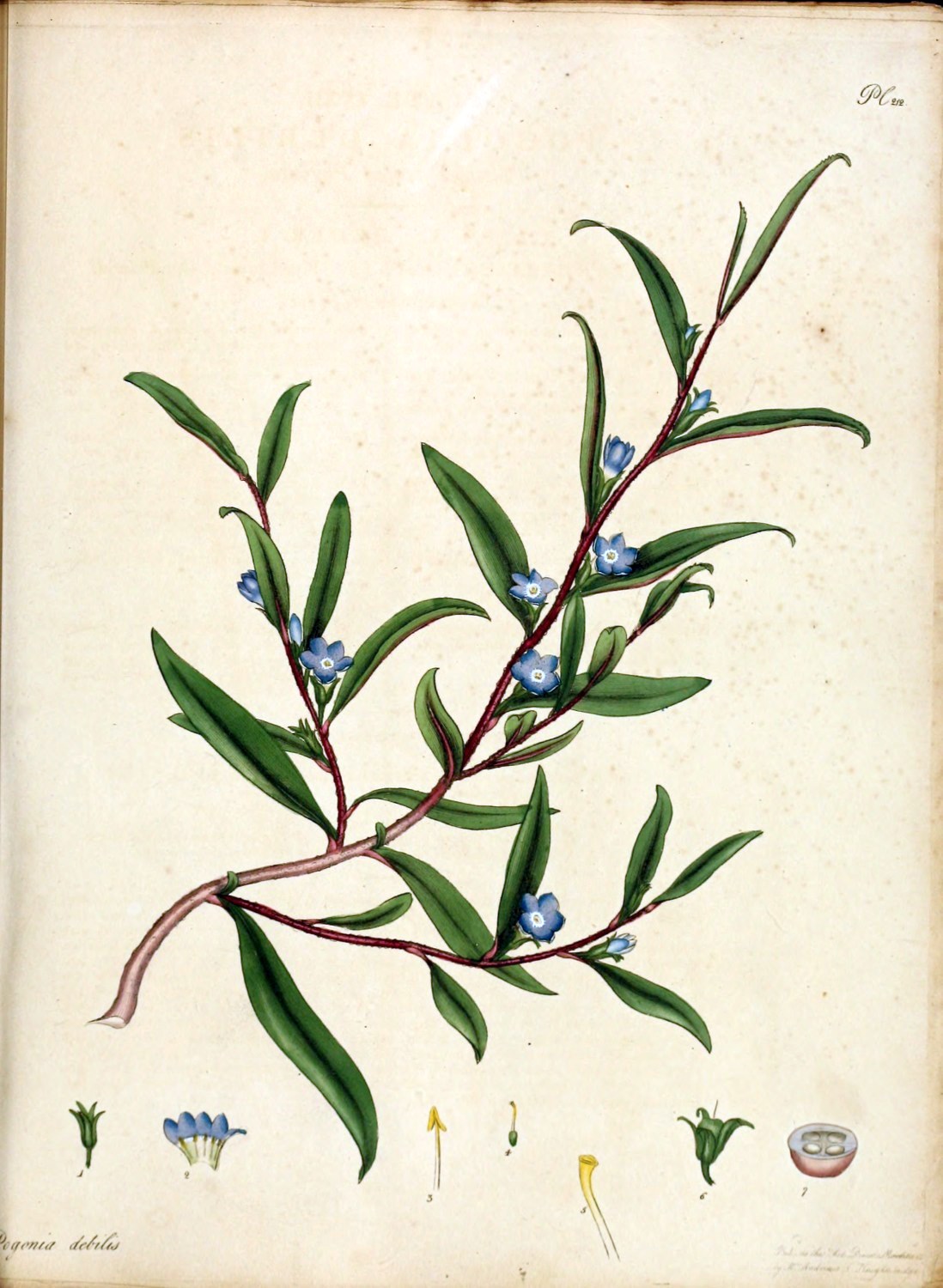
Volume 3 — PLATE CCXII. POGONIA DEBILIS. Slender-stemed Pogonia.
Reading edition
CLASS V. ORDER I.
PENTANDRIA MONOGYNIA. Five Chives. One Pointal.
GENERIC CHARACTER.
Calyx. Perianthium pentaphyllum persistens; foliolis lanceolatis, erectis, acutis, apicibus reflexis.
Corolla monopetala, infundibuliformis, tubus cylindricus, longitudine calycis, ore villis clauso; limbus semiquinquesidus, laciniis concavis, acutis.
Stamina. Filamenta quinque, tubo supra medium inserta. Antheræ erectæ, sagittatæ, intra faucem.
Pistillum. Germen ovatum. Stylus filiformis, apice parum curvatus, longitudine tubi, persistens. Stigma concavum.
Pericarpium. Bacca ovata, compressa, calyci accreta.
Semen. Nux quadrilocularis, putamine durissimo; nuclei oblongi.
Empalement. Cup five-leaved, permanent; leaflets lance-shaped, upright, pointed, and reflexed at the ends.
Blossom one petal, funnel-shaped, tube cylindrical, the length of the cup, the mouth closed with soft hairs; border half five-cleft; segments concave and pointed.
Chives. Threads five, inserted into the tube above the middle. Tips upright, arrow-shaped, within the mouth.
Pointal. Seed-bud egg-shaped. Shaft thread-shaped, a little curved at the end, the length of the tube, remaining. Summit concave.
Seed-vessel. An egg-shaped, flattened berry, growing to the cup.
Seed. A four-celled nut, shell very hard; kernels oblong.
SPECIFIC CHARACTER.
Pogonia foliis lanceolatis, apicibus sæpe serrulatis, distichis; floribus solitariis, axillaribus, cæruleis; cortice scabrosa.
Pogonia with lance-shaped leaves, often slightly sawed at the ends, and pointing opposite ways; flowers solitary, growing from the insertion of the leaves into the stem, and blue; bark rough.
REFERENCE TO THE PLATE.
1. The Empalement.
2. A Flower cut open, with the Chives as they stand in the blossom.
3. A Chive, magnified.
4. The Pointal.
5. Summit, with part of the Shaft, magnified.
6. The Cup, with the ripe berry, the shaft remaining, and the cup a little enlarged.
7. A Berry cut transversly, to shew the situation of the kernels in the cells.
The Pogonia here figured, is the only one of the genus we at present possess; it is a native of Port Jackson, New South Wales, and was first transmitted to England, by Col. Paterson, in the year 1793. It is a climbing plant, the branches acquiring a considerable length, the bark being covered with small tubercles, like glands, and the younger branches covered, their whole length, with blossoms. Although this is not to be reckoned amongst the handsomest of the productions of that country, yet, from the lively colour of the flowers, the profusion of them which the plant produces, and their continued succession, from April, till September, it must be considered as a valuable addition to the small number of scandent plants, as yet in our green-houses; more particularly at the present juncture, when, from fashion, a trellis has become a necessary appendage to them. It is propagated from the seeds, which ripen in this country; as well as from cuttings, which should be made in May, and kept in the heat of a cucumber-frame, or hot-house, till they are rooted. It is grown best in sandy peat. Our figure was taken at the Hammersmith Nursery, where it was first raised in this kingdom. The name, Pogonia, is derived from the appearance of the mouth of the flower which is bearded; Πωγωνιον, Pogonion, signifying a little beard.