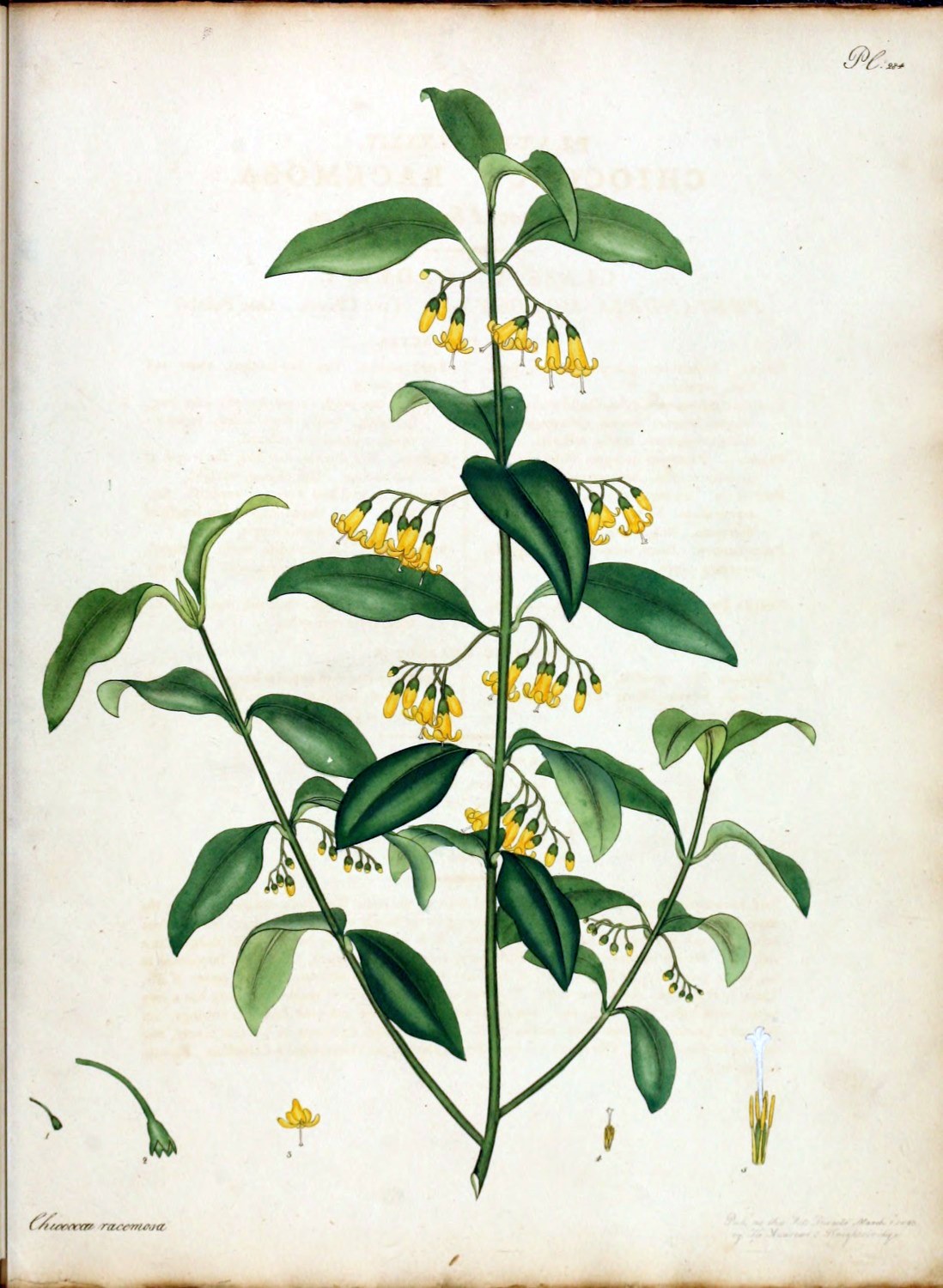
Volume 4 — PLATE CCLXXXIV. CHIOCOCCA RACEMOSA. Opposite-leaved Snowberry-tree.
Reading edition
CLASS V. ORDER I.
PENTANDRIA MONOGYNIA. Five Chives. One Pointal.
GENERIC CHARACTER.
Calyx. Perianthium quinquedentatum, superum, persistens.
Corolla monopetala, infundibuliformis; tubus longus, patens; limbus quinquepartitus; laciniis æqualibus, acutis, reflexis.
Stamina. Filamenta quinque, filiformia, longitudine corollæ. Antheræ oblongæ, erectæ.
Pistillum. Germen inferum, subrotundum, compressum. Stylus filiformis, longitudine staminum. Stigma simplex, obtusum.
Pericarpium. Bacca subrotunda, compressa, coronata calyce, bilocularis.
Semina duo, subrotunda, compressa, distantia.
Empalement. Cup five-toothed, above and remaining.
Blossom one petal, funnel-shaped; tube long, spreading; border five divided; segments equal, pointed and reflexed.
Chives. Five threads, hair-like, the length of the blossom. Tips oblong, upright.
Pointal. Seed-bud beneath, roundish, flattened. Shaft thread-shaped, the length of the chives. Summit simple, blunt.
Seed-vessel. A roundish berry, flattened, crowned with the permanent cup, two-celled.
Seeds two, roundish, flattened, and at a distance from each other.
SPECIFIC CHARACTER.
Chiococca foliis oppositis, ovatis, acuminatis; ramis horizontalibus; floribus racemosis, pendulis.
Snowberry-tree with opposite leaves, egg-shaped, tapered; branches grow horizontal; flowers grow in bunches hanging down.
REFERENCE TO THE PLATE.
1. The Empalement, natural size.
2. The same, magnified.
3. A Flower.
4. The Chives and Pointal, natural size.
5. The same magnified.
The Snowberry-tree is a native of Jamaica, and some of the other West India islands; requiring the temperature of the hothouse to preserve it; growing to the height of four or five feet; but the stem being too weak to support itself, must be assisted. It is propagated by cuttings, and delights in a rich soil. We are informed in Miller’s Dictionary, treating of this plant, that it was introduced to us, in the year 1729, by Mr. Warner, of London; and that it was cultivated, in the garden of Mr. Sherard, at Eltham, about that time. The root of this plant is used medicinally, and has a very bitter, acrid taste. It is a very free blowing plant, flowering the first year from the cuttings; but never produces its fine white berries in this country, which constitute its greatest beauty, and whence its generic title. Our figure was made from a plant in the Hammersmith Collection. Flowers in September.