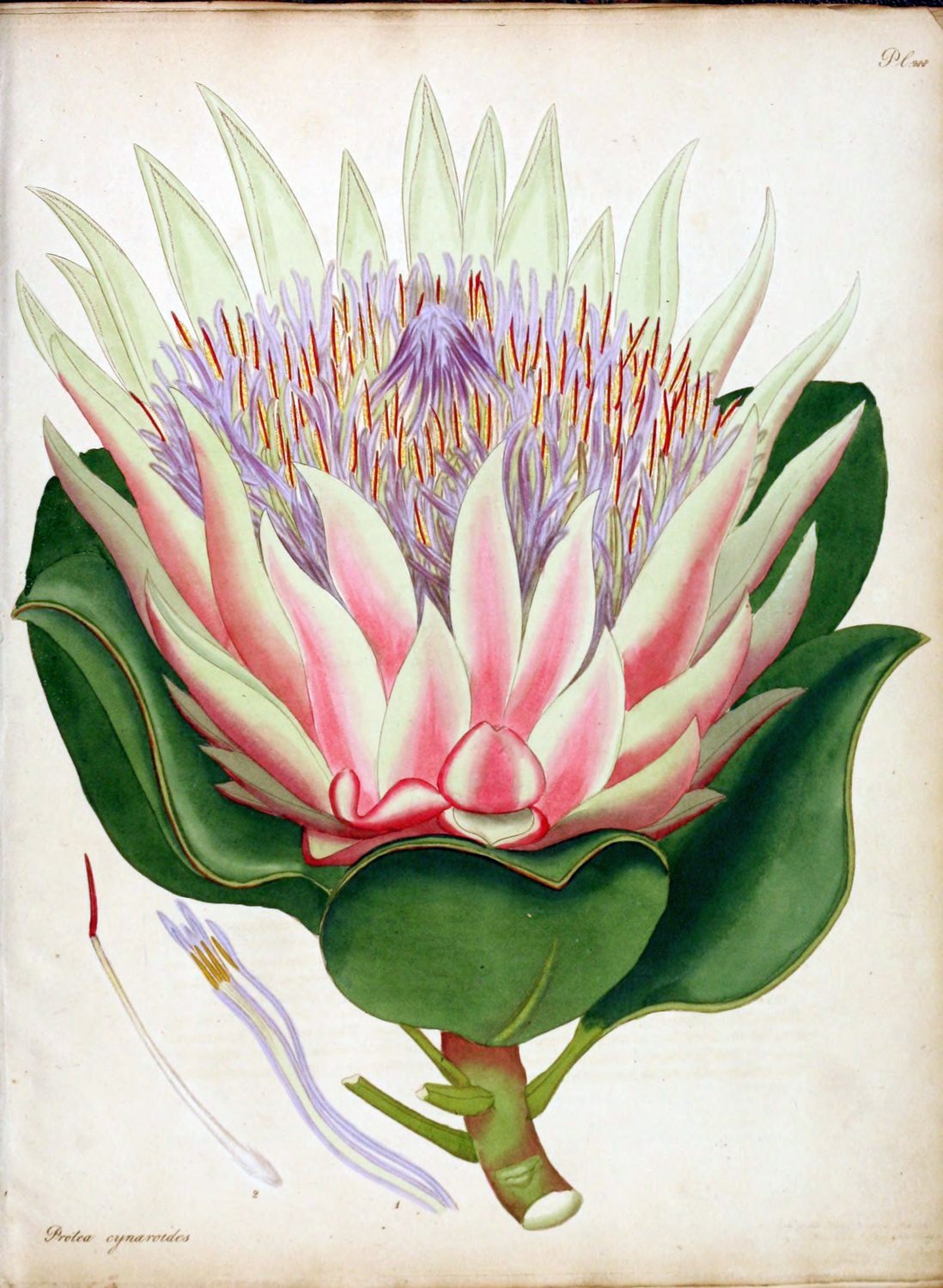
Volume 4 — PLATE CCLXXXVIII. PROTEA CYNAROIDES. Artichoke-like-flowered Protea.
Reading edition
CLASS IV. ORDER I.
TETRANDRIA MONOGYNIA. Four Chives. One Pointal.
ESSENTIAL GENERIC CHARACTER.
Corolla quadrifida seu quadripetala. Antheræ lineares, insertæ petalis infra apicem. Calyx proprius nullus.
Semina solitaria.
Blossom four-cleft or four petals. Tips linear, inserted into the petals below the point. Empalement proper none.
Seeds solitary.
See Protea formosa, Pl. XVII. Vol. I.
SPECIFIC CHARACTER.
Protea foliis suborbiculatis, glaberrimis; petiolis longissimis; squamulis calycinis lanceolatis, apice carinatis.
Protea with nearly orbicular leaves, and very smooth; footstalks very long; scales of the cup lance-shaped, keeled at the point.
REFERENCE TO THE PLATE.
1. A Floret spread open, with the Chives in their places.
2. The Pointal and Seed-bud.
To the Right Hon. the Earl of Coventry we are indebted for the figure of this superb plant; it having flowered in his Lordship’s rich, and extensive collection at Croome, Worcestershire, this present February, 1803, for the first time, in England; his Lordship did us the favour to order the flower to be cut, and sent to London; where it arrived, without the least injury, and continued in perfection many days.
The magnificence of this species of Protea, can be but poorly expressed within the limited bounds of our publication; we have, nevertheless, endeavoured to do it all the justice within our grasp. A considerable part of the lustre of the flower is lost, from the small portion of the leaves which could be introduced; as the contrasted beauty of the fine broad shining leaves, which form, as it were, a nidus, or ground wood for the blossom, contribute, so much, to heighten the beauty of the whole.
The Protea cynaroides is a hardy greenhouse plant, was introduced to Britain, in 1792, by Messrs. Lee and Kennedy, Hammersmith, from the Cape of Good Hope. May be increased by cuttings, taken off the lower part of the plant; where they shoot out in clusters to the length of an inch or more, and must be treated as has already been directed for Proteas in general. The plant, even at the Cape, seldom grows higher than 18 inches, or two feet.