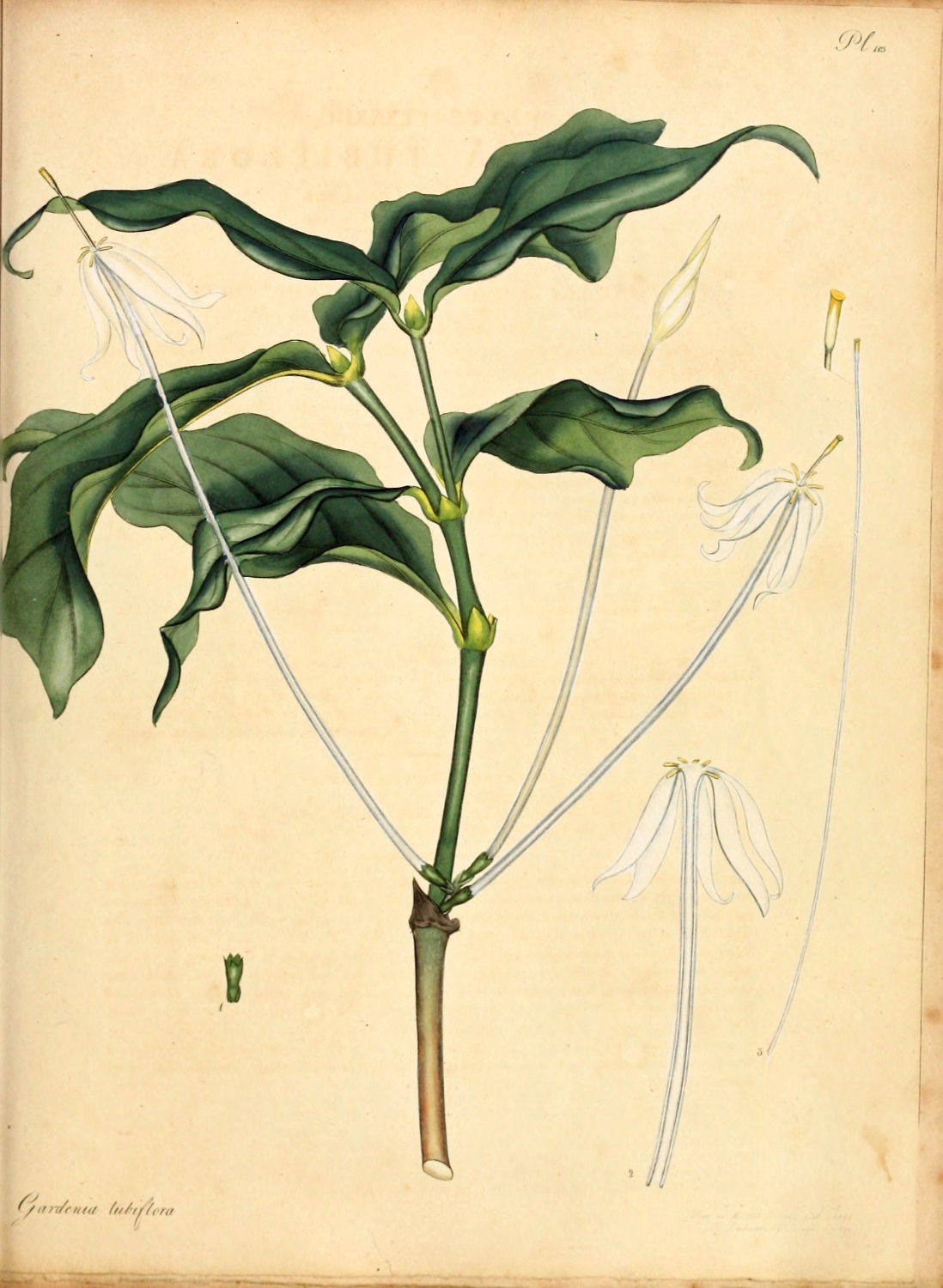
Volume 3 — PLATE CLXXXIII. GARDENIA TUBIFLORA. Tube-flowered Gardenia.
Reading edition
CLASS V. ORDER I.
PENTANDRIA MONOGYNIA. Five Chives. One Pointal.
GENERIC CHARACTER.
Calyx. Perianthium monophyllum, quinquefidum, superum, laciniis erectis, persistentibus.
Corolla monopetala, infundibuliformis; tubus cylindricus, calyce longior; limbus planus, quinquepartitus.
Stamina. Filamenta nulla. Antheræ quinque, ore tubi insertæ, lineares, striatæ, longitudine dimidia limbi.
Pistillum. Germen inferum. Stylus filiformis seu clavatus. Stigma exsertum, ovatum, obtusum, bilobum, sæpe sulcatum.
Pericarpium. Bacca sicca, uni bis seu-quadrilocularis.
Semina plurima, depressa, per series imbricatim sibi imposita.
Empalement. Cup one leaf, five-cleft, above, segments upright, permanent.
Blossom one petal, funnel-shaped; tube cylindrical, longer than the cup; border flat, five divisions.
Chives. Threads none. Tips five, fixed into the mouth of the tube, linear, striped, half the length of the border.
Pointal. Seed-bud beneath. Shaft thread-shaped or club-shaped. Summit standing out, egg-shaped, obtuse, two-lobed, often furrowed.
Seed-vessel. A dry berry, one, two, or four-celled.
Seeds many, flattened, lying upon one another in tiers.
SPECIFIC CHARACTER.
Gardenia inermis; foliis elipticis, undulatis, floribus ternis; corollæ laciniis tortis, linearibus, reflexis, tubo filiformi, longissimo.
Gardenia without thorns; with eliptical, undulated leaves; flowers grow by threes; the segments of the blossom are twisted, linear, reflexed, the tube thread shaped, very long.
REFERENCE TO THE PLATE.
1. The Cup and Seed-bud.
2. A Blossom cut open, with the Chives remaining at the mouth.
3. The Shaft and its Summit, the summit detached and magnified.
The Tube-flowered Gardenia was introduced to Britain, in the year 1789, from Sierra Leone, and must, therefore, be treated as a tender hot-house plant. It grows, with us, to the height of about two feet before it flowers; and, from the beauty and size of the leaves, the regular, opposite manner in which it forms its branches, becomes a very handsome shrub. The flowers, which are produced in July, grow generally three together, at right angles, from the insertion of the leaves, in a bunch, which lasts about six or eight days, having but one flower open and perfect at a time, the decaying ones becoming brown. It is propagated, with ease, by cuttings, made in the month of March, and kept under a bell-glass, in a pot of stiffish loam, in the bark-bed of the hot-house, or a melon frame. The agreeable character, of a delicate fragrance, attendant on the blossoms of most species of this genus, is eminently powerful in this. Our drawing was made at the Hammersmith nursery; where, it was first raised, from seeds received in a present, by Messrs. Lee and Kennedy, from the Hon. Sierra Leone Company.