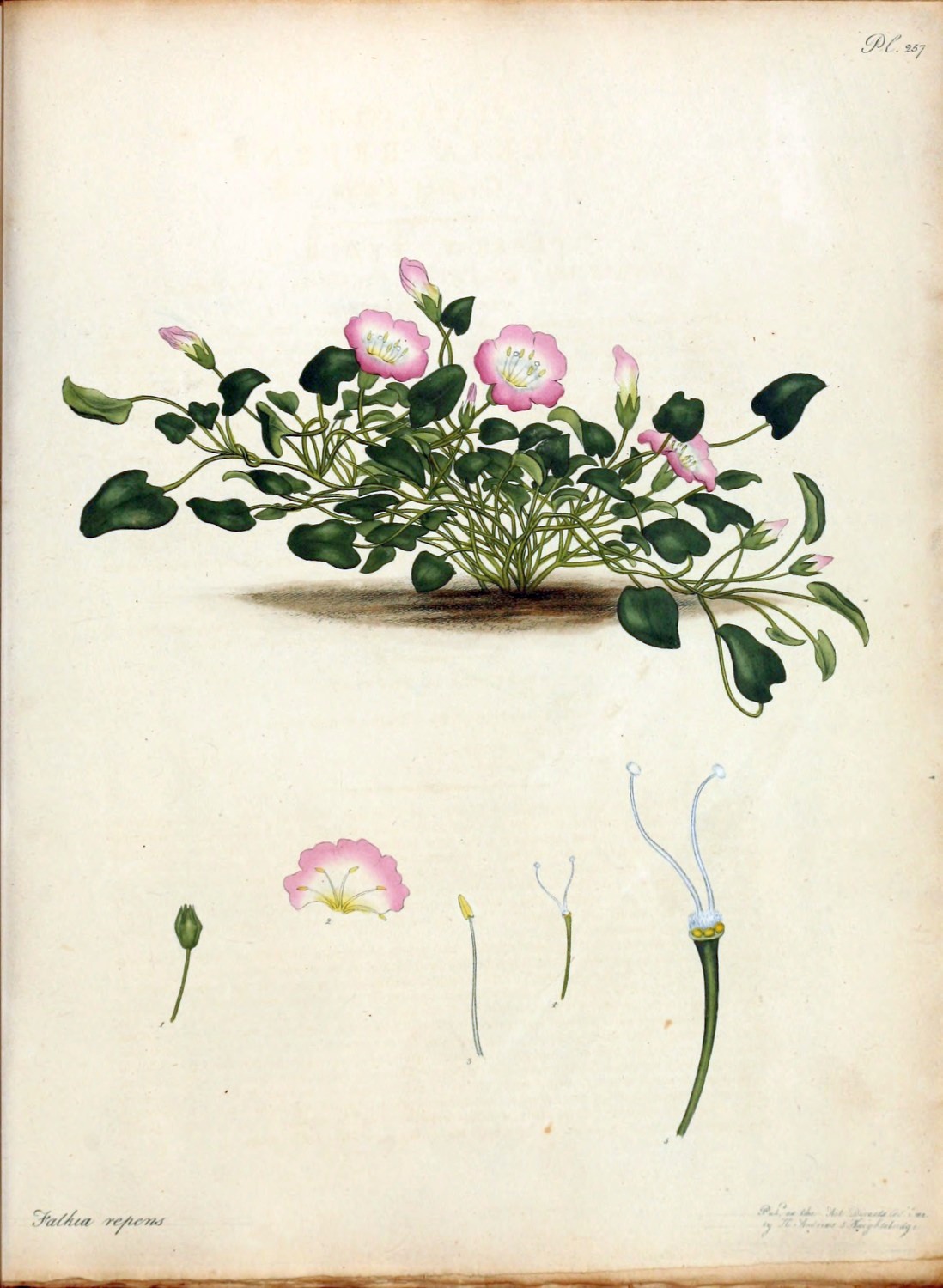
Volume 4 — PLATE CCLVII. FALKIA REPENS. Creeping Falkia.
Reading edition
CLASS V. ORDER II.
PENTANDRIA DIGYNIA. Five Chives. Two Pointals.
GENERIC CHARACTER.
Calyx. Perianthium monophyllum, sub-inflatum, corolla duplo brevius, quinquangulatum, quinquepartitum; angulis medio dilatatis, compressis extantibus; laciniis ovatis, acutis.
Corolla monopetala, campanulata, crenato-decem-partita; limbo patente.
Stamina. Filamenta quinque, filiformia, tubo corollæ inserta, erecta, inæqualia, corolla breviora. Antheræ ovatæ, compressæ.
Pistilla. Germen quatuor, supera, glabra. Styli duo, capillares, divaricati, longitudine corollæ. Stigmata orbiculata, lanata.
Pericarpium nullum.
Semina quatuor, globosa, arillata, in fundo calycis.
Empalement. Cup one leaf, a little inflated, shorter by half than the blossom, five-cornered, five-parted; the angles widened in the middle, flattened, standing out; segments egg-shaped, pointed.
Blossom one-petal, bell-shaped, ten-parted by scollops; border spreading.
Chives. Threads five, hair like, inserted into the tube of the blossom, erect, unequal, shorter than the blossom. Tips egg-shaped, flattened.
Pointals. Seed-buds four, above, smooth. Shafts two, hair-like, straddling, the length of the blossom. Summits orbicular, woolly.
Seed-vessel none.
Seeds four, globular, covered by a coat, at the bottom of the cup.
SPECIFIC CHARACTER.
Falkia foliis cordatis, petiolis longissimis; caule repente.
Falkia with heart-shaped leaves, and very long foot-stalks; creeping stem.
REFERENCE TO THE PLATE.
1. The Cup.
2. A Blossom spread open, with the chives in their place.
3. A Chive magnified.
4. The Pointals, natural size.
5. The same, magnified.
This pretty little plant was first found by Masson and Thunberg, when on their journey together in the interior of the country of the Cape of Good Hope, and was named by Thunberg after Professor Falk of Petersburgh. It was introduced to the Kew gardens in the year 1774. Much as it resembles Convolvulus, it still has a greater affinity to Nolana in all its outward parts, but especially in the cup of the flower, and the situation and character of the seeds. Although the plant is not shrubby, the stems, which are wiry, do not die down in winter, but take root, if laid close to the earth. It is encreased by parting the roots in May; should be planted in sandy loam, and kept in the green-house, where it will blossom in July or August. Our figure is from a plant which flowered in the collection of J. Vere, Esq. Kensington Gore.
It is rather singular that the indefatigable, and generally accurate, Willdenow, should have continued this plant in the sixth class, when he had such authority, as may be found, page 325, Vol. I, in the Catalogue of the Kew Garden (where it unquestionably has flowered) for the removal of it to its proper one, the fifth. It is true, he had reason to suppose, that no man would be rash enough to form a new Genus, without a due examination of the plant, on which he grounds his authority; and that, as Thunberg had discovered and named it, his authority was sufficient, and of greater weight than any other. But, unfortunately, in this instance, for the transcriber, the describer has been mistaken, and has led his followers into error. Indeed, the whole plant in its habit and character has so little affinity to any hexandrous genus, that, although Thunberg might have found a single flower, or even a whole plant, whose flowers had six chives (a circumstance we have not been able to discover, upon an examination of the flowers from four different plants), in such a case, as a botanist, he ought to have looked farther, before he made so violent a decision; and Willdenow ought to have taken it for granted the alteration would not have been made, but upon due consideration.