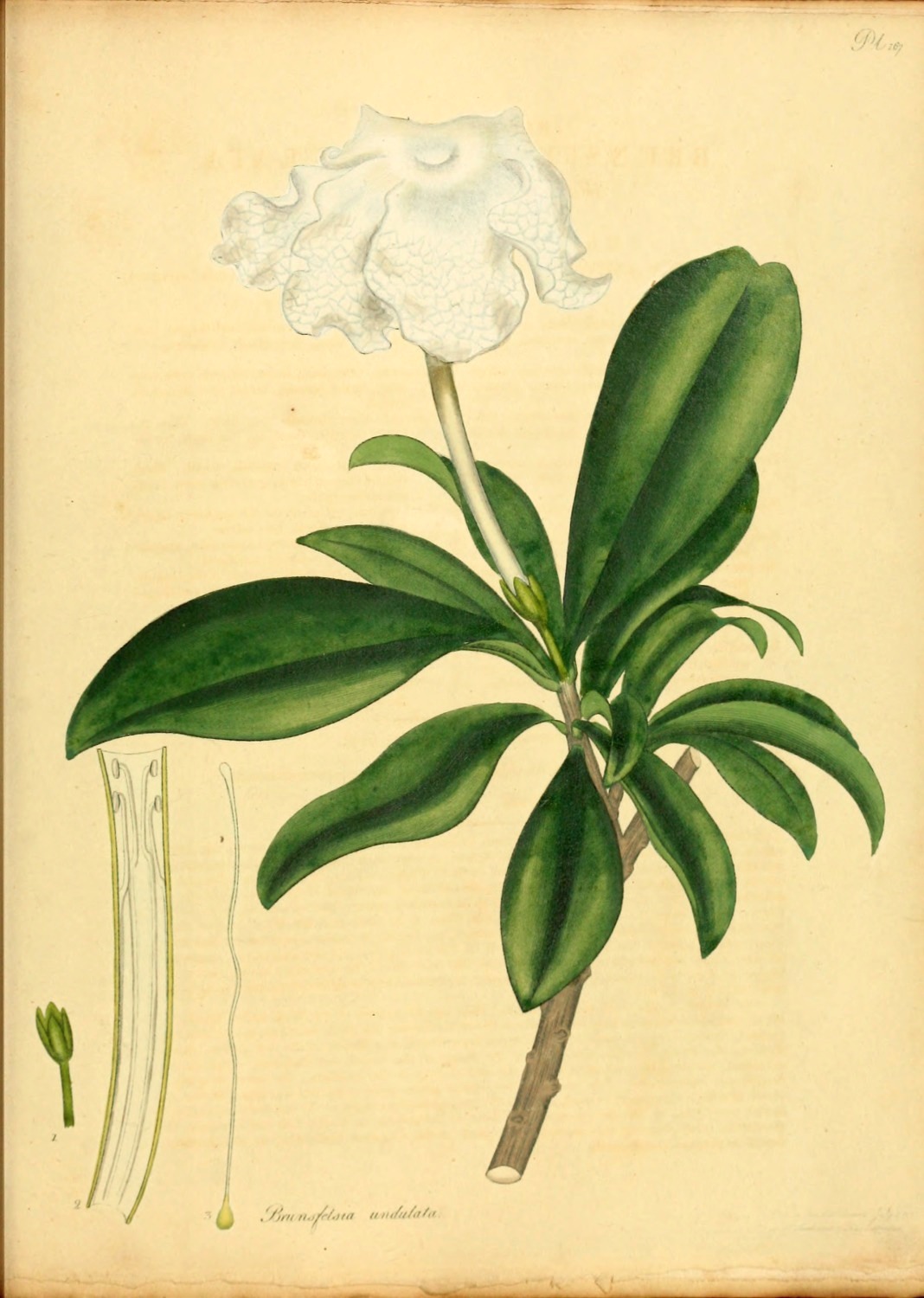
Volume 3 — PLATE CLXVII. BRUNSFELSIA UNDULATA. Waved-flowered Brunsfelsia.
Reading edition
CLASS XIV. ORDER II.
DIDYNAMIA ANGIOSPERMIA. Two Chives longer. Seeds covered.
GENERIC CHARACTER.
Calyx. Perianthium monophyllum, campanulatum, quinquedentatum, obtusum, minimum, persitens.
Corolla monopetala, infundibuliformis; tubus longissimus, subincurvus; limbus planus, quinquefidus, obtusus.
Stamina. Filamenta quatuor, brevissima. Antheræ oblongæ, erectæ, filamentis dorso affixæ.
Pistillum. Germen subrotundum, parvum. Stylus filiformis, longitudine tubi. Stigma crassiusculum.
Pericarpium. Capsula extus baccata, globosa, unilocularis, bivalvis.
Semina plurima, compressa, hinc convexa, inde angulata, punctato-scabra.
Receptaculum fundo capsulæ adnatum, paleaceum; paleis coadunatis, apice subulatis, semina distinguentibus.
Empalement. Cup one leaf, bell-shaped, five-toothed, blunt, very small, remaining.
Blossom. One petal, funnel-shaped; tube very long, rather curved; border flat, five-cleft, obtuse.
Chives. Four threads, very short. Tips oblong, upright, fixed by the back to the threads.
Pointal. Seed-bud roundish, small. Shaft thread-shaped, the length of the tube. Summit rather fleshy.
Seed-vessel. Capsule on the outside a berry, globular, one cell, two valves.
Seeds many, flat, convex on one side, angular on the other, roughly punctured.
Receptacle fixed to the bottom of the capsule, chaffy; chaffs joining at the base, awl shaped at the point, separating the seeds.
SPECIFIC CHARACTER.
Brunsfelsia foliis lanceolato-obovatis, utrinque acuminatis, petiolis brevissimis; tubus parum incurvatus, laciniis limbi undulatis.
Brunsfelsia with leaves between lance and inversely egg-shaped, tapered to both ends, footstalks very short; tube a little incurved, the segments of the border waved.
REFERENCE TO THE PLATE.
1. The Empalement.
2. The tube of the blossom cut open, to shew the insertion and character of the Chives.
3. The Pointal and Seed-bud.
The Genus Brunsfelsia (by Plumier so named, in honour of Otho Brunsfels a monk, the first who edited in 1530 a Botanical work with good figures, it contained 238 plates) has undergone a very necessary revision since the days of Linnæus; indeed, it appears singular that Father Plumier, from whom Linnæus quotes his Generic character, should have committed so great an oversight, as to describe it with five chives; a feature scarcely to be expected, from a sport of nature, in plants of this Class. So however it is on record, and the fifth Class of the Gen. and Spe. Plant, and of the Syst. Nat. tom. ii. each includes this Genus; from which, we should be induced to think he had designed some other plant; if the figure, and the rest of the description, did not confirm it. Schreber, in his Gen. Plant, has likewise an observation, that the fruit should be named a capsule, rather than a berry; as given by Linnæus, Miller, and Swartz; his reason, that it splits determinately, by a suture, from the top to the base.
Our species, is the third now in Britain; they are all natives of the West India Islands. The 1st B. americana has been long an inhabitant of our hothouses; the 2d B. maculata is but little known to most, though long cultivated here; as it has been treated as a variety of the first species, notwithstanding the strong specific difference, in the shape of the leaves and blossoms; which in the B. maculata, are beautifully marked at the base, and as large as the undulata; the leaves inversely egg-shaped and more downy. The present plant seldom grows more than four feet high, flowers freely about March, is very sweet scented, and is easily propagated by cuttings. It was first sent to England in the year 1784 by Mr. Elcock from the Island of Barbadoes, to Messrs. Lee and Kennedy, Hammersmith. Our drawing was made from a plant in the Clapham Collection, in March 1800. It should be planted in rich earth.