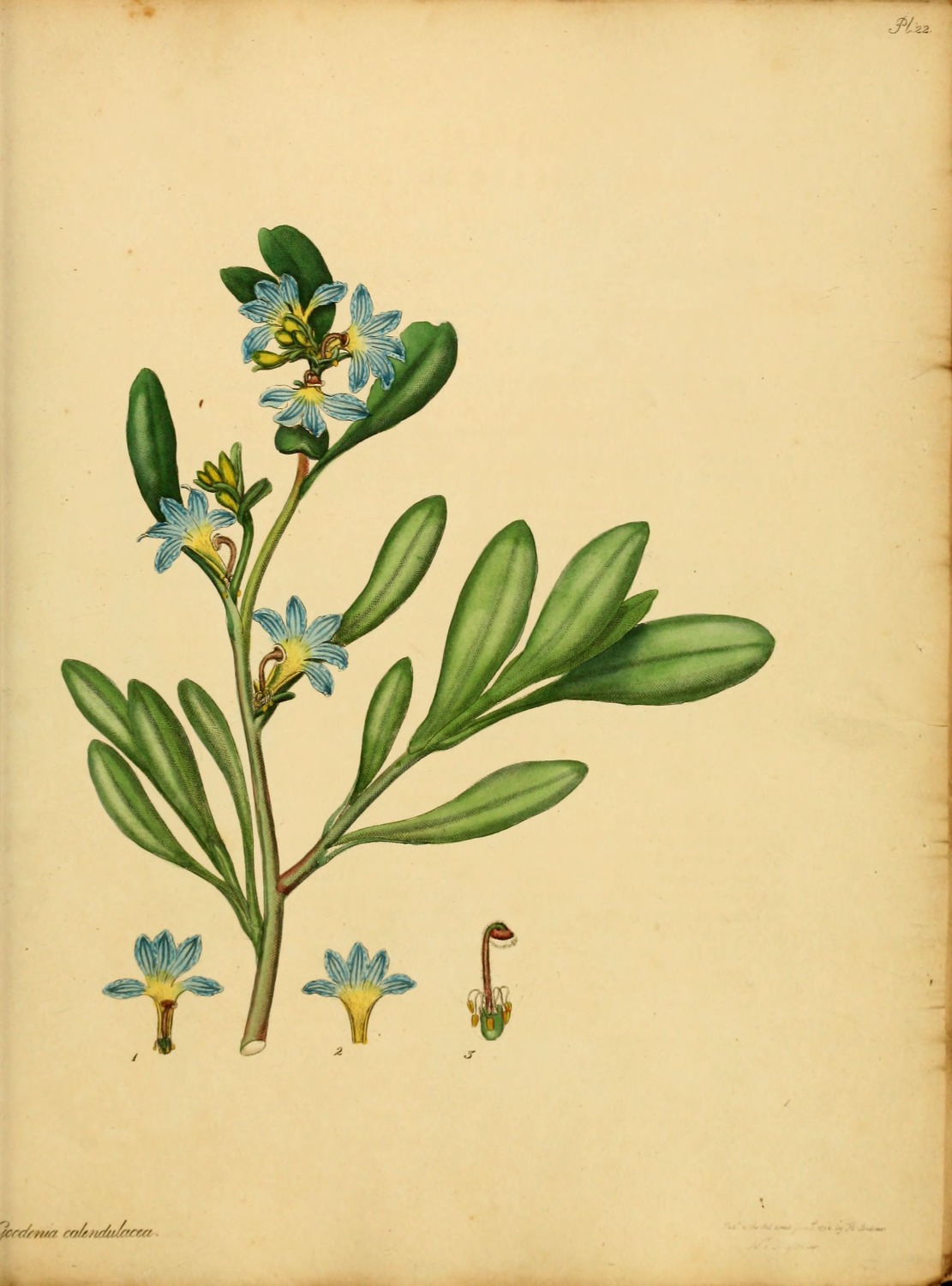
Volume 1 — PLATE XXII. GOODENIA CALENDULACEA. Cape Marygold-leaved Goodenia.
Reading edition
CLASS V. ORDER I.
PENTANDRIA MONOGYNIA. Five Chives. One Pointal.
GENERIC CHARACTER.
Calyx. Perianthium quadrifidum, superum, persistens.
Corolla monopetala, supra longitudinaliter fissa, genitalia exferens; limbo quinquefido, secundo.
Stamina. Filamenta quinque, receptaculo inserta. Antheræ lineares.
Pistillum. Germen inferum. Stylus simplex. Stigma urceolatum, ciliatum.
Pericarpium. Capsula oblonga, bilocularis, bivalvis; dissepimento parallelo.
Semina plura, scabrida.
Empalement. Cup four-cleft, above, and remaining.
Blossom of one leaf, cleft longitudinally on the upper side, exposing the organs of fructification; border five-cleft, leaning one way.
Chives. Five threads fixed into the receptacle. Tips linear.
Pointal. Seed-bud beneath. Shaft simple. Summit pitcher-shaped, and fringed.
Seed-vessel. Capsule oblong, with two cells, and two valves; partition parallel to the valves.
Seeds many and rough.
SPECIFIC CHARACTER.
Goodenia, foliis obovatis, crassis, scabridis; floribus axilaribus, cæruleis.
Goodenia with inversely egg-shaped, thick rough leaves; flowers sitting close to the stem, and blue.
REFERENCE TO THE PLATE.
1. A Flower with all its parts complete. 2. A Blossom without the organs of fructification. 3. The Chives, Pointal, and Seed-bud (magnified).
The Goodenias are all natives of New Holland, and received their generic name of Dr. J. E. Smith, President of the Linnæan Society; in honour of the Rev. Dr. Goodenough, whose valuable dissertation on the British species of Carex, does him the highest honour, as a botanist. The species of this genus (as yet discovered) are ten, from which we may infer that they are numerous; those only yet introduced to Britain are, the lævigata, ovata, and the present species; the others are described by the President, in the second volume of the Linnæan Transactions. This plant, though not to be ranked amongst the handsomest productions of that country, so replete with novelty, is yet possessed of sufficient merit to give it a place in our collections of greenhouse plants, flowering about the month of August; delighting most in an airy situation, and light soil. It is easily propagated by cuttings. Our figure was taken from a plant which flowered at the Hammersmith nursery, in 1797; where it had been raised from seeds, communicated by Colonel Paterson, then commanding at Port Jackson; to whose assiduous labours in collecting seeds, &c. the cabinets and collections of our natural historians are so very much indebted.
PLATE 22