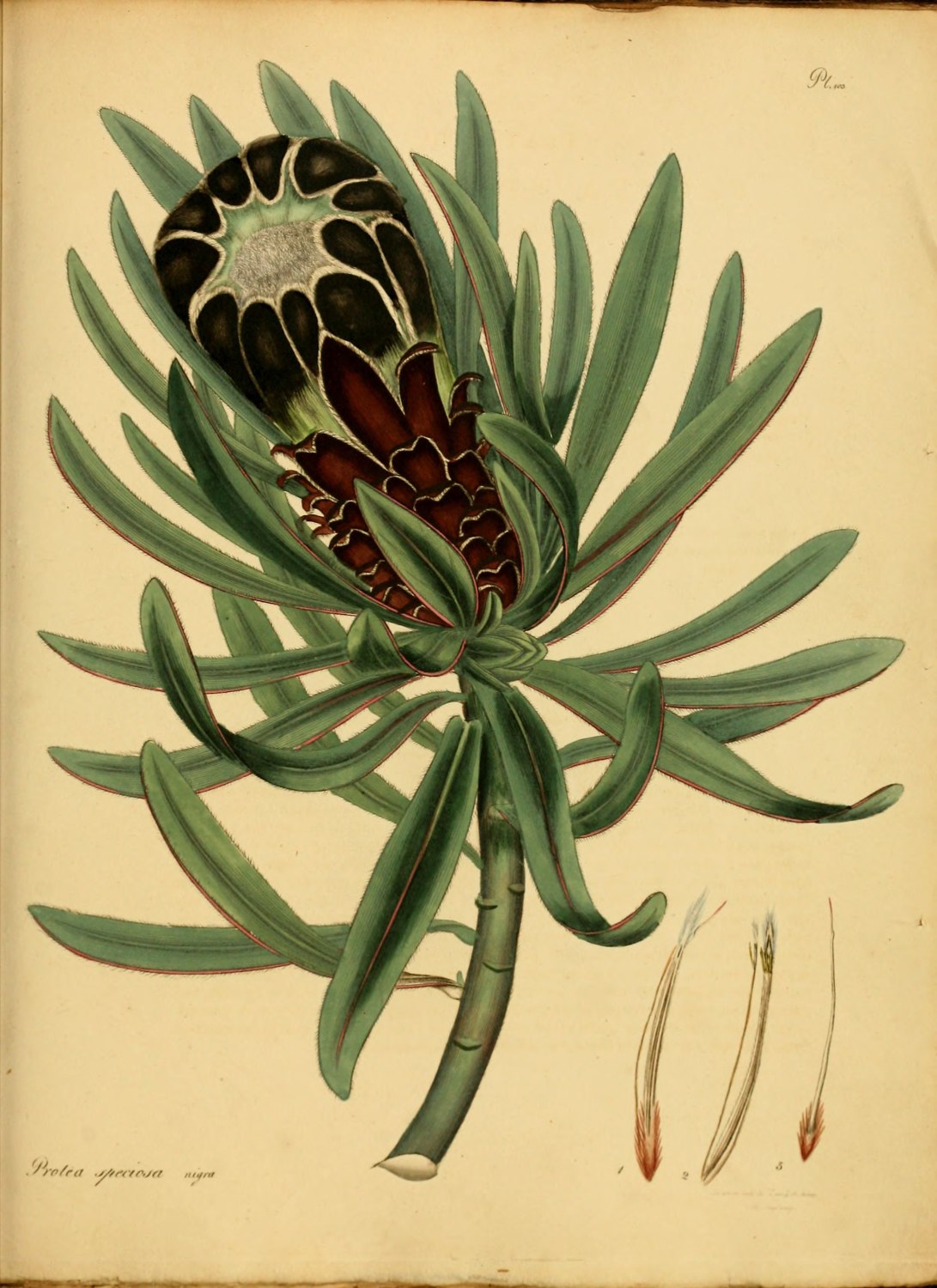
Volume 2 — PLATE CIII. PROTEA SPECIOSA, nigra. Black-flowered Protea.
Reading edition
CLASS IV. ORDER I.
TETRANDRIA MONOGYNIA. Four Chives. One Pointal.
ESSENTIAL GENERIC CHARACTER.
Corolla 4-fida, seu 4-petala. Antheræ lineares, insertæ petalis infra apicem. Calyx proprius, nullus. Sem. folitaria.
Blossom 4-cleft, or of 4 petals. Tips linear, inserted into the petals below the points. Cup proper, none. Seeds solitary.
See Protea formosa, Vol. I. Plate XVII.
SPECIFIC CHARACTER.
Protea foliis longis, lineari-lanceolatis; squamæ calycinæ interiores apice incurvatæ, barbatæ, nigræ.
Protea with long leaves, between linear and lance-shaped; the inner scales of the empalement are turned inward at the end, bearded, and black.
REFERENCE TO THE PLATE.
1. A Blossom complete, as it stands in the Empalement. 2. The four Petals of the Flower thrown open, to shew the situation and character of the tips. 3. The Seed-bud, Shaft, and Summit.
It is to the curious and beautiful structure of the empalement, (the flowers being nearly concealed within it,) that this species of Protea owes its specific title, and for which it is so much admired. There are different varieties of it, which are considered by Thunberg, in his Diss. de Prot. of 1781, as distinct species; but which are certainly only varieties of one stock: we have drawings of two of these, the one flesh-coloured, the other white; and hope to be able to demonstrate as just, our postulatum, when the synonims are given, as proposed, at the close of this volume. This plant was first introduced to the Royal Gardens at Kew, from the Cape of Good Hope, in 1786, by Mr. F. Masson: it flowers at a very early age, and when the stem is not more than two feet high, mostly from the centre or leading branch of the plant. It is propagated by cuttings, which should be put in about the end of May, three or four, at most, in a pot, filled with good stiff loam, which should be pressed hard to the lower end of the cuttings, and the pot placed under a hand-glass in the shade. When the plants are to be removed into separate pots, it will be necessary to add a small portion of peat earth to the loam, and place them in an airy and dry part of the greenhouse. These directions are necessary to be observed, in the culture of nearly every species of this extended genus. Our figure was taken in the month of July 1799, from a plant in the Hibbertian collection, Clapham-common.
PLATE 103