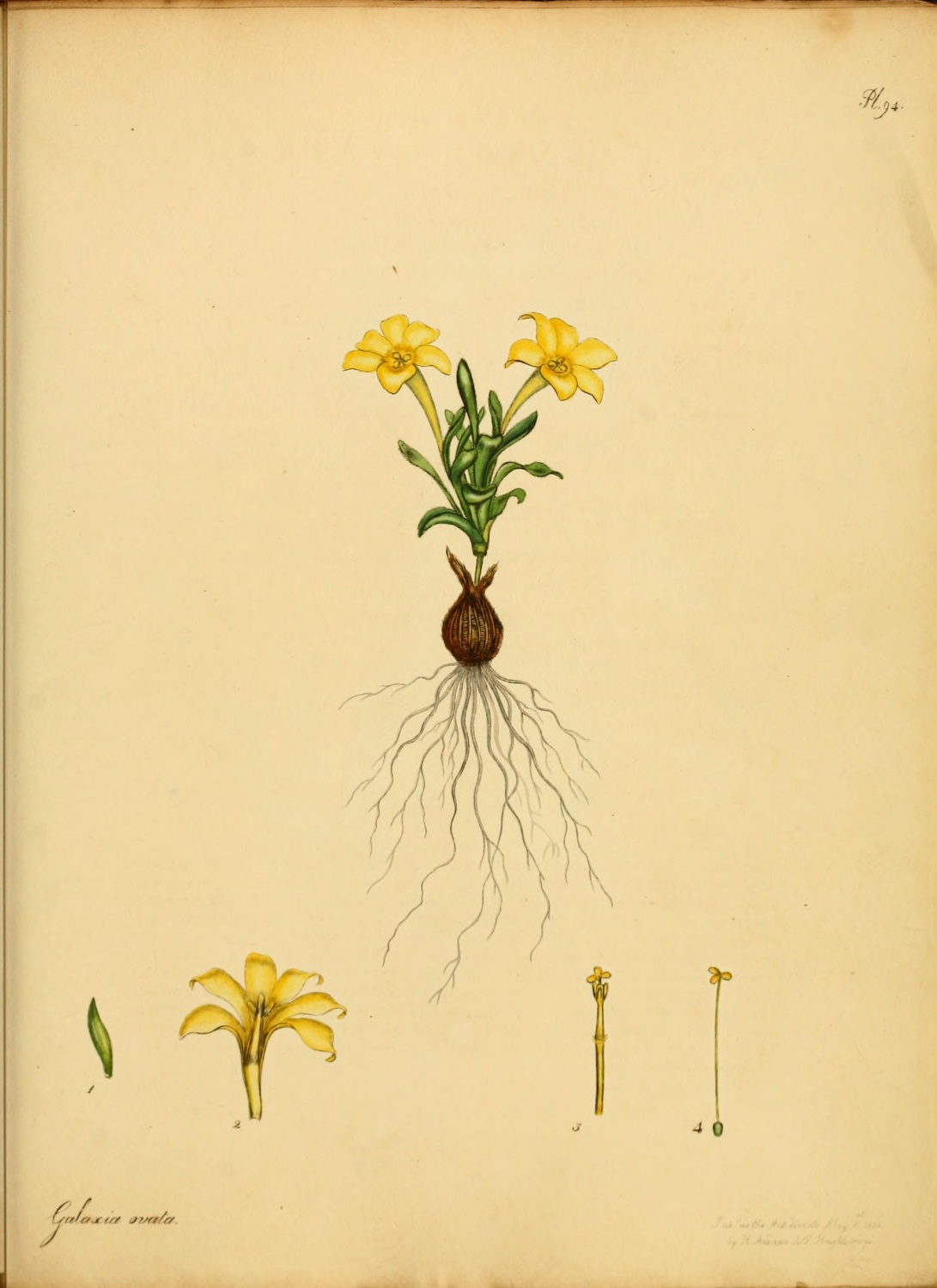
Volume 2 — PLATE XCIV. GALAXIA OVATA. Oval-leaved Galaxia.
Reading edition
CLASS XVI. ORDER I.
MONADELPHIA TRIANDRIA. Threads united. Three Chives.
GENERIC CHARACTER.
Calyx. Spatha univalvis, membranacea, connivens.
Corolla monopetala, supra; tubus filiformis, longus, erectus, apice paullulum ampliatus; limbus sexpartitus; laciniis obovatis, patentibus.
Stamina. Filamenta tria, in cylindrum conata. Antheræ ovatæ.
Pistillum. Germen inserum, obtuse triangulare, glabrum. Stylus filiformis, staminibus paullo longior. Stigmata tria, filiformi-multipartita, patentia.
Pericarpium. Capsula oblongo-subcylindrica, trisulca, trilocularis, trivalvis.
Semina plurima, globosa, minima.
Empalement. Sheath of one valve, skinny, and closing.
Blossom, one leaf, above; tube thread-shaped, long, upright, the upper part a little widened; border divided into six parts; segments inversely egg-shaped and spreading.
Chives. Three threads forming a cylinder. Tips egg-shaped.
Pointal. Seed-bud beneath, obtusely triangular and smooth. Shaft thread-shaped, a little longer than the chives. Three summits, each divided into a number of small threads, and spreading.
Seed-vessel. Capsule of an oblong, and almost cylindrical shape, with three furrows, three cells, and three valves.
Seeds numerous, globular, and small.
SPECIFIC CHARACTER.
Galaxia foliis ovatis margine ciliatis; corollis longissimis, arcuatis, flavis.
Galaxia with egg-shaped leaves, fringed at the edge; blossoms very long, bowed, and yellow.
REFERENCE TO THE PLATE.
1. The Sheath. 2. A Flower cut open, to shew where the threads are fixed to the tube of the blossom. 3. The Chives with the Pointal inclosed, the Blossom cut away. 4. The Pointal and Seed-bud.
Any species of this Genus, must be interesting to the English botanist; as, till last year, not one was to be found, in any collection of this country. The G. ovata is figured in Cavanilles, Diss. 6. p. 340. t. 189; and described by Thunberg, in his Nova Genera Plantarum, p. 50. It is a most singular little plant, but we much fear will prove a fugitive to us; like the Ferraria, (to which in many particulars it very nearly affines) its beauty is but of a few hours duration: indeed, so short is the period, that had not Mr. Hibbert taken a sketch of it, whilst in perfection; and from which our drawing was completed, we could not have accomplished a figure of it. As yet, the true season of its flowering cannot be ascertained; but, it was in the month of October, that the plant flowered last year 1779; the bulbs having been received, from the collector for the Clapham collection, still at the Cape, in the spring of the same year. The treatment for this, appears to be the same as that necessary for most Cape bulbs; light sandy peat, a little warmth when approaching to flower; and to be removed from the pot afterwards.
PLATE 94