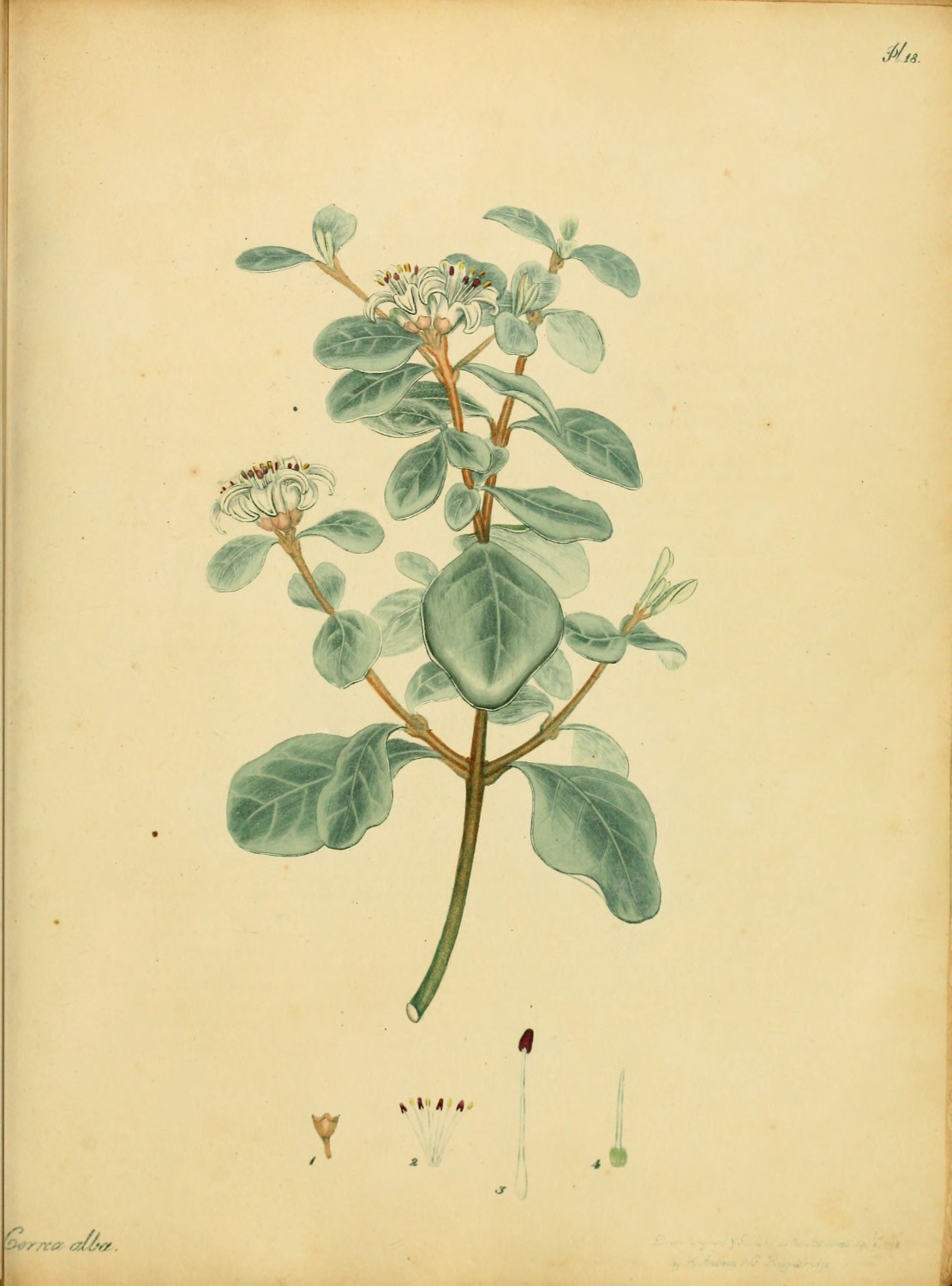
Volume 1 — PLATE XVIII. CORREA ALBA. White Correa.
Reading edition
CLASS VIII. ORDER I.
OCTANDRIA MONOGYNIA. Eight Chives. One Pointal.
GENERIC CHARACTER.
Calyx. Perianthium monophyllum, quadridentatum, campanulatum, erectum, persistens.
Corolla. Petala quatuor, oblonga, concava, apice reflexa, marginibus crassis.
Stamina. Filamenta octo, erecta, filiformia, receptaculo inserta.
Pistillum. Germen turbinatum, superum. Stylus filiformis, longitudine staminium. Stigma obtusum.
Pericarpium. Capsula coriatea, lanata, quadrilocularis, quadrivalvis.
Semina quatuor, solitaria, subrotunda.
Empalement. Cup of one leaf, five-toothed, bell-shaped, upright, and permanent.
Blossom. Four petals, oblong, concave, reflexed at the end, and thick at the edges.
Chives. Eight threads, upright, thread shaped, and fixed into the receptacle.
Pointal. Seed-bud turban-shaped, and above. Shaft thread-shaped, the length of the chives. Summit blunt.
Seed-vessel. Capsule leathery, and woolly, four cells, four valves.
Seeds, four, solitary, and nearly round.
SPECIFIC CHARACTER.
Correa, foliis subrotundis, supra tomentosis, subtus lanigeris; floribus terminalibus, quaternis, albidis.
Correa, with leaves nearly round, downy on the upper surface, woolly on the under surface; flowers terminate the branches by fours, and are white.
REFERENCE TO THE PLATE.
1. The Empalement. 2. The Chives, and Pointal. 3. A Thread, and Tip, (magnified.) 4. The Shaft and Summit, (magnified.)
The Correa is a native of Port Jackson, in New Holland, and commonly termed a Botany-bay plant: it was first raised in the year 1793, from seeds which were given by Sir Joseph Banks, Bart. to J. Vere, Esq. of Kensington-gore, and from a plant in whose collection our figure was taken. It receives its generic title from Mr. Joseph Correa de Serra, a native of Portugal; a gentleman of very distinguished talents as a man of science in general, and botany in particular. Of this genus there are as yet but few species discovered; the Alba grows to a shrub of the height of four or five feet, woody and tough; both stem and leaves are covered with a thick flannelly substance, particularly the under side of the leaves, which gives the whole plant a whitish appearance. It continues to flower through the months of April, May, and June; may be propagated easily by cuttings, should be kept as a hardy greenhouse plant, and thrives best in peat earth.
PLATE 18