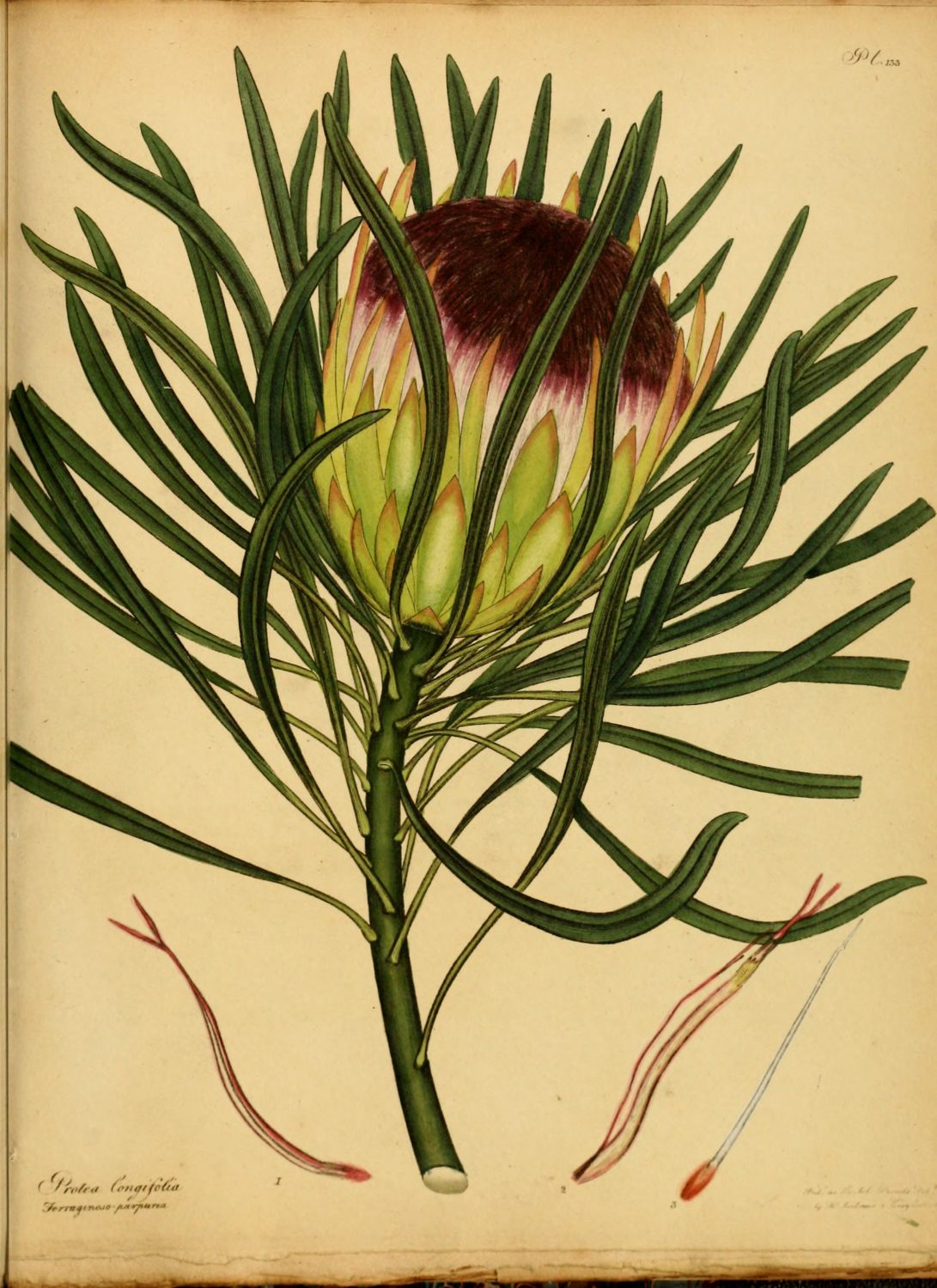
Volume 2 — PLATE CXXXIII. PROTEA LONGIFOLIA. Ferruginoso-purpurea. Long-leaved Protea. Rusty-purple flower.
Reading edition
CLASS IV. ORDER I.
TETRANDRIA MONOGYNIA. Four Chives. One Pointal.
ESSENTIAL GENERIC CHARACTER.
Corolla 4-fida seu 4-petala. Antheræ lineares, insertæ petalis infra apicem. Calyx proprius nullus. Semina solitaria.
Blossom 4-cleft or four petals. Tips linear inserted into the petals below the point. Cup proper none. Seeds solitary.
See Protea speciosa. Pl. XVII. Vol. I.
SPECIFIC CHARACTER.
Protea foliis sub-linearibus, angustis, obliquis, rigidis, longissimis; squamis interioribus calycis lanceolatis erectis; florum plumis ferruginoso-purpureis; conus subglobosus.
Protea with nearly linear leaves, narrow, oblique, harsh and very long; the inner scales of the cup are lance-shaped and upright; the plume of flowers are of a rusty-purple; the cone nearly globe-shaped.
REFERENCE TO THE PLATE.
1. A Blossom complete, with the seed-bud attached. 2. The Petals of the flower spread open, to expose the situation of the Tips. 3. The Seed-bud, Shaft and Summit.
That the attention of the scientific and other collectors and cultivators of exotics, in this kingdom, may be brought to a better acquaintance, with this fine, very extended, yet much neglected Genus; the species of which, now in Britain, amount to more than seventy, has been our chief aim, in endeavouring to lay before them, figures of some of the most rare and beautiful; one of which we deem the present.
This variety of Long-leaved Protea, is figured in Boerhaave’s Index to the Leyden garden, Part 2. p. 186, as one of his Lepidocarpodendrons, and has been given, by Willdenow in his Sp. plant. Tom. I. p. 531, as a synonim of P. speciosa, quoted from Thunberg’s prod. 27. Diss. de Prot.
The culture and treatment of this plant, is the same as P. speciosa, to which we refer our readers.
From a fine plant, in the Hibbertian collection, our drawing was taken in the month of July this year. It was introduced to us from the Royal Gardens at Schonbrun in Germany, communicated by the superintendant to Messrs. Lee and Kennedy, Hammersmith, the seeds having been received from the collector for the Emperor, at the Cape.
PLATE 133