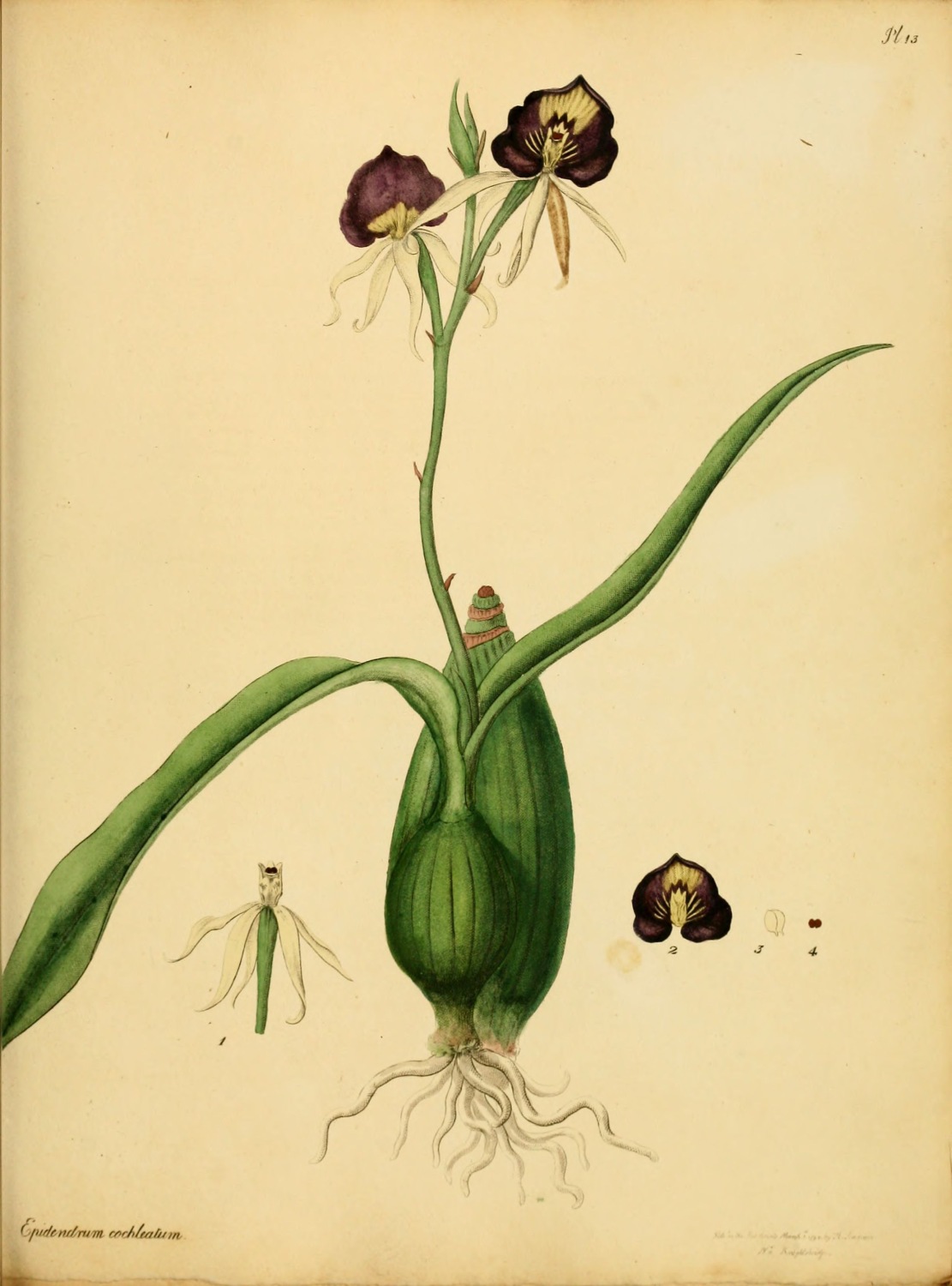
Volume 1 — PLATE XIII. EPIDENDRUM COCHLEATUM. Purple flowered Epidendrum.
Reading edition
CLASS XX. ORDER I.
GYNANDRIA DIANDRIA. Chives on the Pointal. Two Chives.
GENERIC CHARACTER.
Calyx. Spathæ vagæ. Spadix simplex. Perianthium nullum.
Corolla. Petala quinque, oblonga, longissima, patentissima.
Nectarium basi tubulatum, turbinatum, intra petala deorsum positum, ore obliquo, bifido: superiori labio brevissimo, trifido; inferiori in acumen producto.
Stamina. Filamenta duo, brevissima, pistillo insidentia. Antheræ tectæ labio superiore nectarii.
Pistillum. Germen tenue, longum, contortum, inferum. Stylus brevissimus, adnatus labio superiori nectarii. Stigma obsoletum.
Pericarpium. Siliqua longissima, teres, carnosa.
Semina numerosa, minutissima.
Empalement. Sheaths scattered. Fruit-stalk simple. Cup none.
Blossom. Five petals, oblong, of a great length, and spreading much.
Honey-cup tubular at the base, turban-shaped, placed between the lower petals, mouth oblique and divided: the upper lip very short, cut into three divisions; the lower terminating in a point.
Chives. Two very short threads, fixed on the pointal. Tips covered by the upper lip of the honey-cup.
Pointal. Seed-bud slender, long, twisted, and beneath. Shaft very short, fixed to the upper lip of the honey-cup. Summit blunt.
Seed-vessel. Pod very long, round, and fleshy.
Seeds numerous, extremely small.
SPECIFIC CHARACTER.
Epidendrum foliis oblongis, geminis, glabris, bulbo innatis; scapo multifloro; nectario cordato, purpureo.
Epidendrum with oblong leaves growing by pairs, smooth, rising from the bulb; stalk many flowered; honey-cup heart-shaped and purple.
REFERENCE TO THE PLATE.
1. The Blossom, without the Honey-cup; disposed to shew the situation of the Chives, and Pointal, which are covered by the Honey-cup.
2. The Honey-cup.
3. The Tips.
4. The Summits.
Of all plants, none furnish a more agreeable speculation to the Botanist, than those of this class; the singular construction of the whole flower, leads the observer to form analogous comparisons from it to animal life: particularly amongst the Orchis, and Ophris, of our own country; where bees, flies, lizzards, and butterflies are accurately shaped in the honey-cup. The Genus Epidendrum, takes its Generic title from its place of growth, being what Botanists term parasitical, that is, growing on another plant; which is the case, with most of the species of this Genus: yet is cultivated here with success, by planting it in a mixture of rotten wood, and loam. A plant, from which this figure was taken, was a present to Messrs. Lee and Kennedy from the Honourable Mrs. Barrington, who received it from Dr. Dancer’s botanical garden Jamaica, of which island it is a native; therefore must be kept in the stove. It is propagated by dividing the bulbs.
PLATE 13