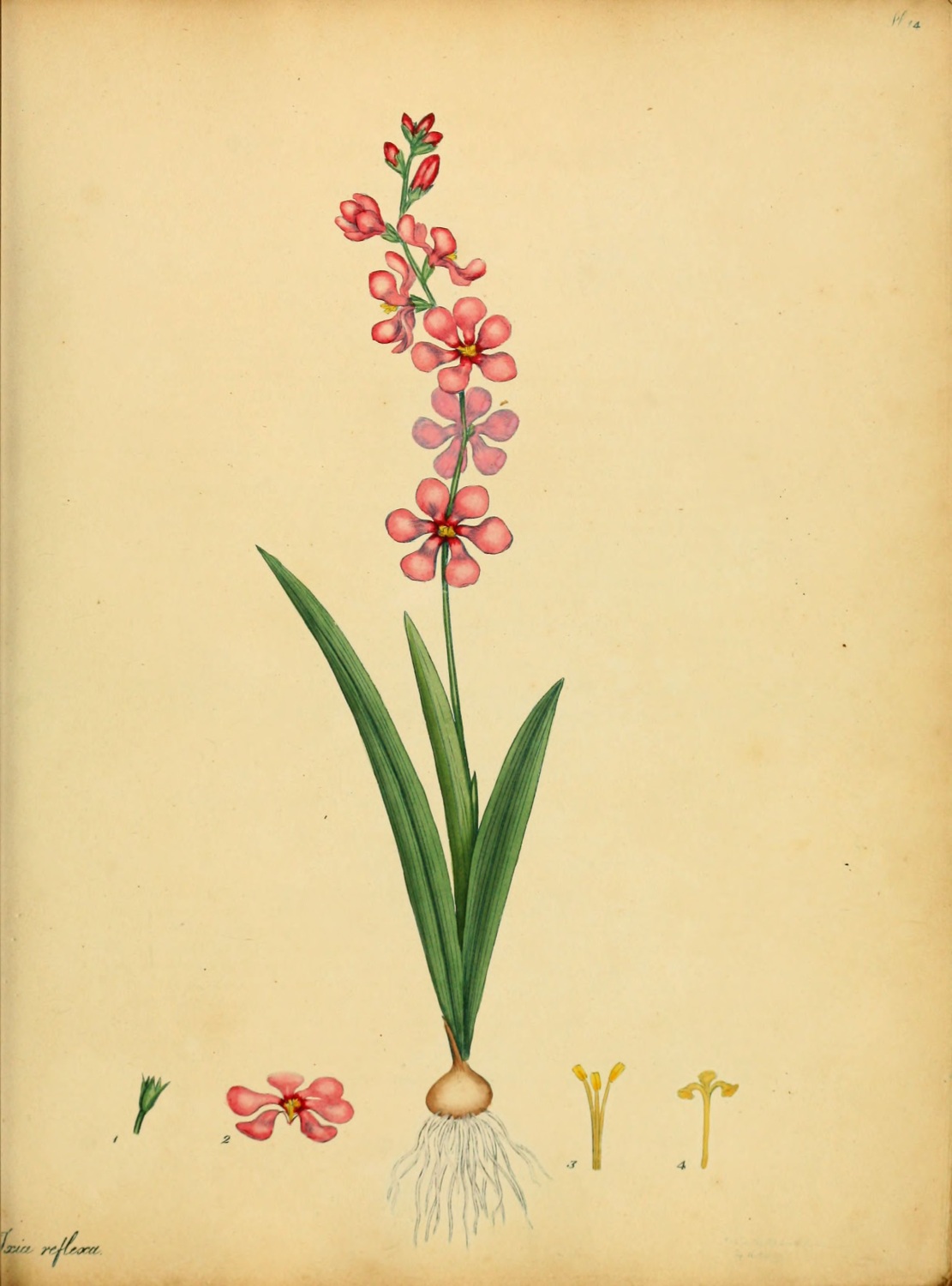
Volume 1 — PLATE XIV. IXIA REFLEXA. Reflex flowered Ixia.
Reading edition
CLASS III. ORDER I.
TRIANDRIA MONOGYNIA. Three Chives. One Pointal.
GENERIC CHARACTER.
Calyx. Spathæ bivalves, oblongæ, persistentes, germina distinguentes.
Corolla. Petala sex, oblonga, æqualia, lanceolata.
Stamina. Filamenta tria, subulata, corolla breviora, situ æqualia. Antheræ simplices.
Pistillum. Germen inferum, ovatum, triquetrum. Stylus simplex, erectus, longitudine staminum. Stigma trifidum, crassiusculum.
Pericarpium. Capsula subovata, triquetra, trilocularis, loculis compressis, trivalvis.
Semina subrotunda, plurima.
Empalement. Cup two valves, oblong, remaining, and dividing the seed-buds.
Blossom. Six oblong petals of an equal length, and spear-shaped.
Chives. Three awl-shaped threads, shorter than the blossom, placed equally. Tips simple.
Pointal. Seed-bud beneath egg shaped, and three-sided. Shaft simple, upright, the length of the chives. Summit cut into three, and thickish.
Seed-vessel. Capsule, nearly egg-shaped, three-sided, three cells, pressed together, three valves.
Seeds many, nearly round.
SPECIFIC CHARACTER.
Ixia floribus spicatis, reflexis; foliis ensiformibus, glabris.
Ixia, with flowers growing in a spike, and bent backward; leaves sword-shaped, and smooth.
REFERENCE TO THE PLATE.
1. The two Sheaths of the Empalement (magnified). 2. The Blossom. 3. The Chives (magnified). 4. The Pointal (magnified).
No genus exhibits greater diversity, either in the figure, or colour of the blossoms, of its various species than Ixia; the extreme delicacy of their colours, rendering it absolutely necessary to protect them both from wind and rain; even watering them over their heads (as is usual with greenhouse plants), at once destroys their brilliancy. The bulbs of this species were gathered at the Cape, by J. Pringle, Esq. from whom they were sent to Messrs. Lee and Kennedy in 1795, at whose nursery they flowered the ensuing spring, when this figure was taken. No particular treatment is necessary for this plant, other than what is given to Cape bulbs in general, viz., an airy situation, and light soil. Is propagated by seeds, and by the roots.
PLATE 14