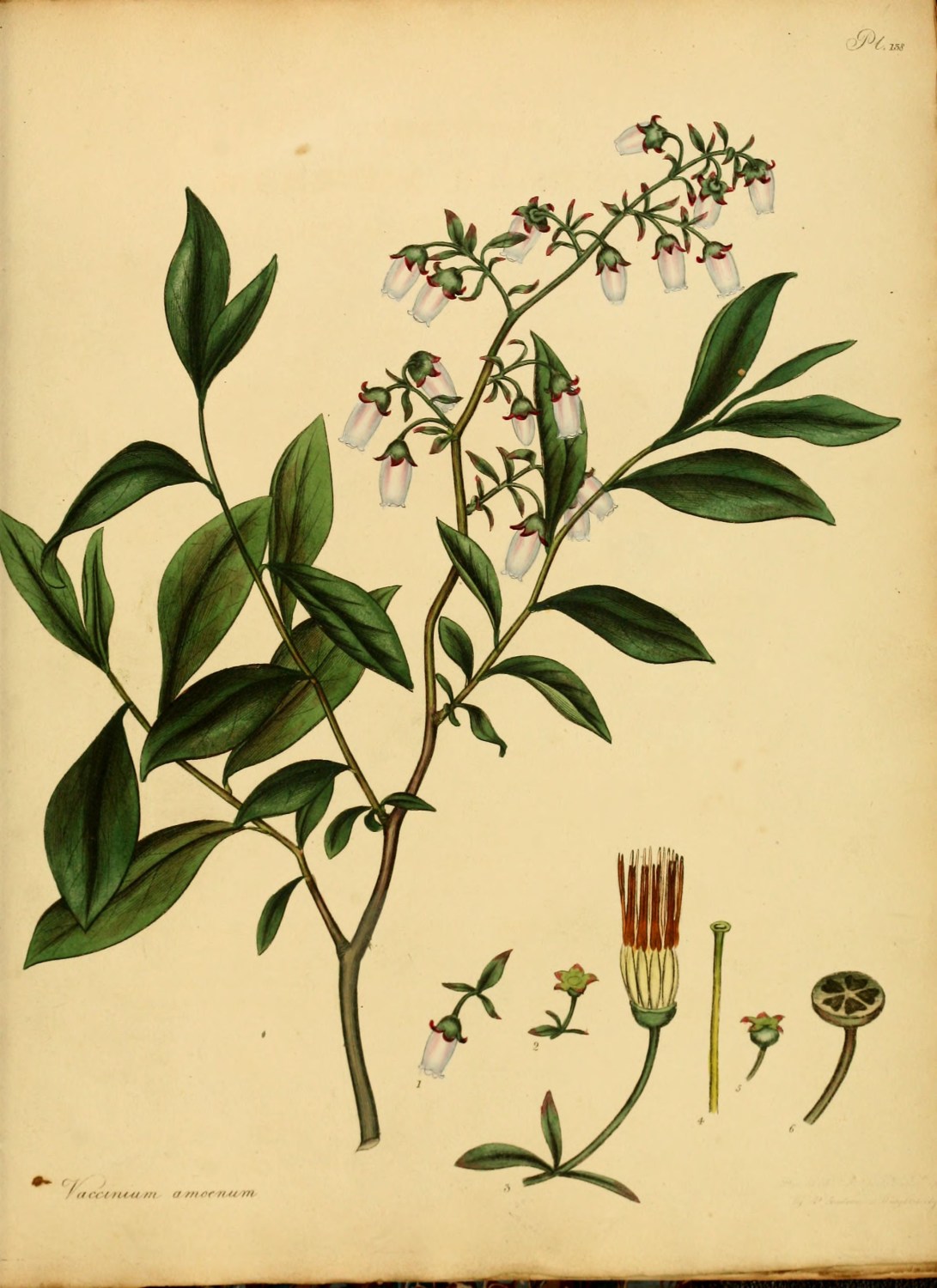
Volume 2 — PLATE CXXXVIII. VACCINIUM AMOENUM. Broad-leaved Whortle-berry.
Reading edition
CLASS VIII. ORDER I.
OCTANDRIA MONOGYNIA. Eight Chives. One Pointal.
ESSENTIAL GENERIC CHARACTER.
Calyx superus. Corolla monopetala.
Filamenta receptaculo inserta. Bacca quadrilocularis, polysperma.
Cup superior. Blossom one petal.
Threads fixed into the receptacle. A Berry with four cells and many seeds.
See Vac. arctostaphyllos, Pl. XXX. Vol. I.
SPECIFIC CHARACTER.
Vaccinium foliis utrinque acuminatis, subserrulatis, deciduis; floribus racemosis, pedunculis bracteatis, calycibus reflexis, corollis cylindraceis. Stamina decem.
Whortle-berry with leaves tapering to both ends, a little sawed at the edges and falling off; flowers grow in long bunches, foot-stalks with floral leaves, cups reflexed, blossoms cylinder-shaped. Ten Chives.
REFERENCE TO THE PLATE.
1. A Flower complete. 2. The Empalement, with the floral leaves. 3. The Chives, magnified. 4. The Shaft and its Summit, magnified. 5. A nearly ripe Berry. 6. The same, cut transversely, magnified.
This very handsome species of Whortleberry was introduced, from North America, in the year 1765, by Mr. John Cree, Nurseryman, of Addlestone, amongst many others. It is a hardy plant, in our climate. This species inclines to a loamy, rather than a peat soil, and is propagated by suckers, which it throws up from the root, or from layers; which may be put down in May, and taken off the succeeding year. Its time of flowering is about June or July, in which latter month our drawing was made last year, at Messrs. Lee and Kennedy’s, Hammersmith.
PLATE 138