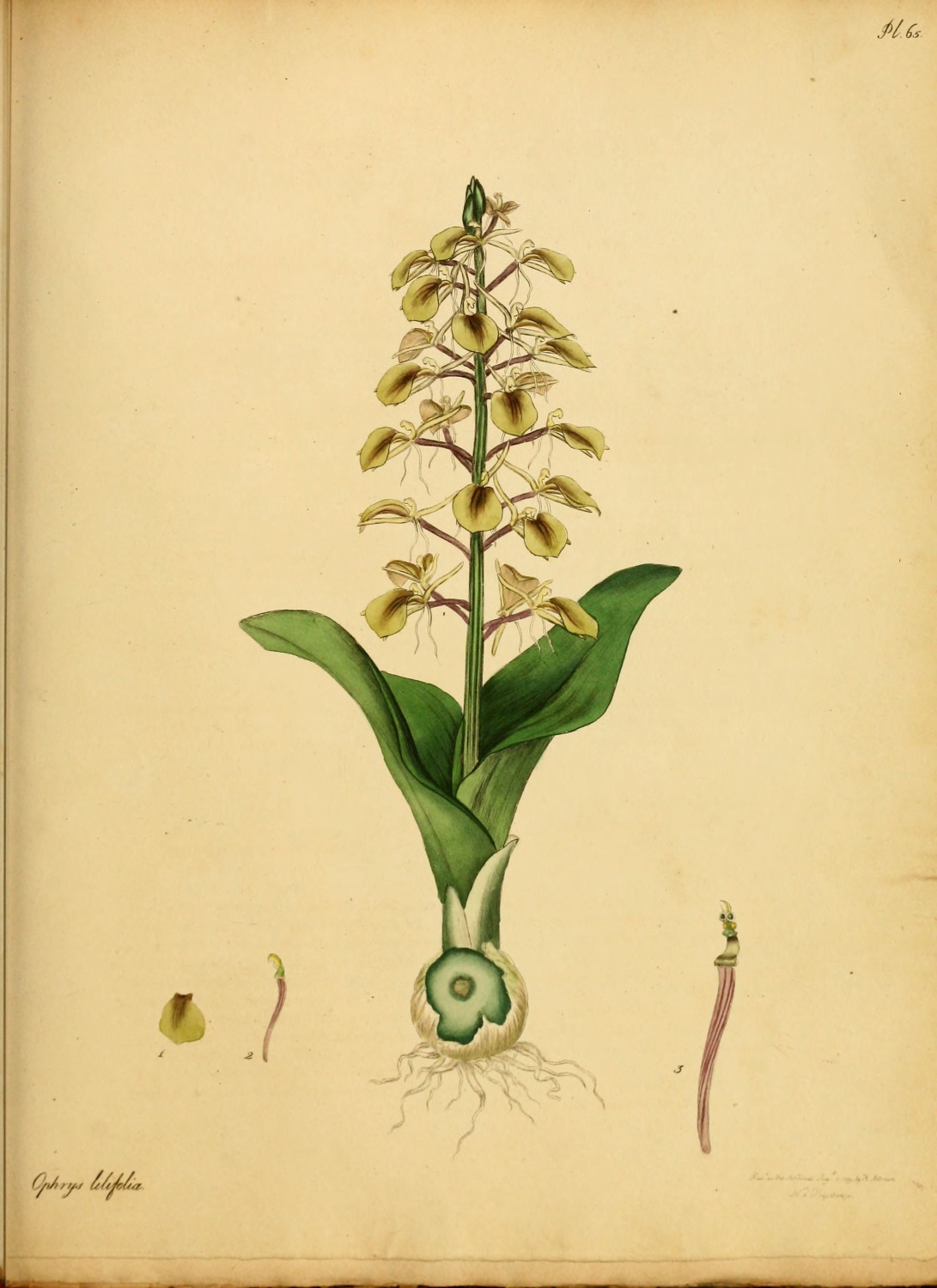
Volume 1 — PLATE LXV. OPHRYS LILIFOLIA. Lily-leaved Ophrys.
Reading edition
CLASS XX. ORDER I.
GYNANDRIA DIANDRIA. Chives on the Pointal. Two Chives.
GENERIC CHARACTER.
Calyx. Spathæ vagæ. Spadix simplex. Perianthium nullum.
Corolla. Petala quinque, oblonga, sursum conniventia, æqualia; duo horum exteriora.
Nectarium petalis longius, dependens; postice tantum carinatum.
Stamina. Filamenta duo, brevissima, pistillo insidentia. Antheræ erectæ, tectæ margine interiore nectarii.
Pistillum. Germen oblongum, contortum, inferum. Stylus margini interiori nectarii adnatus. Stigma obsoletum.
Pericarpium. Capsula subovata, trigona, obtusa, striata, trivalvis, unilocularis, angulis carinatis dehiscens.
Semina numerosa, scobiformia.
Receptaculum lineare, adnatum singulæ valvulæ pericarpii.
Empalement. Sheaths scattered. Fruit-stalks simple. Cup none.
Blossom. Five petals, oblong, approaching upwards, equal; two of them placed outwards.
Honey-cup longer than the petals, hanging down; only keeled on the back part.
Chives. Two threads, very short, fixed to the pointal. Tips upright, covered by the inner edge of the honey-cup.
Pointal. Seed-bud beneath, oblong, twisted beneath. Shaft fixed to the inner edge of the honey-cup. Summit imperfect.
Seed-vessel. Capsule nearly egg-shaped, three-sided, blunt, channelled, three-valved, and one cell, opening at the keel-shaped angles.
Seeds numerous, like saw-dust.
Receptacle linear, growing to each valve of the seed-vessel.
SPECIFIC CHARACTER.
Ophrys bulbo subrotundo; scapo nudo; foliis ovato-oblongis, radicalibus; nectarii labio integro; petalis dorsalibus linearibus.
Ophrys with roundish roots; stem naked; leaves oblong, egg-shaped, growing from the root; the two back petals linear.
REFERENCE TO THE PLATE.
1. The Honey-cup cut off the blossom. 2. The Seed-bud and Pointal (natural size) shewn sideways. 3. The same (magnified) shewn in front, with the cup lifted up, to expose the parts of fructification.
Gronovius, in his arrangement of the plants discovered by Mr. J. Clayton in Virginia, P. i, page 185, has described this plant; and Linnæus after him, in his second edition of the Species Plantarum, page 1341, has it likewise, but thought it only a large variety of a species found in marshy grounds in Sweden; however that may be, it is perfectly new to Britain, as a plant in our gardens. This species of Ophrys seems much more easy to preserve than most of its congeners, as, since its introduction, the bulbs seem to acquire additional size, and the spikes of flowers to grow larger each year. Our drawing was taken from a plant in the extensive collection of the Right Hon. the Marquis of Blandford, Bill-hill, Berkshire, in the year 1797, about the beginning of the month of July; having been sent the preceding year from Philadelphia, by J. Lyons, gardener to William Hamilton, Esq. of that State. It is a hardy plant, and will thrive in a sheltered border, if planted in light earth, and kept moist; is propagated but slowly by the root, which seems the only method; as the seeds are too small of all this natural order to raise them by that means.
PLATE 65